Tissue Sodium in Patients With Early Stage Hypertension: A Randomized Controlled Trial
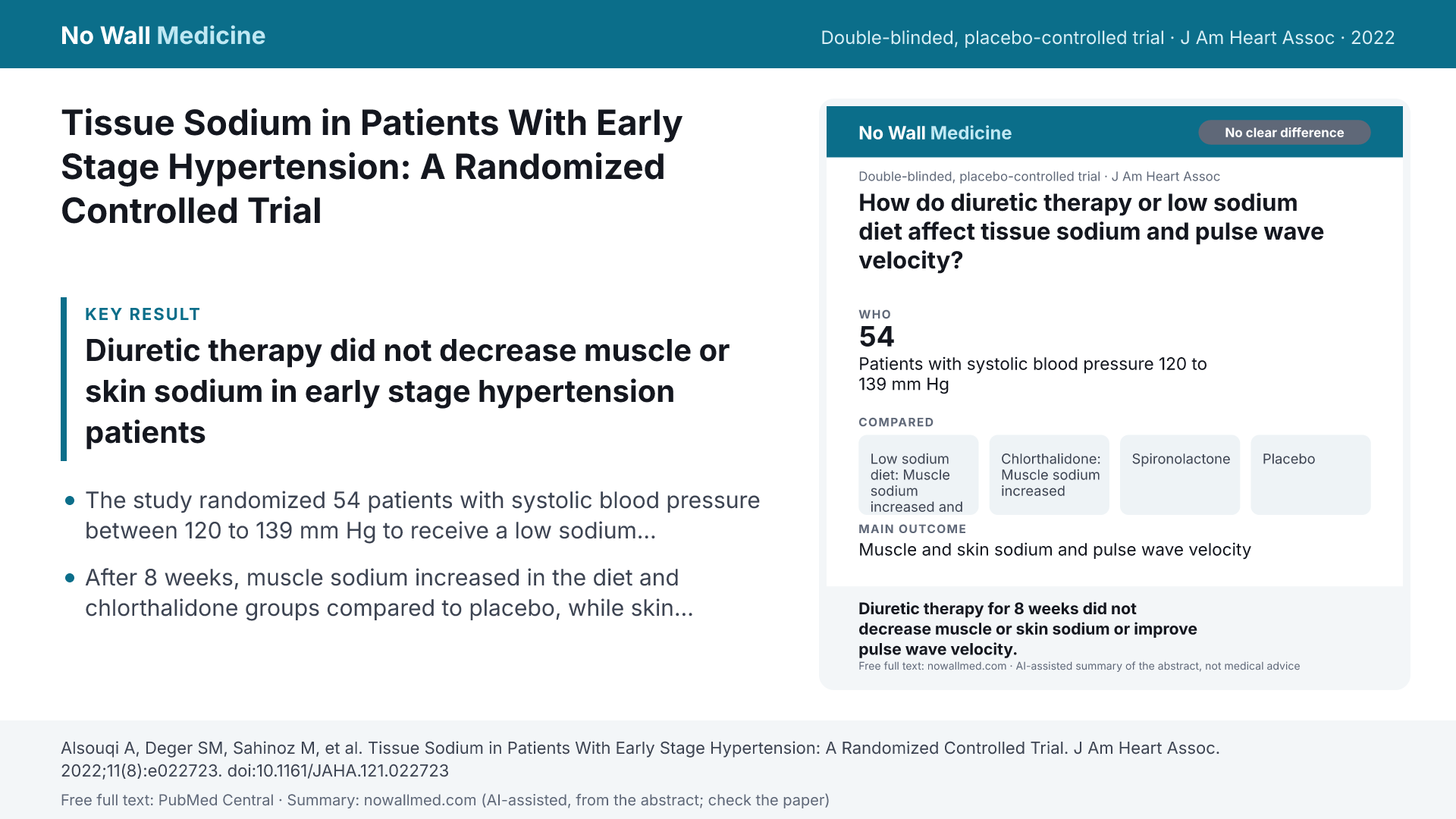
Key result: Diuretic therapy did not decrease muscle or skin sodium in early stage hypertension patients
Double-blinded, placebo-controlled trialNo clear difference
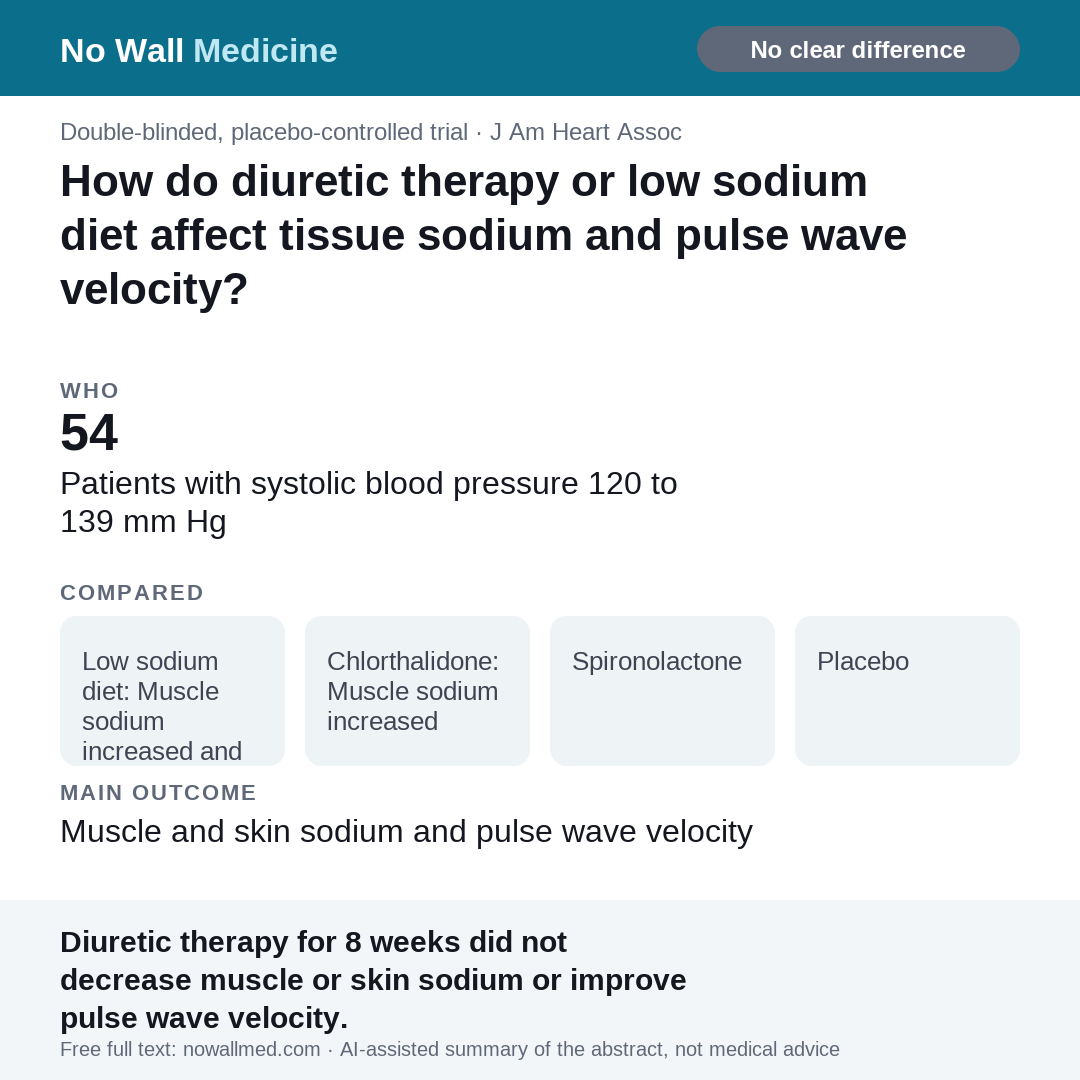
How do diuretic therapy or low sodium diet affect tissue sodium and pulse wave velocity?
Who
54
Patients with systolic blood pressure 120 to 139 mm Hg
Compared
Low sodium diet: Muscle sodium increased and skin sodium decreased
Chlorthalidone: Muscle sodium increased
Spironolactone
Placebo
Main outcome
Muscle and skin sodium and pulse wave velocity
Bottom line: Diuretic therapy for 8 weeks did not decrease muscle or skin sodium or improve pulse wave velocity.
J Am Heart Assoc · 2022-04-18Download image
Key points
- The study randomized 54 patients with systolic blood pressure between 120 to 139 mm Hg to receive a low sodium diet, chlorthalidone, spironolactone, or a placebo for 8 weeks.
- After 8 weeks, muscle sodium increased in the diet and chlorthalidone groups compared to placebo, while skin sodium decreased only in the diet group compared to placebo.
- No changes were observed in pulse wave velocity, a measure of arterial stiffness, among the different groups when compared with placebo.
Why it matters: It was unknown how diuretic therapy or a low sodium diet affects sodium stored in skin and muscle tissue in patients with elevated blood pressure or stage I hypertension.
Discussion prompts
- Would these patients look like yours? Who was left out?
- Is the main outcome one that matters to patients?
- Is the difference large enough to change what you do?
Cite: Alsouqi A, Deger SM, Sahinoz M, et al. Tissue Sodium in Patients With Early Stage Hypertension: A Randomized Controlled Trial. J Am Heart Assoc. 2022. doi:10.1161/JAHA.121.022723
Free full text: PubMed Central · Summary and visual abstract: nowallmed.com/a/tissue-sodium-in-patients-with-early-stage-hypertension-a-randomized-69lrs/ (AI-assisted from the abstract; check the paper before relying on it).