Tonotopic and Default Frequency Fitting for Music Perception in Cochlear Implant Recipients: A Randomized Clinical Trial
Randomized, double-blind trialBenefit found
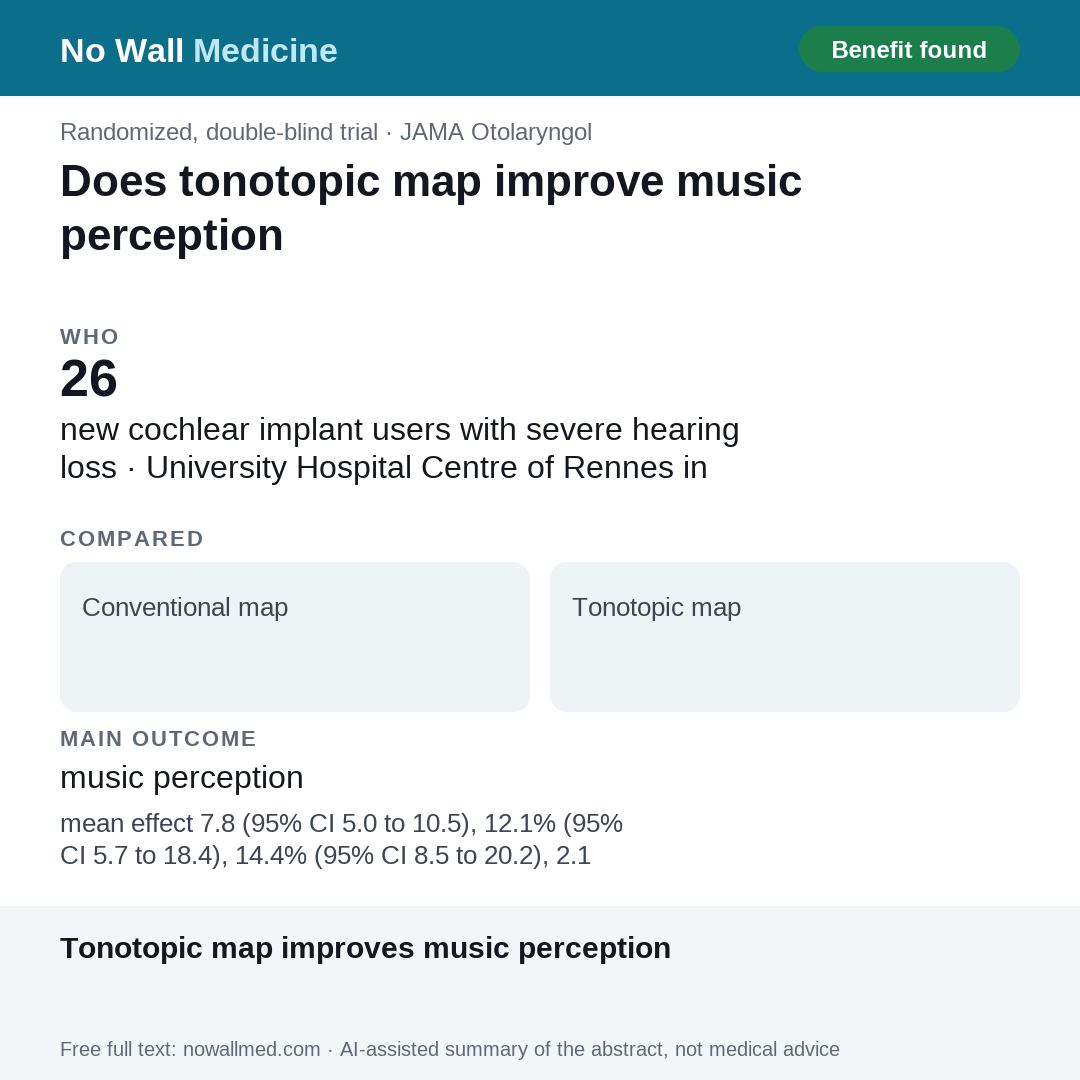
Does tonotopic map improve music perception
Who
26
new cochlear implant users with severe hearing loss · University Hospital Centre of Rennes in France
Compared
Conventional map
Tonotopic map
Main outcome
music perception
Result: mean effect 7.8 (95% CI 5.0 to 10.5), 12.1% (95% CI 5.7 to 18.4), 14.4% (95% CI 8.5 to 20.2), 2.1 (95% CI 1.7 to 2.5)
Bottom line: Tonotopic map improves music perception
JAMA Otolaryngol · 2024-09-12Download image
Abstract
Importance
Cochlear implants are an effective technique for enhancing speech perception abilities in quiet environments for people with severe to profound deafness. Nevertheless, complex sound signals perception, such as music perception, remains challenging for cochlear implant users. Objective
To assess the benefit of a tonotopic map on music perception in new cochlear implant users. Design, setting, and participants
A prospective, randomized, double-blind, 2-period crossover study including 26 new cochlear implant users was performed over a 6-month period (June 2021 to November 2021). An anatomical tonotopic map was created using postoperative flat-panel computed tomography and a reconstruction software based on Greenwood function. New cochlear implant users older than 18 years with bilateral severe to profound sensorineural hearing loss or complete hearing loss for less than 5 years were selected in the University Hospital Centre of Rennes in France. The trial was conducted from June to November 2021 (inclusion) and to February 2022 (end of the assessment procedure at 12 weeks postactivation), and the analysis itself was completed in December 2022. Intervention
Each participant was randomized to receive a conventional map followed by a tonotopic map or vice versa. Main outcomes and measures
Participants performed pitch-scaling tasks (multidimensional qualitative assessment, melodic contour identification, melodic recognition test) after 6 weeks of each setting. Results
Thirteen participants were randomized to each sequence. Two of the 26 participants recruited (1 in each sequence) had to be excluded due to the COVID-19 pandemic. The multidimensional qualitative assessment (Gabrielsson test), melodic contour identification, and melodic recognition scores were significantly higher with the tonotopic setting than the conventional one (mean effect [ME], 7.8; 95% CI, 5.0-10.5; ME, 12.1%; 95% CI, 5.7%-18.4%; ME, 14.4%, 95% CI, 8.5%-20.2%; and ME, 2.1, 95% CI, 1.7-2.5, respectively). Among the different dimensions evaluated by the Gabrielsson test, the mean scores for clarity, spaciousness, fullness, nearness, and total impression were significantly higher with tonotopic fitting. Ninety-two percent of the participants kept the tonotopy-based map after the study period. Conclusions
In this randomized clinical trial of patients with new cochlear implants, a tonotopic-based fitting was associated with better results in perception of complex sound signals such as music listening experience. Trial registration
ClinicalTrials.gov Identifier: NCT04922619.
Subject terms
Cite this article
Creff G, Bernard-Le Liboux N, Coudert P, Bourdon H, Pean V, Wallaert N. Tonotopic and Default Frequency Fitting for Music Perception in Cochlear Implant Recipients: A Randomized Clinical Trial. JAMA Otolaryngol. 2024. doi:10.1001/jamaoto.2024.2895
Spotted a mistake? Suggest a correction
Top studies every Monday
The week’s key trials and guidelines in your specialties, plus any topics you follow. By email, free.
Get the weekly digest