Clinical practice guideline recommends EMLA cream for minor needle procedures in children
Topical analgesia during needle-related procedures in children: a clinical practice guideline
Clinical practice guidelineBenefit found
Which topical analgesia should be used for needle-related procedures in children?
Who
1808
Children undergoing minor needle-related procedures · Netherlands
Compared
EMLA
tetracaine-containing creams
Main outcome
needle-related pain during minor procedures
Bottom line: Use EMLA for at least 60 minutes or tetracaine-containing creams if rapid cannulation is required.
Limitation: very low-quality evidence
Arch Dis Child · 2025-07-18Download image
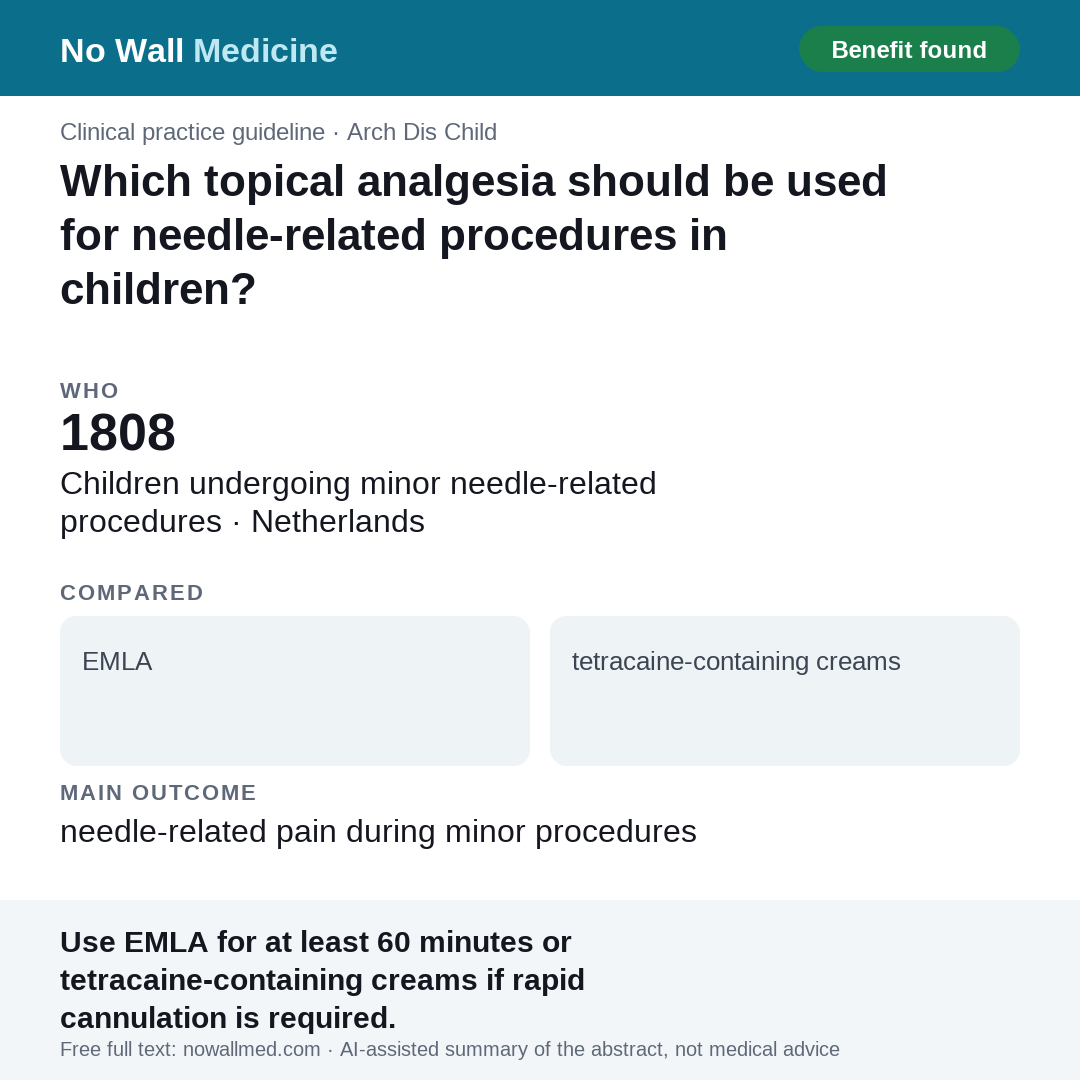
Clinical question: Which topical analgesia should be used for needle-related procedures in children?
Why it matters: Uncertainty exists regarding whether EMLA or tetracaine-containing creams are more appropriate for managing needle-related pain in children.
Key points
- A multidisciplinary panel reviewed ten randomized controlled trials involving 1808 children to develop recommendations for needle-related pain management.
- The guideline recommends using EMLA, a eutectic mixture of topical analgesia, with a minimum application time of 60 min.
- The panel suggests using tetracaine-containing creams only when a procedure like venous cannulation is required within 30-60 min.
Limitation the authors note: The evidence used to form these recommendations was of very low quality.
Headline and key points written with AI from the paper’s abstract, with every number checked against it. Read the paper before relying on them.
Was this summary helpful?
Abstract
During intensive and long-lasting treatments, short-term or emergency care, children often undergo minor needle-related procedures (ie, venepuncture, venous cannulation and puncture of central venous access ports). The use of topical analgesia topical analgesia before these procedures can reduce needle-related pain. There is, however, uncertainty about the type of local anaesthetic (ie, eutectic mixture of topical analgesia (EMLA) or tetracaine-containing creams (eg, Rapydan) that should be used.Therefore, a clinical practice guideline (CPG) was developed to establish a comprehensive, evidence-based overview and provide recommendations for clinical practice.A comprehensive multidisciplinary panel was assembled, comprising 16 professionals and patient representatives in the Netherlands. A systematic literature review was performed, and after dual appraisal of all articles, results were extracted and meta-analyses were performed. The Grading of Recommendations Assessment, Development and Evaluation methodology was used to assess, extract and summarise the evidence. An in-person meeting was held to discuss the evidence, complete an evidence-to-decision framework and formulate recommendations.In total, ten randomised controlled trials comprising 1808 children formed the evidence base for the recommendations. We recommend the use of EMLA in children who need to undergo a minor needle-related procedure, with minimal application duration of 60 min (strong recommendation, very low-quality evidence). We suggest the use of tetracaine-containing creams only when rapid cannulation/puncture (ie, within 30-60 min) is required (weak recommendation, very low-quality evidence).In this CPG, we provide recommendations regarding the choice of local anaesthetic for needle-induced pain during minor procedures in children. With these recommendations, we aim to reduce procedural pain and thereby contribute to improving care for children.
Abstract reproduced under the article’s CC BY NC licence.
Subject terms
Cite this article
Stavleu DC, Mulder RL, Kruimer DM, Mensink MO, Kremer LC, Tissing WJ. Topical analgesia during needle-related procedures in children: a clinical practice guideline. Arch Dis Child. 2025. doi:10.1136/archdischild-2024-326917
Spotted a mistake? Suggest a correction
Top studies every Monday
The week’s key trials and guidelines in your specialties, plus any topics you follow. By email, free.
Get the weekly digest