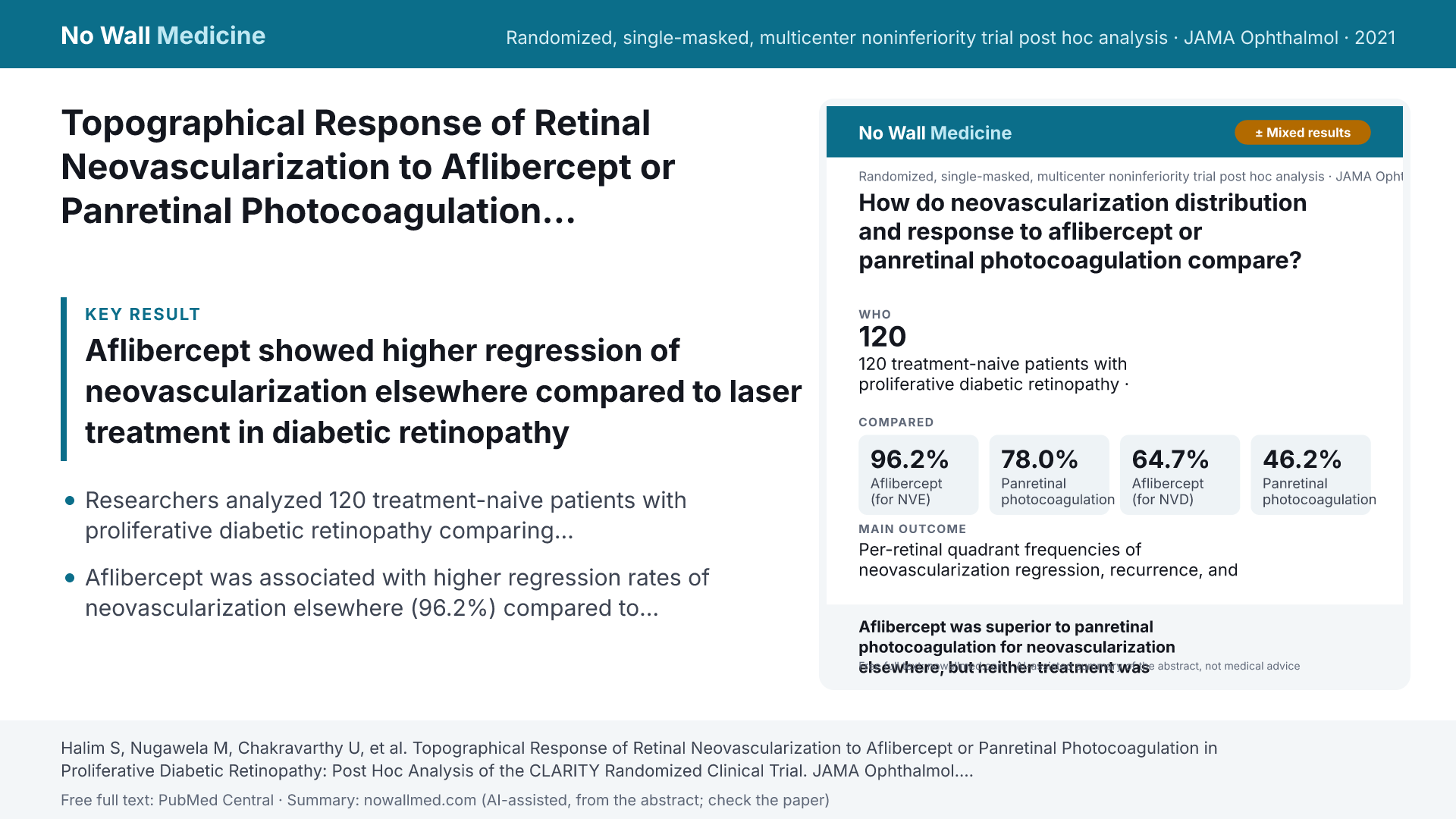
Aflibercept showed higher regression of neovascularization elsewhere compared to laser treatment in diabetic retinopathy
Topographical Response of Retinal Neovascularization to Aflibercept or Panretinal Photocoagulation in Proliferative Diabetic Retinopathy: Post Hoc Analysis of the CLARITY Randomized Clinical Trial
Randomized, single-masked, multicenter noninferiority trial post hoc analysisMixed results
How do neovascularization distribution and response to aflibercept or panretinal photocoagulation compare?
Who
120
120 treatment-naive patients with proliferative diabetic retinopathy · Multicenter
Compared
96.2%Aflibercept (for NVE) (50/52)
78.0%Panretinal photocoagulation (for NVE) (39/50)
64.7%Aflibercept (for NVD) (11/17)
46.2%Panretinal photocoagulation (for NVD) (12/26)
Main outcome
Per-retinal quadrant frequencies of neovascularization regression, recurrence, and new occurrence
Result: difference 18.2% (95% CI 5.5%-30.8%) for NVE; difference 18.6% (95% CI -11.2% to 48.3%) for NVD
Bottom line: Aflibercept was superior to panretinal photocoagulation for neovascularization elsewhere, but neither treatment was particularly effective against neovascularization of the disc.
JAMA Ophthalmol · 2021-03-12 · Save PNG
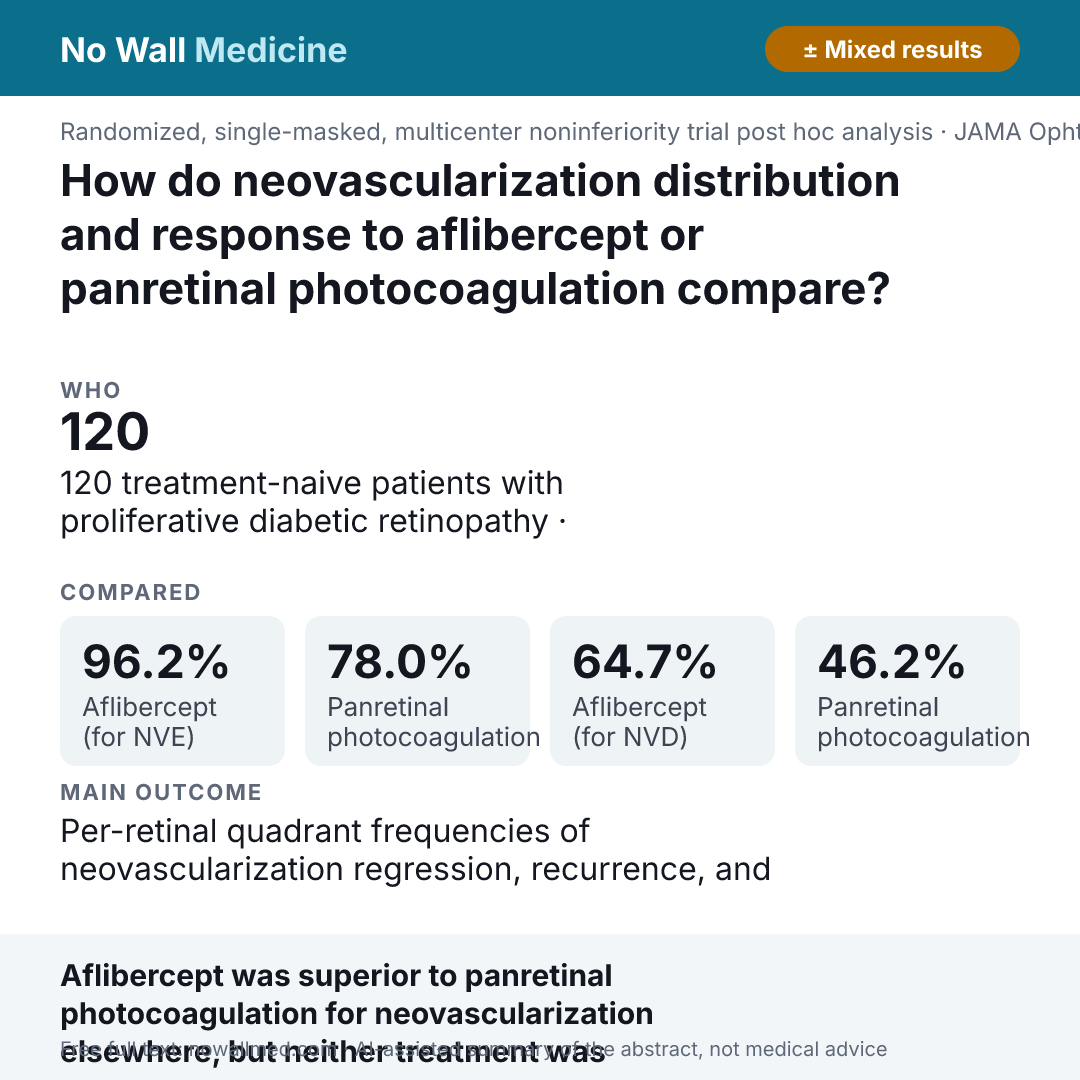
Clinical question: How do neovascularization distribution and response to aflibercept or panretinal photocoagulation compare?
Why it matters: The response to treatment for proliferative diabetic retinopathy may vary depending on whether new blood vessel growth occurs at the optic disc or elsewhere in the retina.
Key points
- Researchers analyzed 120 treatment-naive patients with proliferative diabetic retinopathy comparing aflibercept injections to panretinal photocoagulation, which is laser treatment.
- Aflibercept was associated with higher regression rates of neovascularization elsewhere (96.2%) compared to laser treatment (78.0%), but no difference was found for neovascularization of the disc.
- Neovascularization of the disc was associated with higher resistance to both treatments, with 51.3% of those cases persisting by 52 weeks.
Headline and key points written with AI from the paper’s abstract, with every number checked against it. Read the paper before relying on them.
Was this summary helpful?
Subject terms
Headline, design, result, key points, caveat and citation as plain text.
Cite this article
Halim S, Nugawela M, Chakravarthy U, et al. Topographical Response of Retinal Neovascularization to Aflibercept or Panretinal Photocoagulation in Proliferative Diabetic Retinopathy: Post Hoc Analysis of the CLARITY Randomized Clinical Trial. JAMA Ophthalmol. 2021;139(5):501-507. doi:10.1001/jamaophthalmol.2021.0108
Spotted a mistake? Suggest a correction