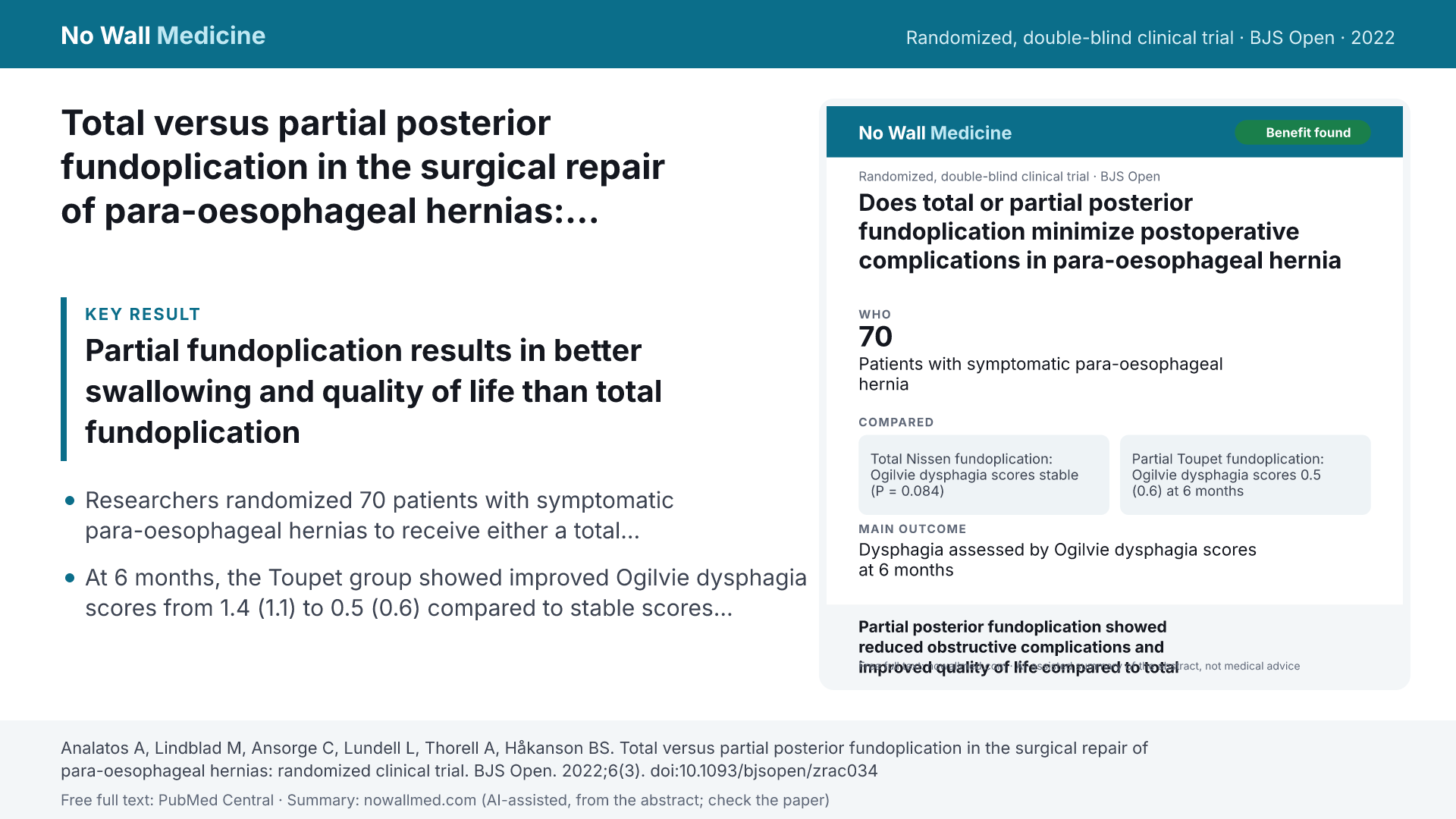
Partial fundoplication results in better swallowing and quality of life than total fundoplication
Total versus partial posterior fundoplication in the surgical repair of para-oesophageal hernias: randomized clinical trial
Randomized, double-blind clinical trialBenefit found
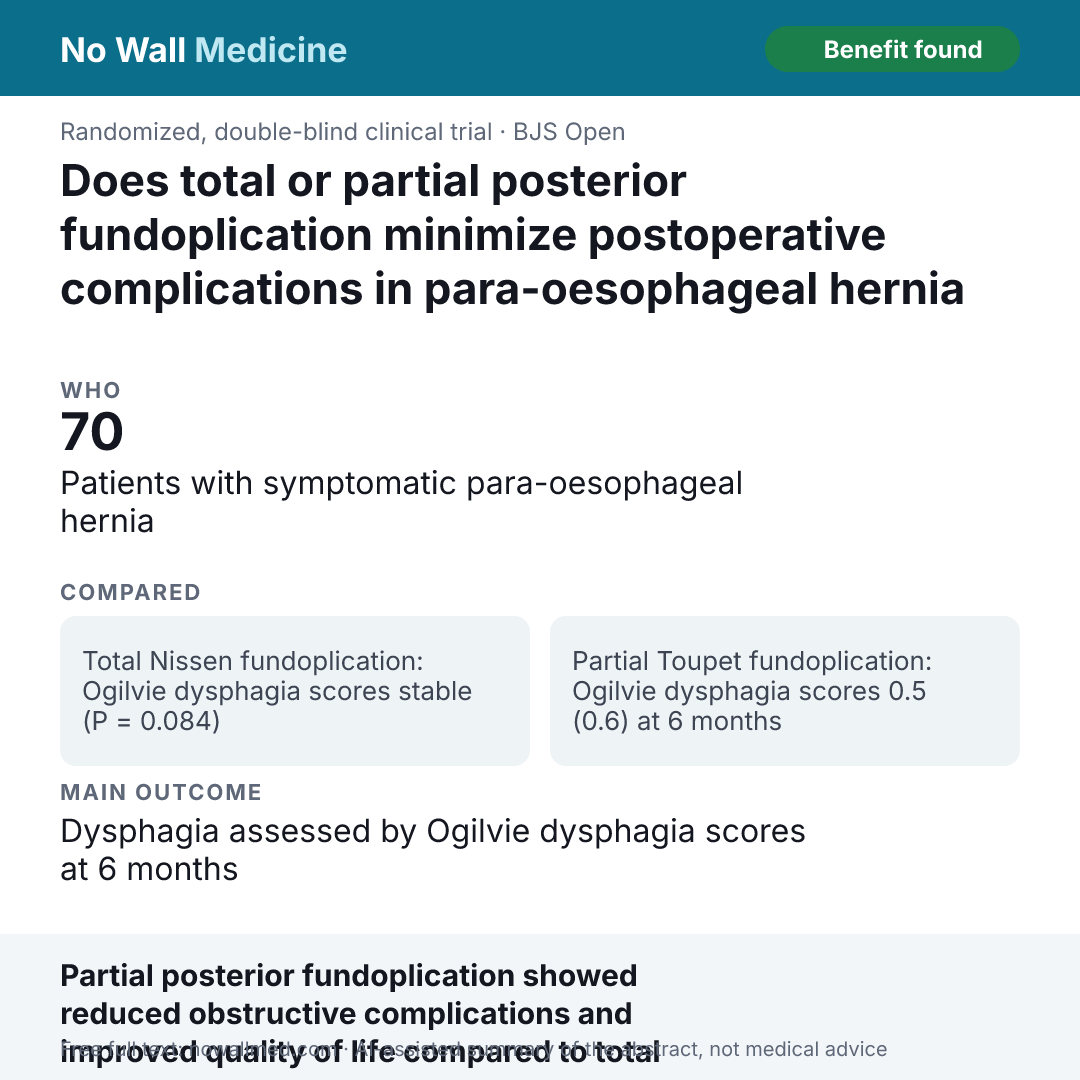
Does total or partial posterior fundoplication minimize postoperative complications in para-oesophageal hernia repair?
Who
70
Patients with symptomatic para-oesophageal hernia
Compared
Total Nissen fundoplication: Ogilvie dysphagia scores stable (P = 0.084)
Partial Toupet fundoplication: Ogilvie dysphagia scores 0.5 (0.6) at 6 months
Main outcome
Dysphagia assessed by Ogilvie dysphagia scores at 6 months
Bottom line: Partial posterior fundoplication showed reduced obstructive complications and improved quality of life compared to total fundoplication.
BJS Open · 2022-05-05 · Save PNG
Clinical question: Does total or partial posterior fundoplication minimize postoperative complications in para-oesophageal hernia repair?
Why it matters: It is controversial which type of fundoplication, the surgical procedure used to repair the valve between the esophagus and stomach, minimizes postoperative mechanical complications.
Key points
- Researchers randomized 70 patients with symptomatic para-oesophageal hernias to receive either a total Nissen fundoplication or a partial Toupet fundoplication.
- At 6 months, the Toupet group showed improved Ogilvie dysphagia scores from 1.4 (1.1) to 0.5 (0.6) compared to stable scores in the Nissen group.
- The Toupet group had significantly higher Dakkak dysphagia scores and greater improvements in mental quality of life scores than the Nissen group at 6 months.
Headline and key points written with AI from the paper’s abstract, with every number checked against it. Read the paper before relying on them.
Was this summary helpful?
Subject terms
Headline, design, result, key points, caveat and citation as plain text.
Cite this article
Analatos A, Lindblad M, Ansorge C, Lundell L, Thorell A, Håkanson BS. Total versus partial posterior fundoplication in the surgical repair of para-oesophageal hernias: randomized clinical trial. BJS Open. 2022;6(3). doi:10.1093/bjsopen/zrac034
Spotted a mistake? Suggest a correction