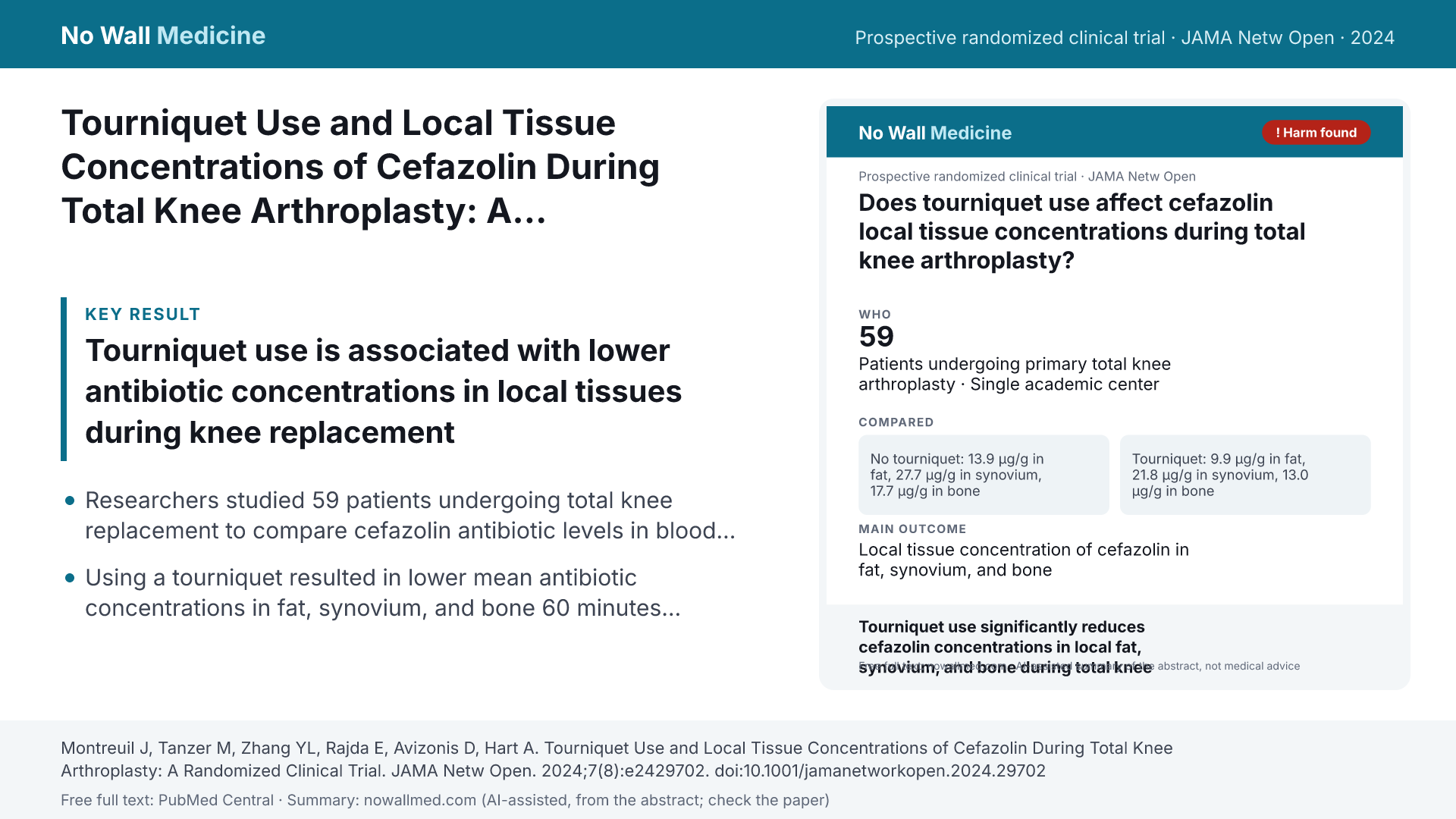
Tourniquet use is associated with lower antibiotic concentrations in local tissues during knee replacement
Tourniquet Use and Local Tissue Concentrations of Cefazolin During Total Knee Arthroplasty: A Randomized Clinical Trial
Prospective randomized clinical trialHarm found
Does tourniquet use affect cefazolin local tissue concentrations during total knee arthroplasty?
Who
59
Patients undergoing primary total knee arthroplasty · Single academic center
Compared
No tourniquet: 13.9 μg/g in fat, 27.7 μg/g in synovium, 17.7 μg/g in bone
Tourniquet: 9.9 μg/g in fat, 21.8 μg/g in synovium, 13.0 μg/g in bone
Main outcome
Local tissue concentration of cefazolin in fat, synovium, and bone
Result: 10.8 μg/g [95% CI, 9.1-12.4 μg/g] vs 16.9 μg/g [95% CI, 14.1-19.6 μg/g] in fat
Bottom line: Tourniquet use significantly reduces cefazolin concentrations in local fat, synovium, and bone during total knee arthroplasty.
JAMA Netw Open · 2024-08-01 · Save PNG
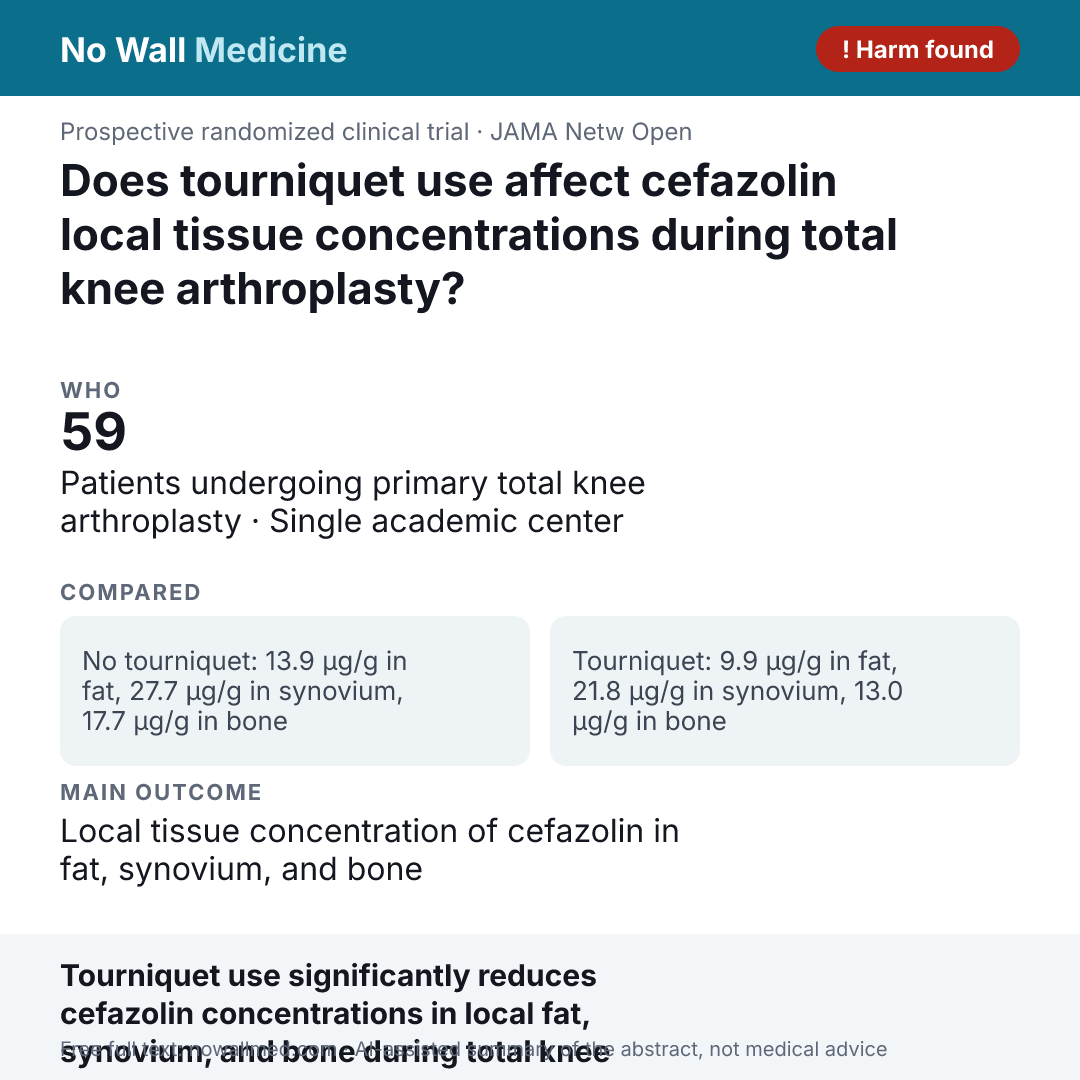
Clinical question: Does tourniquet use affect cefazolin local tissue concentrations during total knee arthroplasty?
Why it matters: The local tissue concentration of cefazolin during knee replacement is poorly understood, and it is unknown how a limb tourniquet affects these levels.
Key points
- Researchers studied 59 patients undergoing total knee replacement to compare cefazolin antibiotic levels in blood and local tissues with and without a limb tourniquet.
- Using a tourniquet resulted in lower mean antibiotic concentrations in fat, synovium, and bone 60 minutes after infusion compared to no tourniquet.
- In the no tourniquet group, mean antibiotic concentrations were 13.9 μg/g in fat, 27.7 μg/g in synovium, and 17.7 μg/g in bone.
Headline and key points written with AI from the paper’s abstract, with every number checked against it. Read the paper before relying on them.
Was this summary helpful?
Subject terms
Headline, design, result, key points, caveat and citation as plain text.
Cite this article
Montreuil J, Tanzer M, Zhang YL, Rajda E, Avizonis D, Hart A. Tourniquet Use and Local Tissue Concentrations of Cefazolin During Total Knee Arthroplasty: A Randomized Clinical Trial. JAMA Netw Open. 2024;7(8):e2429702. doi:10.1001/jamanetworkopen.2024.29702
Spotted a mistake? Suggest a correction