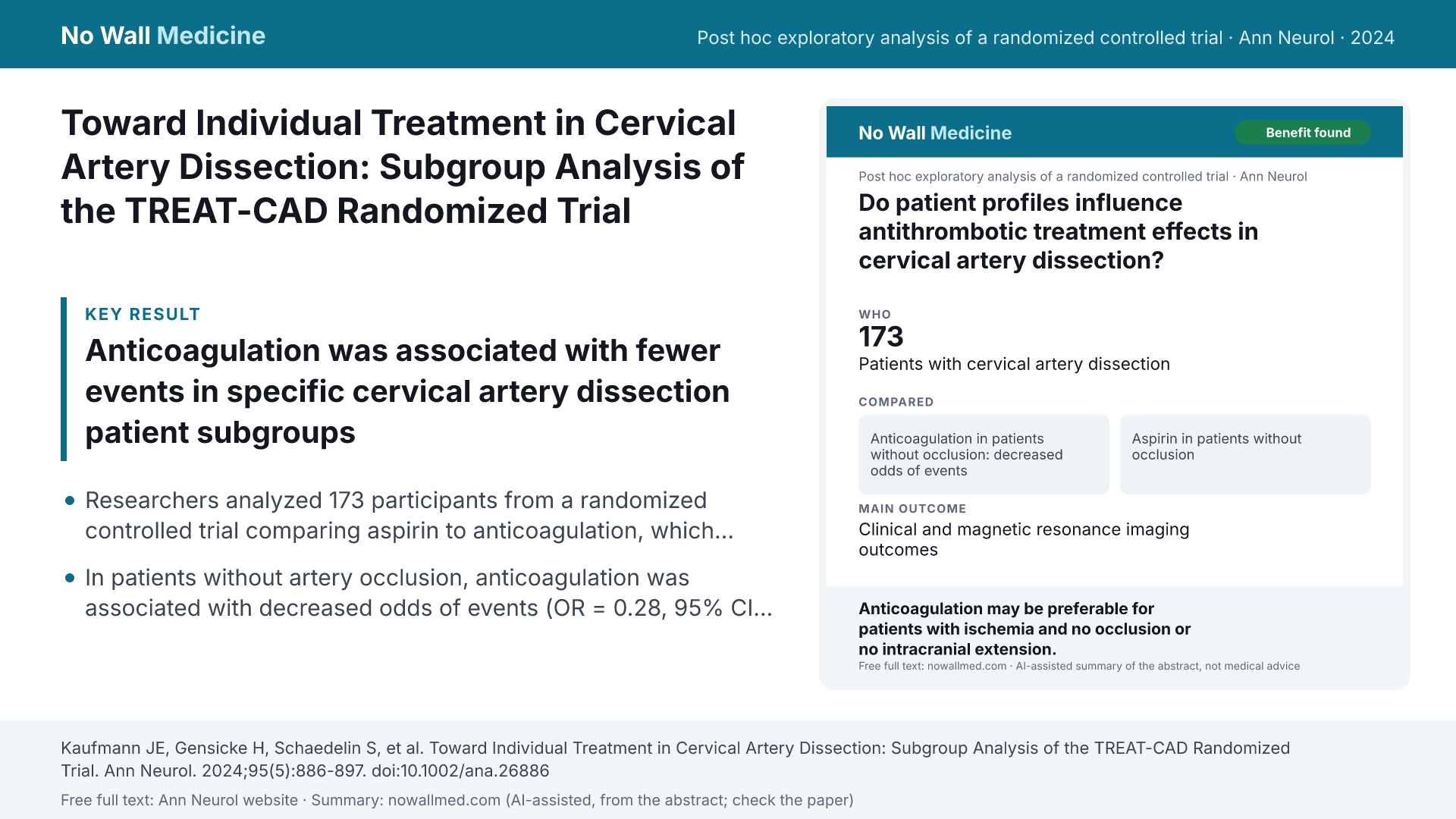
Toward Individual Treatment in Cervical Artery Dissection: Subgroup Analysis of the TREAT-CAD Randomized Trial
Key result: Anticoagulation was associated with fewer events in specific cervical artery dissection patient subgroups
Post hoc exploratory analysis of a randomized controlled trialBenefit found
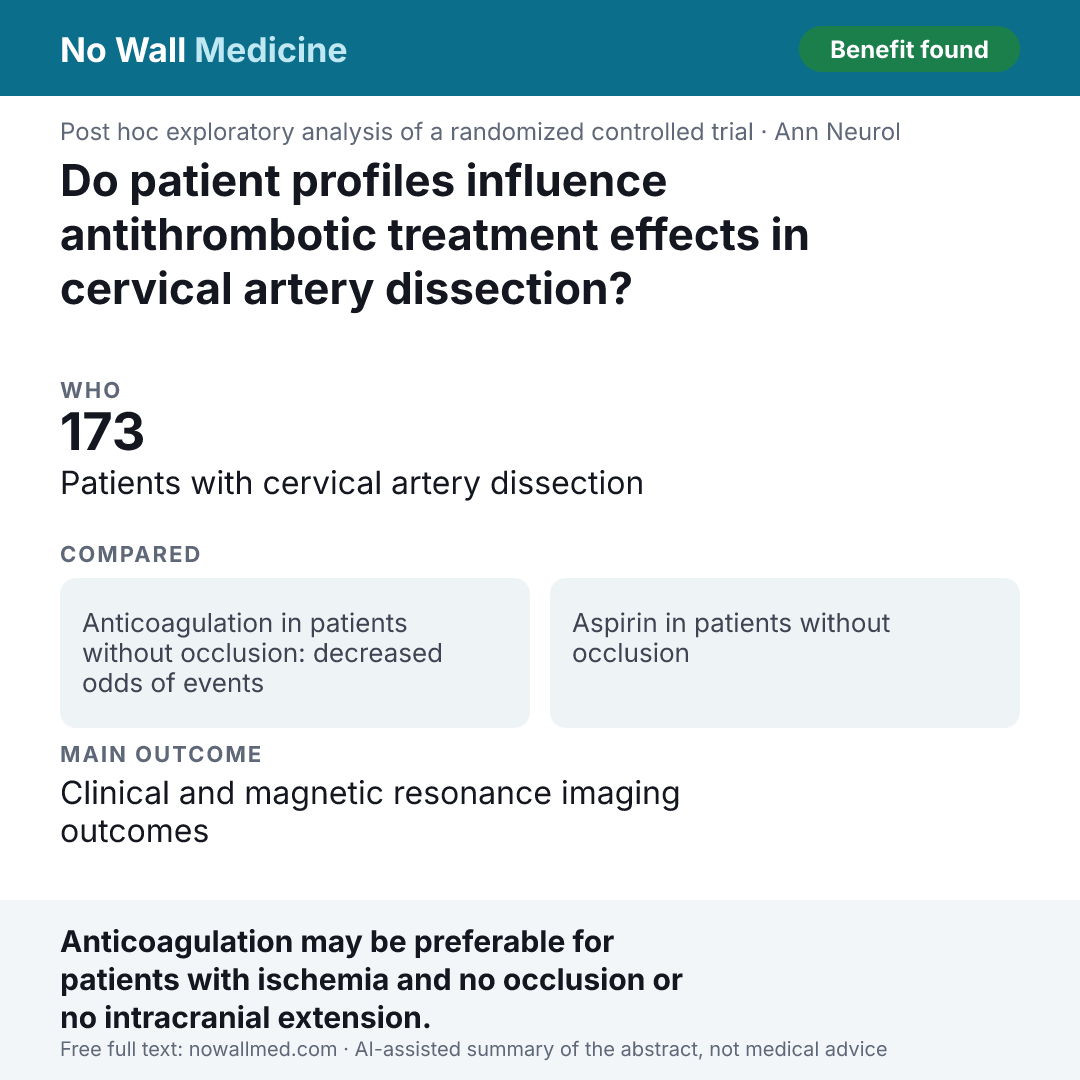
Do patient profiles influence antithrombotic treatment effects in cervical artery dissection?
Who
173
Patients with cervical artery dissection
Compared
Anticoagulation in patients without occlusion: decreased odds of events
Aspirin in patients without occlusion
Main outcome
Clinical and magnetic resonance imaging outcomes
Result: odds ratio 0.28 (95% CI 0.07-0.86)
Bottom line: Anticoagulation may be preferable for patients with ischemia and no occlusion or no intracranial extension.
Ann Neurol · 2024-02-16 · Save PNG
Key points
- Researchers analyzed 173 participants from a randomized controlled trial comparing aspirin to anticoagulation, which is blood-thinning medication, for cervical artery dissection.
- In patients without artery occlusion, anticoagulation was associated with decreased odds of events (OR = 0.28, 95% CI = 0.07-0.86).
- Among those with cerebral ischemia, early treatment (OR = 0.26, 95% CI = 0.07-0.85) or no intracranial extension (OR = 0.34, 95% CI = 0.11-0.97) was associated with decreased odds of events with anticoagulation.
Discussion prompts
- Would these patients look like yours? Who was left out?
- Is the main outcome one that matters to patients?
- Is the difference large enough to change what you do?
Cite: Kaufmann JE, Gensicke H, Schaedelin S, et al. Toward Individual Treatment in Cervical Artery Dissection: Subgroup Analysis of the TREAT-CAD Randomized Trial. Ann Neurol. 2024;95(5):886-897. doi:10.1002/ana.26886
Free full text: Ann Neurol website · Summary and visual abstract: nowallmed.com/a/toward-individual-treatment-in-cervical-artery-dissection-subgroup-qt5m5o/ (AI-assisted from the abstract; check the paper before relying on it).