Review of sixty-one mobile health interventions shows inconsistent reporting and design for young people
Toward Participatory Precision Health With Co-Designed Recommendations: Systematic Review of Just-in-Time Adaptive Interventions in Adolescents and Young Adults
Digital Health & AIAdult and pediatric
Systematic reviewUnclear result
How are just-in-time adaptive interventions designed and implemented for adolescents and young adults?
Who
61
Adolescents and young adults aged 10 to 25 years
Compared
24Substance use interventions (39.3%)
23Mental health interventions (37.7%)
14Physical health or chronic conditions (23%)
Main outcome
Adaptive mechanisms, design, implementation, and methodological reporting quality
Bottom line: Just-in-time adaptive interventions for youth rely on self-reported data but face pervasive methodological reporting concerns.
Limitation: Substantial heterogeneity in populations, interventions, mechanisms, comparators, and outcomes prevented meta-analysis.
J Med Internet Res · 2026-05-21Download image
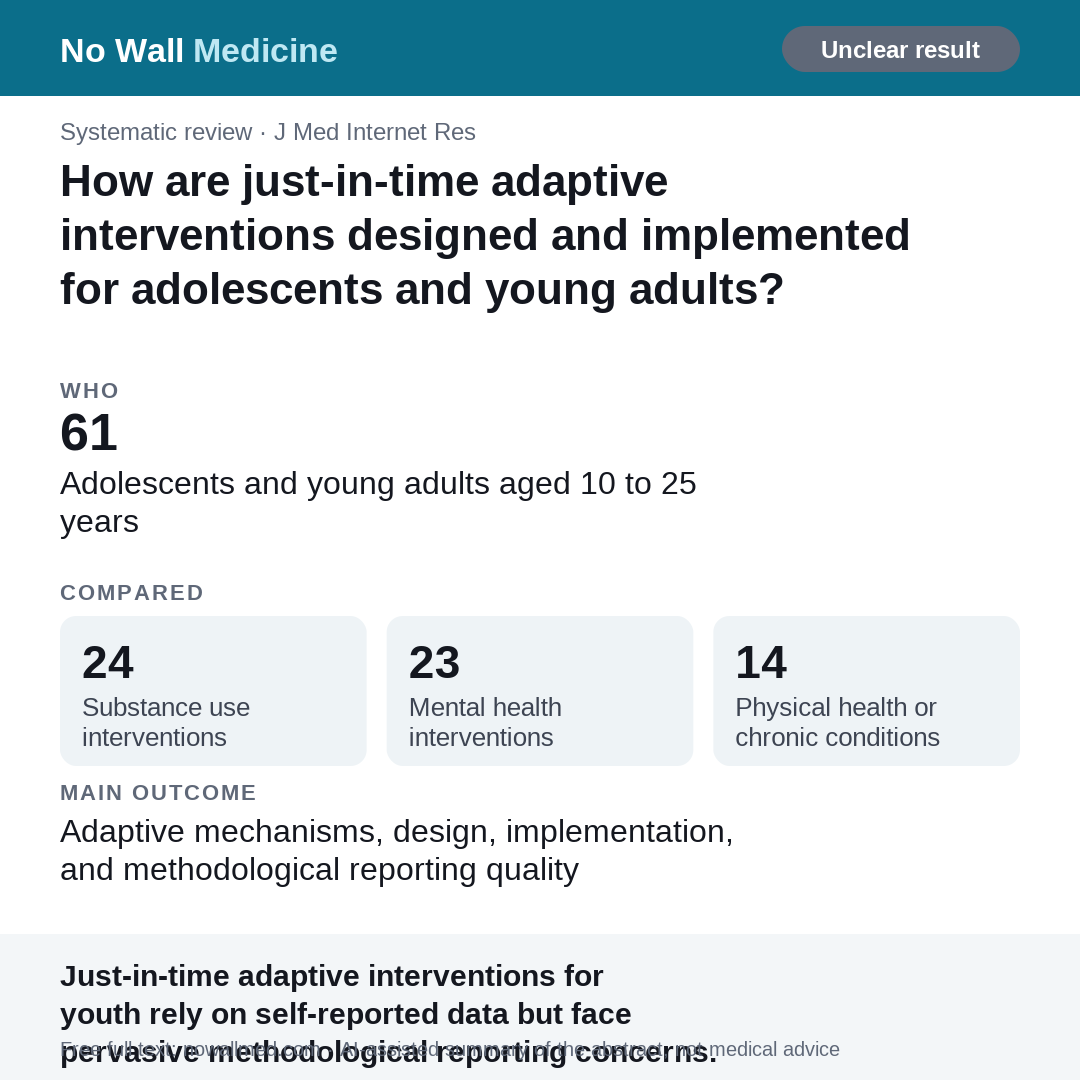
Clinical question: How are just-in-time adaptive interventions designed and implemented for adolescents and young adults?
Why it matters: Mobile health tools often adapt poorly to the changing contexts of adolescents and young adults, leading to inconsistent engagement and effects.
Key points
- Researchers reviewed 61 unique just-in-time adaptive interventions, which are mobile tools that provide real-time support, for people aged 10 to 25 years.
- The interventions focused on substance use in 24 studies (39.3%), mental health in 23 studies (37.7%), and physical health or chronic conditions in 14 studies (23%).
- Methodological concerns regarding how interventions were administered, how participants were selected, and the reliability of outcome measurements were common across all studies.
Limitation the authors note: The authors noted substantial heterogeneity in study populations, intervention content, adaptive mechanisms, comparators, and outcome measurements.
Headline and key points written with AI from the paper’s abstract, with every number checked against it. Read the paper before relying on them.
Topics
Spotted a mistake? Suggest a correction