Botulinum toxin type A was associated with digital ulcer healing in Raynaud disease patients
Toxin for Treating Raynaud Conditions in Hands (The TORCH Study): A Systematic Review and Meta-analysis
Systematic review and meta-analysisBenefit found
Is botulinum toxin type A effective for treating primary and secondary Raynaud disease?
Who
Patients with primary or secondary Raynaud disease
Compared
Botulinum toxin type A intervention: 81.95% pain visual analog scale score improvement
Botulinum toxin type A intervention: 79.37% digital ulcer healing
Main outcome
Pain visual analog scale score improvement and digital ulcer healing
Result: pain improvement 81.95% (95% CI 74.12-87.81); digital ulcer healing 79.37% (95% CI 62.45-89.9)
Bottom line: Botulinum toxin type A may effectively manage primary and secondary Raynaud disease by improving pain and healing digital ulcers.
Plast Reconstr Surg Glob Open · 2024-06-14Download image
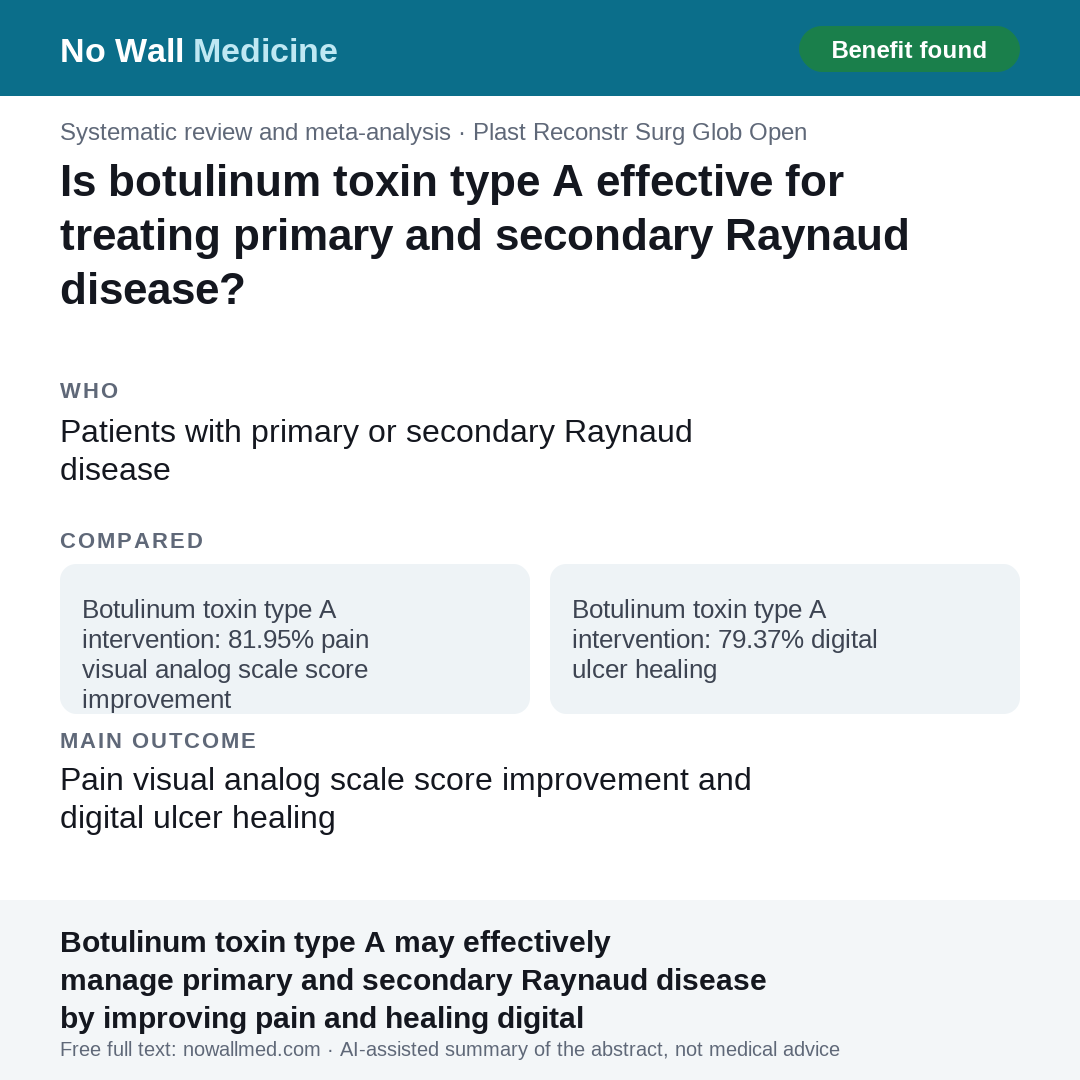
Clinical question: Is botulinum toxin type A effective for treating primary and secondary Raynaud disease?
Why it matters: The effectiveness of botulinum toxin type A for managing primary and secondary Raynaud disease in the hands was not clearly established.
Key points
- Researchers analyzed 18 studies, including four randomized controlled trials, to evaluate botulinum toxin type A for treating primary and secondary Raynaud disease.
- The probability of digital ulcer healing was 79.37% [95% confidence interval (62.45-89.9) P = 0.02].
- The probability of improvement in pain visual analog scale scores was 81.95% [95% confidence interval (74.12-87.81) P = 0.19].
Limitation the authors note: A definitive, appropriately-powered randomized controlled trial with objective functional and patient-reported outcome measures is required to accurately assess efficacy.
Headline and key points written with AI from the paper’s abstract, with every number checked against it. Read the paper before relying on them.
Was this summary helpful?
Cite this article
Geary E, Wormald JCR, Cronin KJ, Giele HP, Durcan L, Kennedy O. Toxin for Treating Raynaud Conditions in Hands (The TORCH Study): A Systematic Review and Meta-analysis. Plast Reconstr Surg Glob Open. 2024. doi:10.1097/GOX.0000000000005885
Spotted a mistake? Suggest a correction
Top studies every Monday
The week’s key trials and guidelines in your specialties, plus any topics you follow. By email, free.
Get the weekly digest