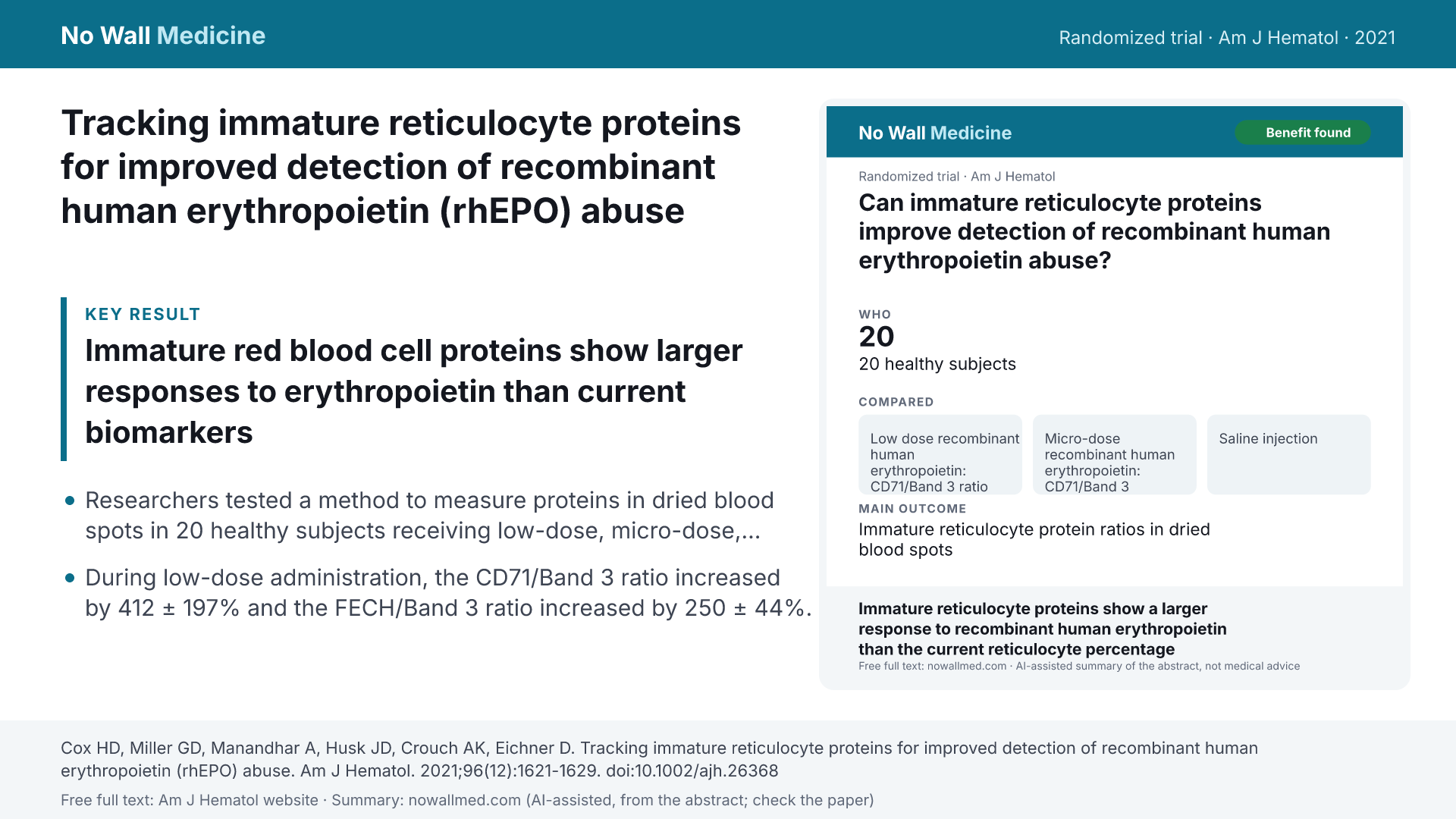
Immature red blood cell proteins show larger responses to erythropoietin than current biomarkers
Tracking immature reticulocyte proteins for improved detection of recombinant human erythropoietin (rhEPO) abuse
Randomized trialBenefit found
Can immature reticulocyte proteins improve detection of recombinant human erythropoietin abuse?
Who
20
20 healthy subjects
Compared
Low dose recombinant human erythropoietin: CD71/Band 3 ratio increased by 412±197%
Micro-dose recombinant human erythropoietin: CD71/Band 3 increased to 127±25% on day 35
Saline injection
Main outcome
Immature reticulocyte protein ratios in dried blood spots
Bottom line: Immature reticulocyte proteins show a larger response to recombinant human erythropoietin than the current reticulocyte percentage biomarker.
Am J Hematol · 2021-10-16 · Save PNG

Clinical question: Can immature reticulocyte proteins improve detection of recombinant human erythropoietin abuse?
Why it matters: Athletes use micro-dosing of erythropoietin to evade detection, requiring more sensitive biomarkers and testing methods that work with dried blood spots.
Key points
- Researchers tested a method to measure proteins in dried blood spots in 20 healthy subjects receiving low-dose, micro-dose, or saline injections.
- During low-dose administration, the CD71/Band 3 ratio increased by 412 ± 197% and the FECH/Band 3 ratio increased by 250 ± 44%.
- In micro-dosing, the CD71/Band 3 ratio increased to 127 ± 25% on day 35, while the current RET% biomarker showed no increase.
Headline and key points written with AI from the paper’s abstract, with every number checked against it. Read the paper before relying on them.
Was this summary helpful?
Subject terms
Headline, design, result, key points, caveat and citation as plain text.
Cite this article
Cox HD, Miller GD, Manandhar A, Husk JD, Crouch AK, Eichner D. Tracking immature reticulocyte proteins for improved detection of recombinant human erythropoietin (rhEPO) abuse. Am J Hematol. 2021. doi:10.1002/ajh.26368
Spotted a mistake? Suggest a correction