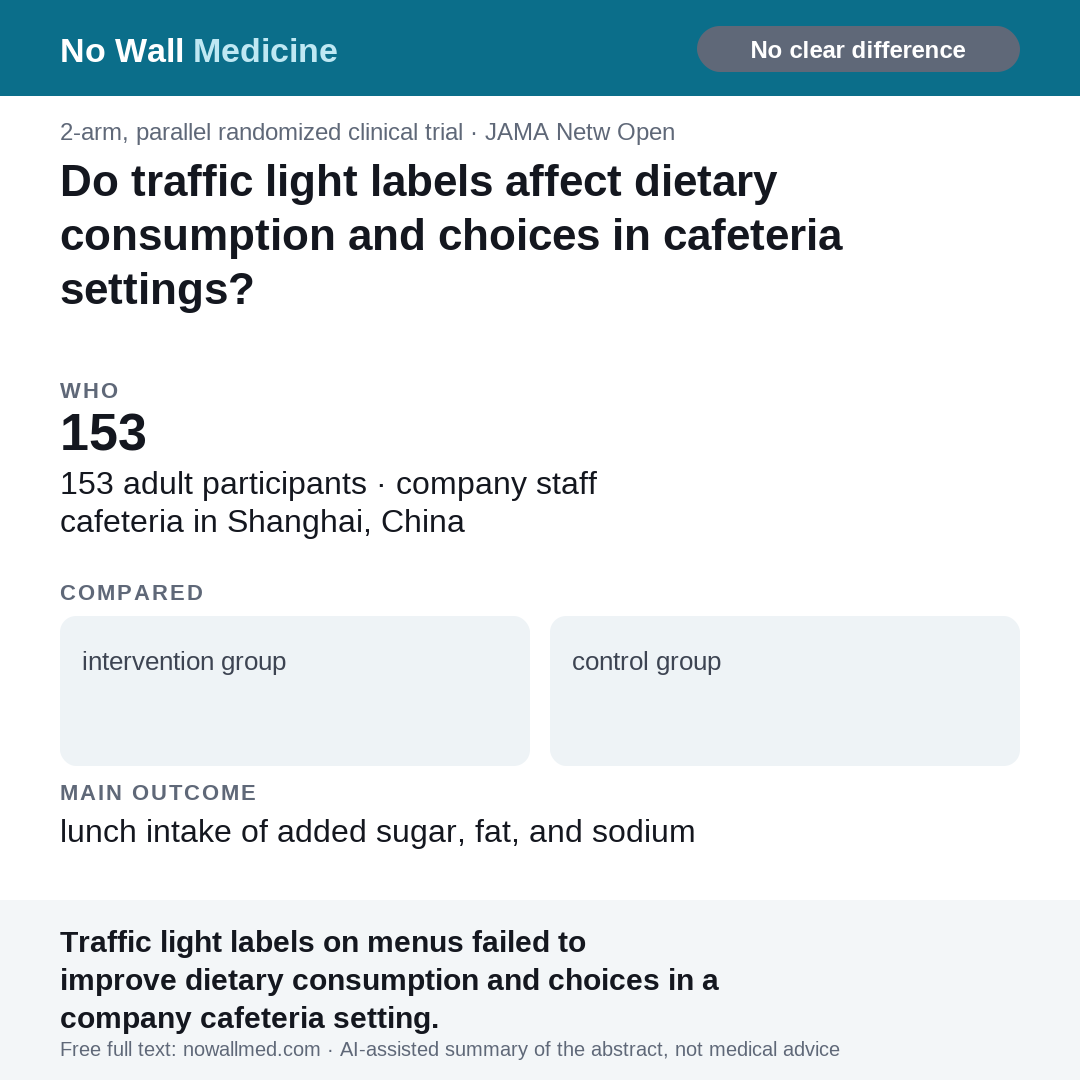
Traffic light labels on cafeteria menus did not change dietary intake or food choices
Traffic Light Labels and Dietary Behavior Change: A Randomized Clinical Trial
2-arm, parallel randomized clinical trialNo clear difference
Do traffic light labels affect dietary consumption and choices in cafeteria settings?
Who
153
153 adult participants · company staff cafeteria in Shanghai, China
Compared
intervention group
control group
Main outcome
lunch intake of added sugar, fat, and sodium
Result: mean difference added sugar -0.15 (95% CI, -0.75 to 0.46) g, fat -1.54 (95% CI, -6.13 to 3.05) g, sodium -116.12 (95% CI, -454.78 to 222.54) mg
Bottom line: Traffic light labels on menus failed to improve dietary consumption and choices in a company cafeteria setting.
JAMA Netw Open · 2025-05-01Download image
Clinical question: Do traffic light labels affect dietary consumption and choices in cafeteria settings?
Why it matters: Evidence regarding how traffic light labels affect dietary improvement in everyday dining situations remains inconsistent.
Key points
- Researchers conducted a randomized trial with 153 adults in a company cafeteria in Shanghai to compare food labels against a control group.
- At week 12, the group with traffic light labels showed no statistically significant changes in the intake of added sugar, fat, or sodium.
- The use of labels was also not associated with significant differences in the mean traffic light score or the number of green, yellow, or red-coded dishes chosen.
Headline and key points written with AI from the paper’s abstract, with every number checked against it. Read the paper before relying on them.
Topics
Cite this article
Liu H, Hu Z, Song Q, Xu J, Mai S, Zhu Z. Traffic Light Labels and Dietary Behavior Change: A Randomized Clinical Trial. JAMA Netw Open. 2025. doi:10.1001/jamanetworkopen.2025.10894
Spotted a mistake? Suggest a correction
Top studies every Monday
The week’s key trials and guidelines in your specialties, by email. Free.
Get the weekly digest