Semiendoscopic video-assisted technique was associated with fewer complications than the blind transaxillary approach
Transaxillary Breast Augmentation: A Randomized Controlled Trial Comparing a New Semiendoscopic Video-Assisted Technique versus the Blind Technique
Randomized controlled trialBenefit found
Is semiendoscopic video-assisted transaxillary approach better than the blind technique for breast augmentation?
Who
118
Patients undergoing transaxillary breast augmentation
Compared
Transaxillary blind approach
Semiendoscopic video-assisted transaxillary approach: lower incidence of complications
Main outcome
Incidence of complications and operative time
Bottom line: Semiendoscopic video-assisted approach improved surgical outcomes with lower complication rates despite longer operative times.
Plast Reconstr Surg · 2025-10-20Download image
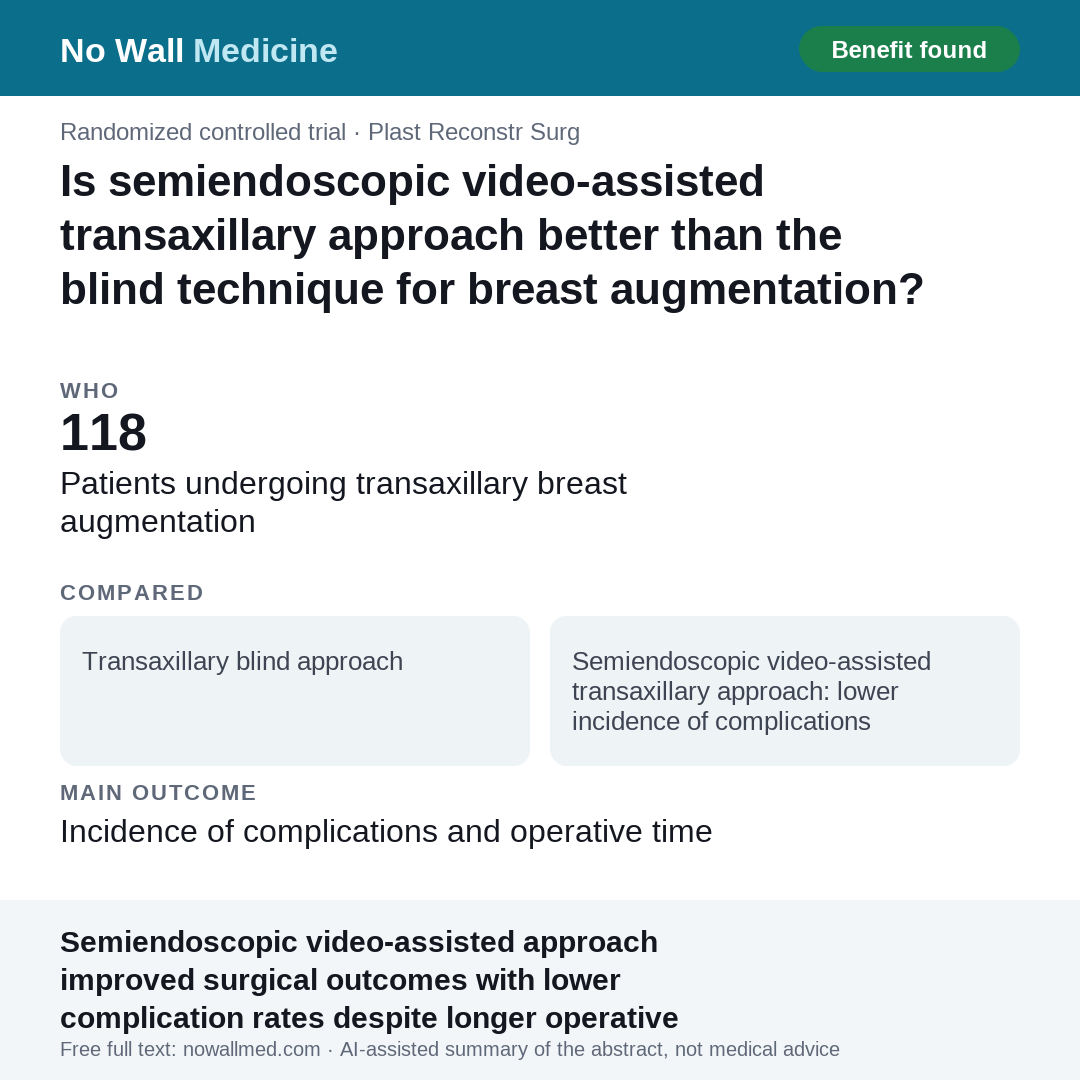
Clinical question: Is semiendoscopic video-assisted transaxillary approach better than the blind technique for breast augmentation?
Why it matters: Surgeons seek to optimize aesthetic outcomes and minimize complications in transaxillary breast augmentation by comparing different surgical techniques.
Key points
- Researchers randomized 118 patients to receive either a transaxillary blind approach or a new semiendoscopic video-assisted transaxillary approach for breast augmentation.
- The semiendoscopic video-assisted approach was associated with a lower incidence of complications, such as asymmetry, breast animation deformity, and capsular contracture.
- The semiendoscopic video-assisted approach required longer operative times compared to the blind approach.
Headline and key points written with AI from the paper’s abstract, with every number checked against it. Read the paper before relying on them.
Topics
Cite this article
Boliglowa D, Pontillo M, Velotti N, Rocco N. Transaxillary Breast Augmentation: A Randomized Controlled Trial Comparing a New Semiendoscopic Video-Assisted Technique versus the Blind Technique. Plast Reconstr Surg. 2025. doi:10.1097/PRS.0000000000012546
Spotted a mistake? Suggest a correction