Transcatheter Aortic Valve Replacement for Severe Bicuspid Aortic Valve Stenosis: A Systematic Review and Meta-Analysis
Systematic review and meta-analysisMixed results
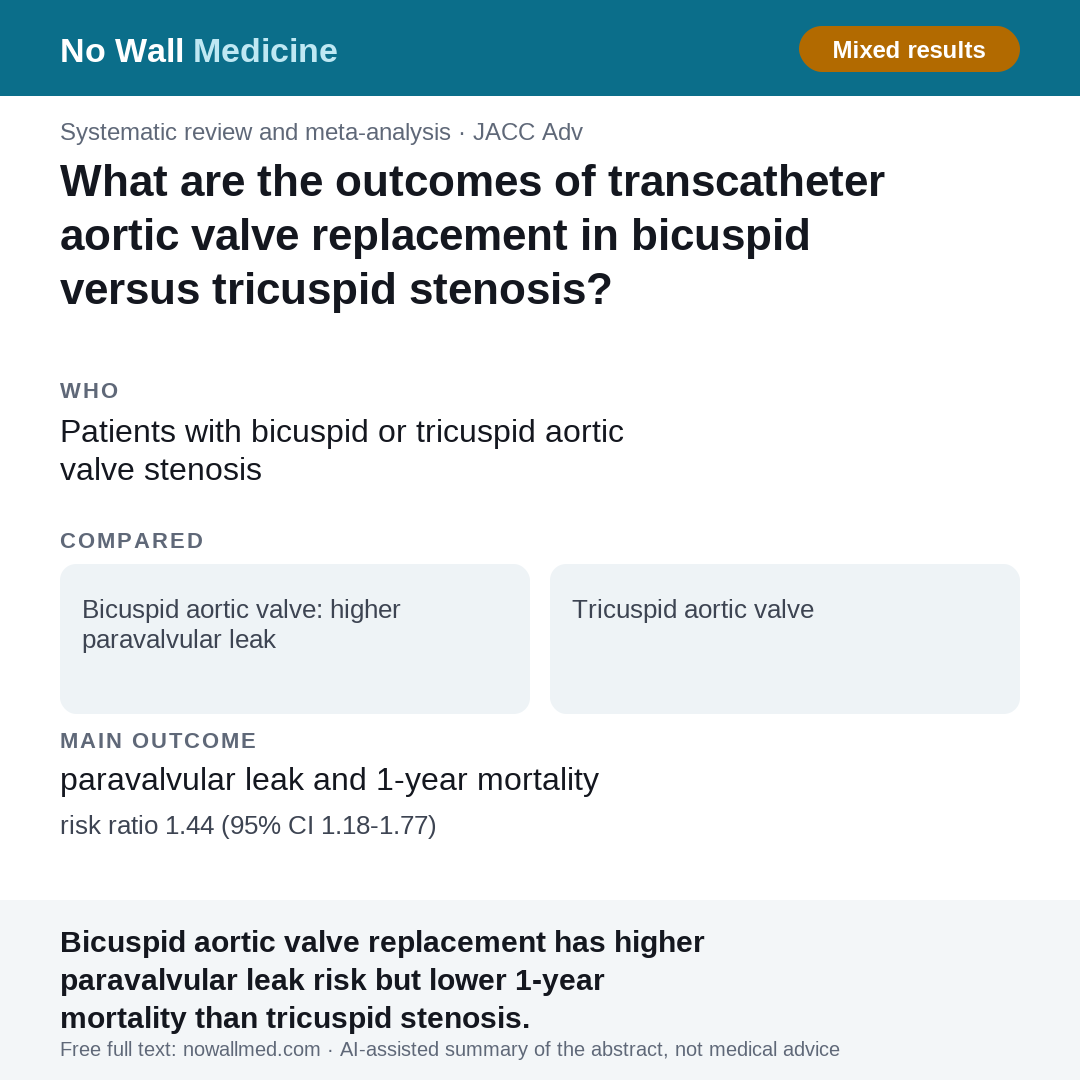
What are the outcomes of transcatheter aortic valve replacement in bicuspid versus tricuspid stenosis?
Who
Patients with bicuspid or tricuspid aortic valve stenosis
Compared
Bicuspid aortic valve: higher paravalvular leak
Tricuspid aortic valve
Main outcome
paravalvular leak and 1-year mortality
Result: risk ratio 1.44 (95% CI 1.18-1.77)
Bottom line: Bicuspid aortic valve replacement has higher paravalvular leak risk but lower 1-year mortality than tricuspid stenosis.
JACC Adv · 2026-08-27Download image
Clinical question: What are the outcomes of transcatheter aortic valve replacement in bicuspid versus tricuspid stenosis?
Abstract
Background
Comparative outcomes of transcatheter aortic valve replacement (TAVR) in bicuspid aortic valve (BAV) stenosis remain uncertain. Objectives
The authors synthesized evidence comparing: 1) TAVR outcomes in BAV vs tricuspid aortic valve (TAV) stenosis; and 2) TAVR vs surgical aortic valve replacement (SAVR) among patients with BAV stenosis. Methods
MEDLINE, Scopus, and Cochrane CENTRAL were searched through January 31, 2026 (CRD420261304542). Random-effects models pooled risk ratios (RRs) with 95% CIs. Exploratory meta-regression assessed study-level modifiers and temporal trends in 1-year mortality. Results
Fifty-two studies were included. In 39 studies comparing TAVR in BAV vs TAV, BAV was associated with higher paravalvular leak (RR: 1.44; 95% CI: 1.18-1.77; P Conclusions
TAVR for BAV stenosis was associated with procedural risk than TAVR for TAV stenosis but lower 1-year mortality. Compared with SAVR, TAVR showed procedural trade-offs without early mortality differences.
Spotted a mistake? Suggest a correction
More in Cardiology
Clonal hematopoiesis mutations linked to higher atrial fibrillation risk in cancer populations
Association of Clonal Hematopoiesis Mutations With Incident Atrial Fibrillation: A Systematic Review and Meta-Analysis
Deep learning model detects aortic stenosis from finger-cuff pressure waveforms accurately
Aortic Valve Stenosis Screening Using Deep Learning on Noninvasive Arterial Pressure Waveforms
Spontaneous coronary artery dissection affects younger women more often than expected
Spontaneous coronary artery dissection: implications for women's health, clinical care, and future research
Early lipid-lowering strategies may reduce atherosclerotic cardiovascular disease risk
Lipid-Lowering Strategies in the Era of Early Atherosclerosis Detection: 2026 ACC Scientific Statement: A Report of the American College of Cardiology