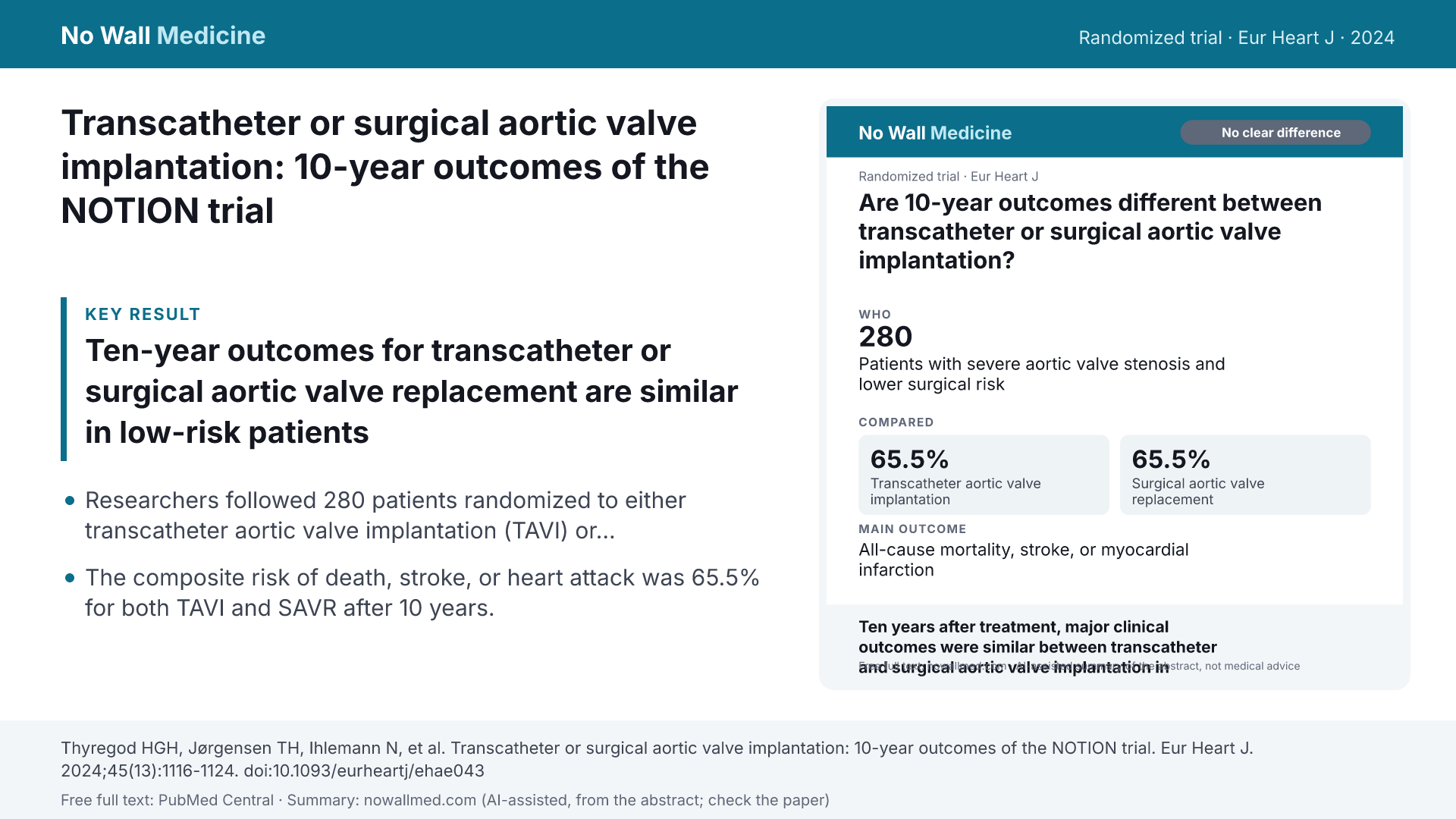
Ten-year outcomes for transcatheter or surgical aortic valve replacement are similar in low-risk patients
Transcatheter or surgical aortic valve implantation: 10-year outcomes of the NOTION trial
Randomized trialNo clear difference
Are 10-year outcomes different between transcatheter or surgical aortic valve implantation?
Who
280
Patients with severe aortic valve stenosis and lower surgical risk
Compared
65.5%Transcatheter aortic valve implantation
65.5%Surgical aortic valve replacement
Main outcome
All-cause mortality, stroke, or myocardial infarction
Result: hazard ratio 1.0 (95% CI 0.7-1.3)
Bottom line: Ten years after treatment, major clinical outcomes were similar between transcatheter and surgical aortic valve implantation in low-risk patients.
Eur Heart J · 2024-02-07 · Save PNG
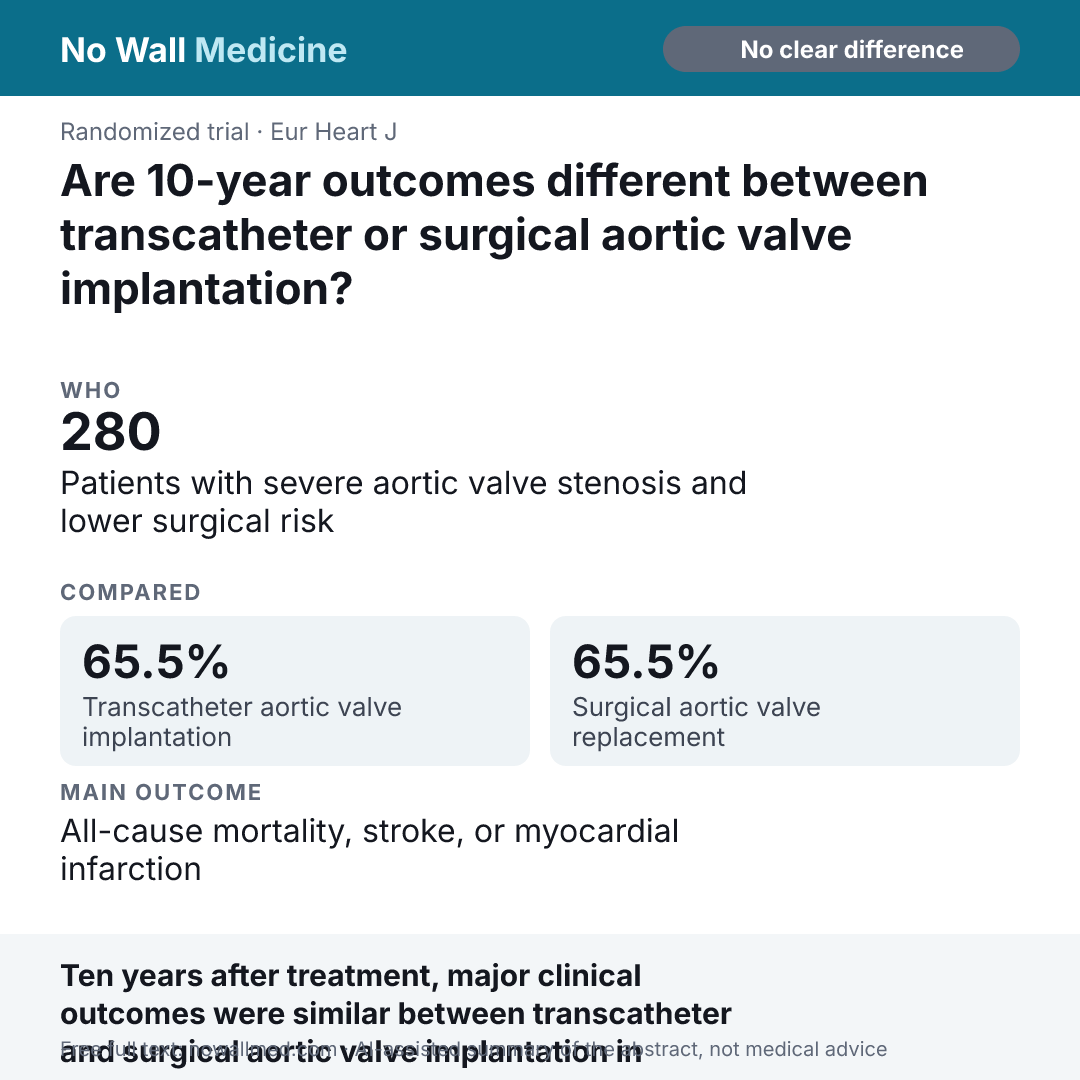
Clinical question: Are 10-year outcomes different between transcatheter or surgical aortic valve implantation?
Key points
- Researchers followed 280 patients randomized to either transcatheter aortic valve implantation (TAVI) or surgical aortic valve replacement (SAVR) for 10 years.
- The composite risk of death, stroke, or heart attack was 65.5% for both TAVI and SAVR after 10 years.
- Severe structural valve deterioration occurred in 1.5% of TAVI patients compared to 10.0% of SAVR patients.
Headline and key points written with AI from the paper’s abstract, with every number checked against it. Read the paper before relying on them.
Was this summary helpful?
Subject terms
Headline, design, result, key points, caveat and citation as plain text.
Cite this article
Thyregod HGH, Jørgensen TH, Ihlemann N, et al. Transcatheter or surgical aortic valve implantation: 10-year outcomes of the NOTION trial. Eur Heart J. 2024;45(13):1116-1124. doi:10.1093/eurheartj/ehae043
Spotted a mistake? Suggest a correction