Transcatheter aortic valve replacement associated with lower death risk than surgery in lower-risk patients
Transcatheter vs Surgical Aortic Valve Replacement in Lower-Risk Patients: An Updated Meta-Analysis of Randomized Controlled Trials
Meta-analysis of six randomized controlled trialsBenefit found
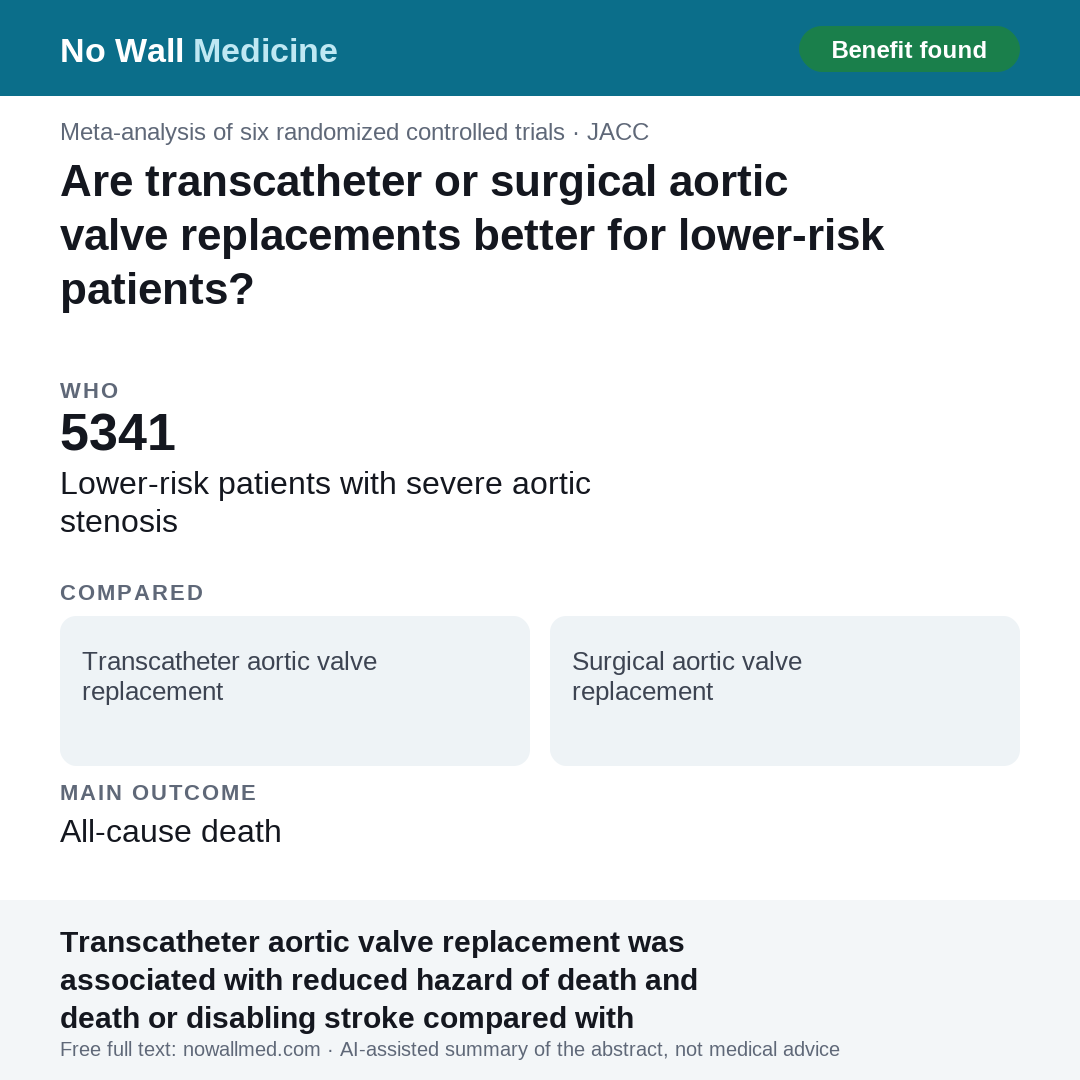
Are transcatheter or surgical aortic valve replacements better for lower-risk patients?
Who
5341
Lower-risk patients with severe aortic stenosis
Compared
Transcatheter aortic valve replacement
Surgical aortic valve replacement
Main outcome
All-cause death
Result: hazard ratio 0.80 (95% CI 0.66-0.97)
Bottom line: Transcatheter aortic valve replacement was associated with reduced hazard of death and death or disabling stroke compared with surgical replacement.
JACC · 2025-03-06Download image
Clinical question: Are transcatheter or surgical aortic valve replacements better for lower-risk patients?
Why it matters: Long-term clinical outcomes for lower-risk patients undergoing transcatheter aortic valve replacement versus surgical aortic valve replacement were not fully established.
Key points
- Researchers analyzed six randomized trials involving 5,341 lower-risk patients, with 2,717 receiving transcatheter aortic valve replacement and 2,624 receiving surgical aortic valve replacement.
- At 5 years, transcatheter aortic valve replacement was associated with a 20% reduction in the hazard of all-cause death and a 19% reduction in death or disabling stroke.
- There was no difference in the rates of stroke between the two procedures (HR: 0.97; 95% CI: 0.74-1.26; P = 0.80).
Headline and key points written with AI from the paper’s abstract, with every number checked against it. Read the paper before relying on them.
Topics
Cite this article
Reddy RK, Howard JP, Mack MJ, Reardon MJ, Jørgensen TH, Hørsted Thyregod HG. Transcatheter vs Surgical Aortic Valve Replacement in Lower-Risk Patients: An Updated Meta-Analysis of Randomized Controlled Trials. JACC. 2025. doi:10.1016/j.jacc.2024.12.031
Spotted a mistake? Suggest a correction
Top studies every Monday
The week’s key trials and guidelines in your specialties, plus any topics you follow. By email, free.
Get the weekly digest