Transcranial direct current stimulation reduced depression scores in patients undergoing breast cancer surgery
Transcranial direct current stimulation for perioperative depression in breast cancer surgery: a randomized controlled trial
Randomized clinical trialBenefit found
Does transcranial direct current stimulation alleviate perioperative depression in breast cancer surgery patients?
Who
64
Patients aged 18 years or older undergoing elective breast cancer surgery · Xuzhou Central Hospital
Compared
active transcranial direct current stimulation group: HAMD score of 4.67(1.75)
6.37sham transcranial direct current stimulation group (2.99)
Main outcome
Hamilton Depression Rating Scale 17 items scores
Bottom line: Transcranial direct current stimulation can accelerate depressive symptoms relief during acute recovery after breast cancer surgery.
Transl Psychiatry · 2026-06-23Download image
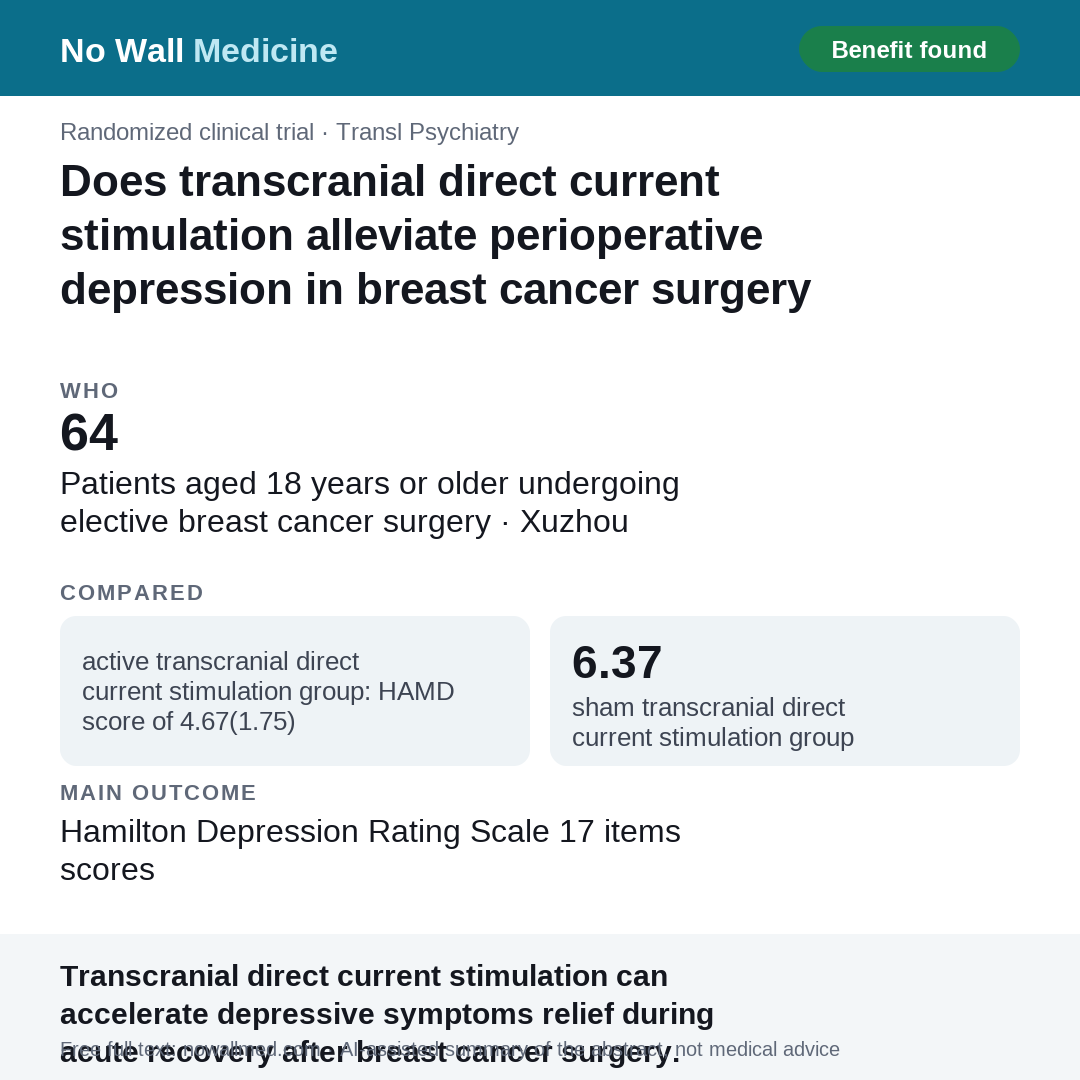
Clinical question: Does transcranial direct current stimulation alleviate perioperative depression in breast cancer surgery patients?
Why it matters: There is a lack of effective interventions for perioperative depression, which is a psychological disorder common in patients undergoing breast cancer surgery.
Key points
- Researchers studied 64 patients undergoing elective breast cancer surgery, comparing active transcranial direct current stimulation to a sham or placebo version.
- At day 5, the active group had a Hamilton Depression Rating Scale 17 items score of 4.67(1.75) compared to 6.37(2.99) in the sham group.
- The active stimulation group also showed significantly lower Number Rating Scale scores for pain than the sham group.
Headline and key points written with AI from the paper’s abstract, with every number checked against it. Read the paper before relying on them.
Spotted a mistake? Suggest a correction
More in Psychiatry & Mental Health
Depressive symptoms linked to stronger defensive response in panic disorder patients
Defensive reactivity to interoceptive perturbation in panic disorder: Depressive symptom burden and panic severity dimensions
Genes linked to mitochondria implicated in psychiatric disorders
Brain-derived multi-omics prioritization of mitochondria-related genes in schizophrenia, bipolar disorder, and major depressive disorder
Brain structure variations linked to alcohol use severity in large studies
A reproducible structural brain axis of alcohol use severity
Most animal psychedelic studies use stress-inducing methods and brief testing
Animal models in psychedelic research - Tripping over translation