Brain stimulation over the prefrontal cortex improves walking and thinking during dual tasks after stroke
Transcranial direct current stimulation of the dorsolateral prefrontal cortex improves dual-task performance in people with stroke
Sham-controlled, within-subject crossover studyBenefit found
Does anodal transcranial direct current stimulation of the left dorsolateral prefrontal cortex improve dual-task performance in chronic stroke?
Who
53
Individuals with chronic stroke
Compared
Active transcranial direct current stimulation: improved gait speed, stride length, foot strike angle, and cognitive tasks
Sham stimulation
Main outcome
Dual-task costs, gait parameters, and cognitive functions
Bottom line: Anodal transcranial direct current stimulation over the left dorsolateral prefrontal cortex improves mobility and cognitive performance during dual tasks.
J Neuroeng Rehabil · 2026-04-06Download image
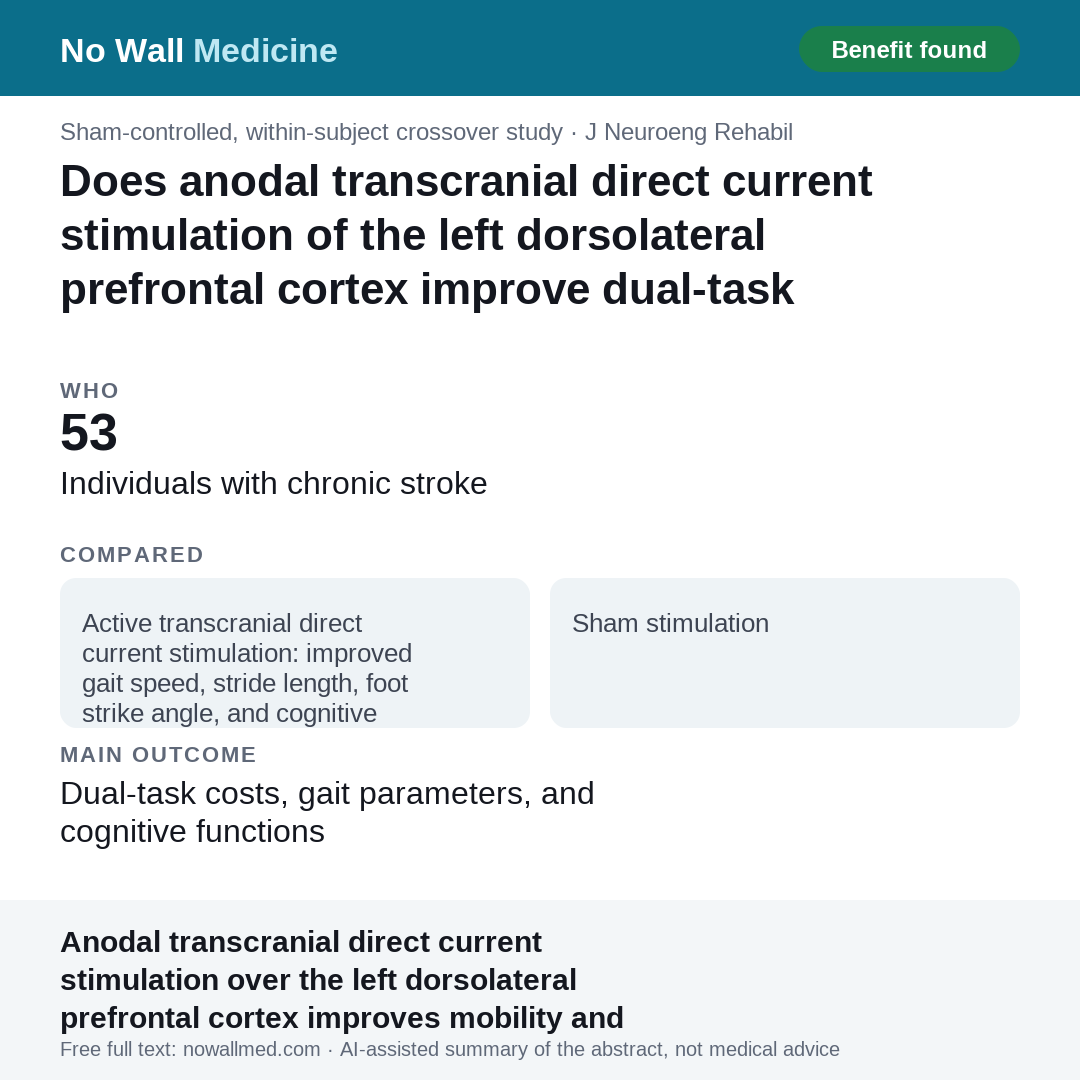
Clinical question: Does anodal transcranial direct current stimulation of the left dorsolateral prefrontal cortex improve dual-task performance in chronic stroke?
Why it matters: People with stroke often experience worsened walking and thinking abilities when trying to perform two tasks at the same time.
Key points
- Researchers studied 53 people with chronic stroke using a crossover study to compare active transcranial direct current stimulation against a sham stimulation.
- Active stimulation improved gait speed, stride length, and foot strike angle, while also improving performance in random number, counting forward, and serial subtraction tasks.
- The improvements were specific to dual-task conditions, as no significant changes were observed during single-task conditions.
Headline and key points written with AI from the paper’s abstract, with every number checked against it. Read the paper before relying on them.
Topics
Spotted a mistake? Suggest a correction