Ear nerve stimulation was more effective than sham stimulation for chronic insomnia disorder
Transcutaneous Auricular Vagus Nerve Stimulation for Chronic Insomnia Disorder: A Randomized Clinical Trial
Randomized clinical trialBenefit found
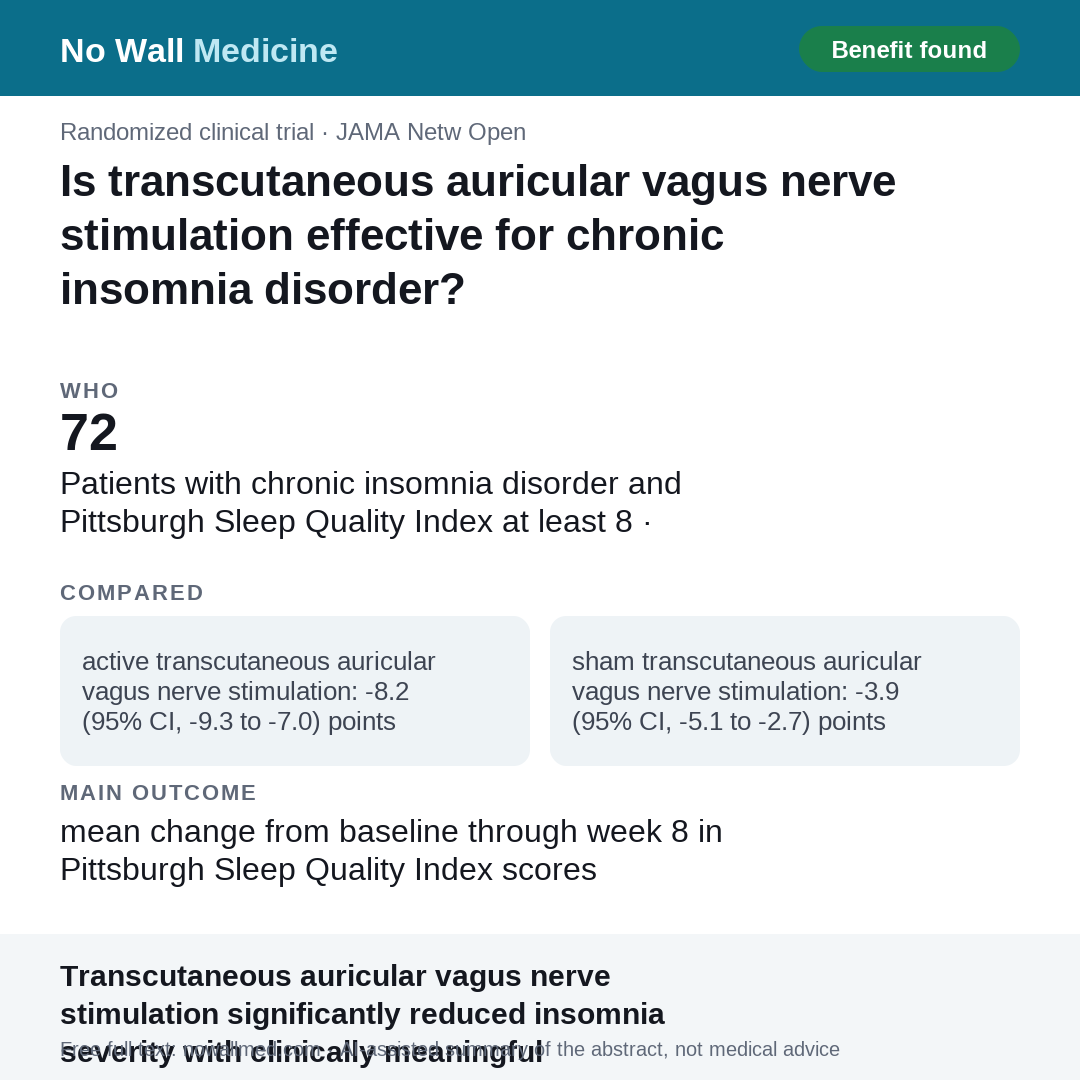
Is transcutaneous auricular vagus nerve stimulation effective for chronic insomnia disorder?
Who
72
Patients with chronic insomnia disorder and Pittsburgh Sleep Quality Index at least 8 · Single center in Beijing, China
Compared
active transcutaneous auricular vagus nerve stimulation: -8.2 (95% CI, -9.3 to -7.0) points
sham transcutaneous auricular vagus nerve stimulation: -3.9 (95% CI, -5.1 to -2.7) points
Main outcome
mean change from baseline through week 8 in Pittsburgh Sleep Quality Index scores
Result: 4.2-point greater reduction (95% CI, -5.9 to -2.6 points)
Bottom line: Transcutaneous auricular vagus nerve stimulation significantly reduced insomnia severity with clinically meaningful improvements sustained over 20 weeks.
Limitation: Future multicenter clinical trials with large sample sizes are needed to validate effectiveness.
JAMA Netw Open · 2024-12-02Download image
Clinical question: Is transcutaneous auricular vagus nerve stimulation effective for chronic insomnia disorder?
Why it matters: Evidence from randomized clinical trials regarding the efficacy of transcutaneous auricular vagus nerve stimulation for chronic insomnia disorder is lacking.
Key points
- Researchers studied 72 participants with chronic insomnia, comparing active transcutaneous auricular vagus nerve stimulation to a sham treatment over 8 weeks.
- The active stimulation group had a -8.2 point change in Pittsburgh Sleep Quality Index scores compared to -3.9 points in the sham group.
- The 4.2-point greater reduction in insomnia severity compared to the sham group exceeded the minimal clinically important difference of 2.5 points.
Limitation the authors note: Future multicenter clinical trials with large sample sizes are needed to validate effectiveness across diverse populations.
Headline and key points written with AI from the paper’s abstract, with every number checked against it. Read the paper before relying on them.
Topics
Cite this article
Zhang S, Zhao Y, Qin Z, Han Y, He J, Zhao B. Transcutaneous Auricular Vagus Nerve Stimulation for Chronic Insomnia Disorder: A Randomized Clinical Trial. JAMA Netw Open. 2024. doi:10.1001/jamanetworkopen.2024.51217
Spotted a mistake? Suggest a correction
Top studies every Monday
The week’s key trials and guidelines in your specialties, plus any topics you follow. By email, free.
Get the weekly digest