Transcutaneous Auricular Vagus Nerve Stimulation Treatment for Erythematotelangiectatic Rosacea: A Randomized Clinical Trial
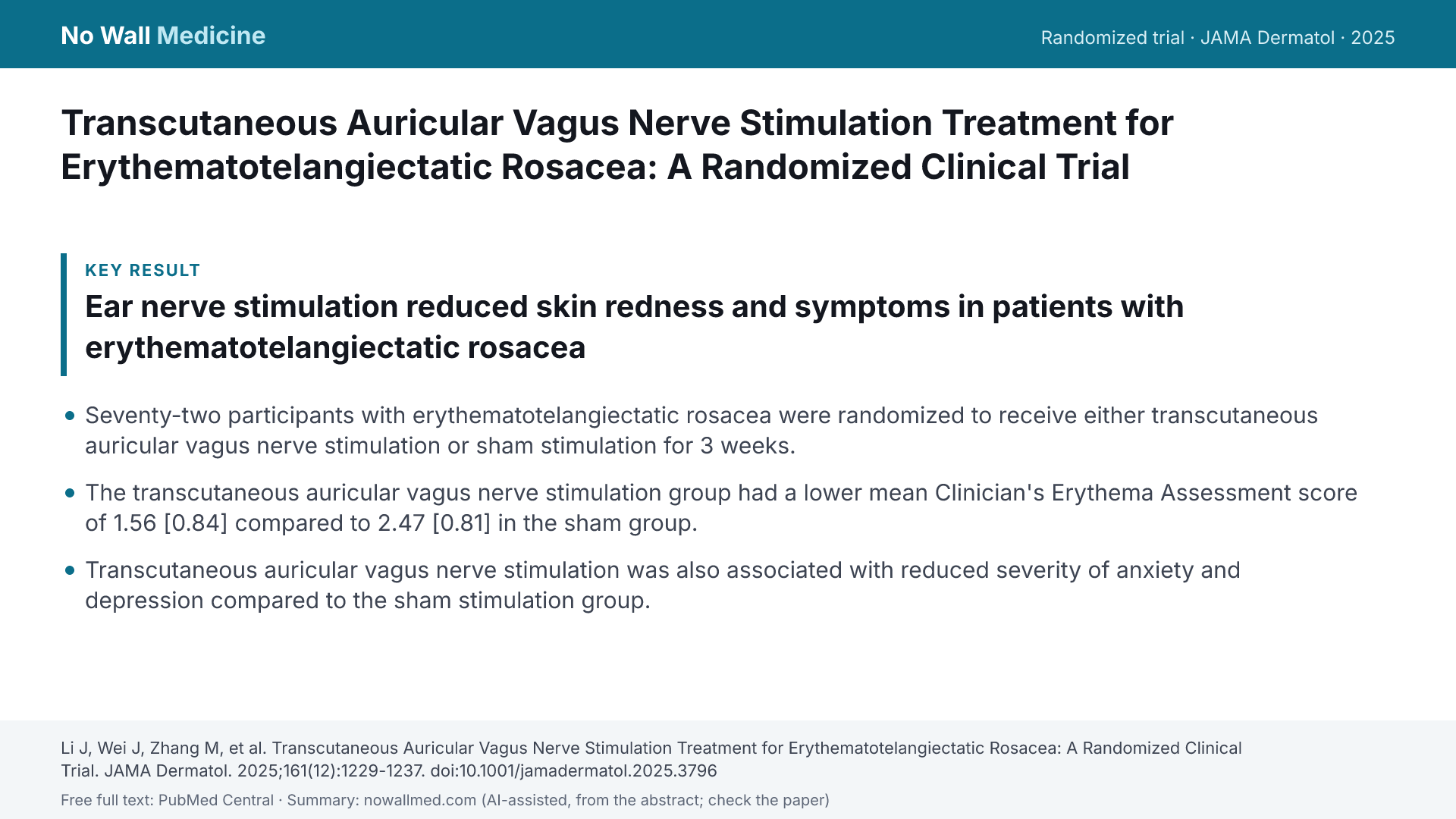
Key result: Ear nerve stimulation reduced skin redness and symptoms in patients with erythematotelangiectatic rosacea
Key points
- Seventy-two participants with erythematotelangiectatic rosacea were randomized to receive either transcutaneous auricular vagus nerve stimulation or sham stimulation for 3 weeks.
- The transcutaneous auricular vagus nerve stimulation group had a lower mean Clinician's Erythema Assessment score of 1.56 [0.84] compared to 2.47 [0.81] in the sham group.
- Transcutaneous auricular vagus nerve stimulation was also associated with reduced severity of anxiety and depression compared to the sham stimulation group.
Why it matters: Treating facial flushing and redness in patients with erythematotelangiectatic rosacea is challenging and transcutaneous auricular vagus nerve stimulation has not been rigorously evaluated in a randomized clinical trial.
Discussion prompts
- Would these patients look like yours? Who was left out?
- Is the main outcome one that matters to patients?
- Is the difference large enough to change what you do?
Cite: Li J, Wei J, Zhang M, et al. Transcutaneous Auricular Vagus Nerve Stimulation Treatment for Erythematotelangiectatic Rosacea: A Randomized Clinical Trial. JAMA Dermatol. 2025;161(12):1229-1237. doi:10.1001/jamadermatol.2025.3796
Free full text: PubMed Central · Summary and visual abstract: nowallmed.com/a/transcutaneous-auricular-vagus-nerve-stimulation-treatment-for-brxwpa/ (AI-assisted from the abstract; check the paper before relying on it).