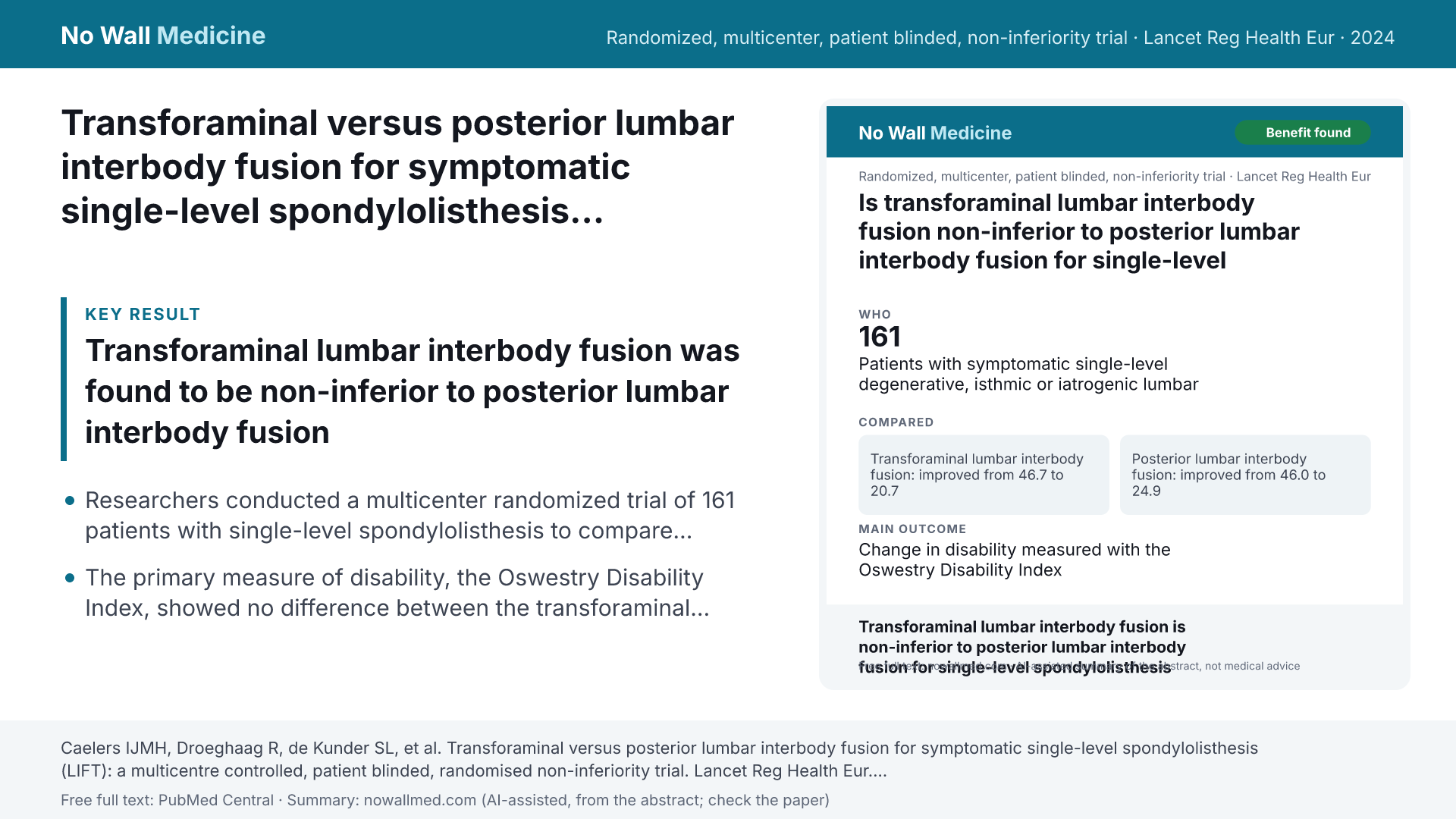
Transforaminal lumbar interbody fusion was found to be non-inferior to posterior lumbar interbody fusion
Transforaminal versus posterior lumbar interbody fusion for symptomatic single-level spondylolisthesis (LIFT): a multicentre controlled, patient blinded, randomised non-inferiority trial
Randomized, multicenter, patient blinded, non-inferiority trialBenefit found
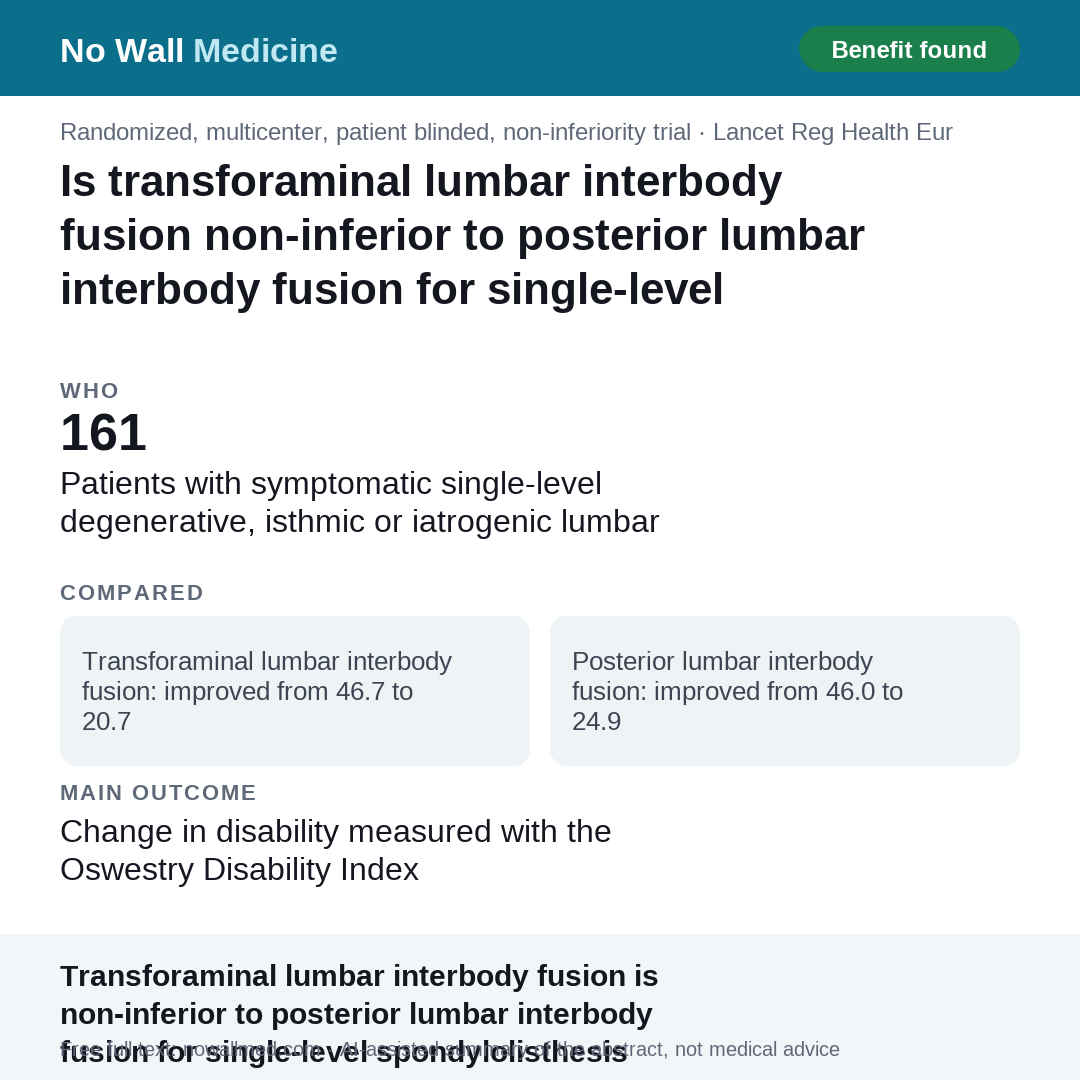
Is transforaminal lumbar interbody fusion non-inferior to posterior lumbar interbody fusion for single-level spondylolisthesis?
Who
161
Patients with symptomatic single-level degenerative, isthmic or iatrogenic lumbar spondylolisthesis · Five Dutch hospitals
Compared
Transforaminal lumbar interbody fusion: improved from 46.7 to 20.7
Posterior lumbar interbody fusion: improved from 46.0 to 24.9
Main outcome
Change in disability measured with the Oswestry Disability Index
Result: -4.9, 90% CI -12.2 to +2.4
Bottom line: Transforaminal lumbar interbody fusion is non-inferior to posterior lumbar interbody fusion for single-level spondylolisthesis effectiveness.
Limitation: Total loss-to-follow-up after one year was 16 patients.
Lancet Reg Health Eur · 2024-06-19Download image
Clinical question: Is transforaminal lumbar interbody fusion non-inferior to posterior lumbar interbody fusion for single-level spondylolisthesis?
Why it matters: It was unknown whether transforaminal lumbar interbody fusion is as effective as posterior lumbar interbody fusion for patients with symptomatic single-level spondylolisthesis.
Key points
- Researchers conducted a multicenter randomized trial of 161 patients with single-level spondylolisthesis to compare two types of spinal fusion surgery.
- The primary measure of disability, the Oswestry Disability Index, showed no difference between the transforaminal group and the posterior group that exceeded the 7.0 point non-inferiority limit.
- No differences were found between the two surgical methods regarding blood loss, surgery duration, hospital stay, or complications.
Headline and key points written with AI from the paper’s abstract, with every number checked against it. Read the paper before relying on them.
Was this summary helpful?
Cite this article
Caelers IJMH, Droeghaag R, de Kunder SL, et al. Transforaminal versus posterior lumbar interbody fusion for symptomatic single-level spondylolisthesis (LIFT): a multicentre controlled, patient blinded, randomised non-inferiority trial. Lancet Reg Health Eur. 2024. doi:10.1016/j.lanepe.2024.100964
Spotted a mistake? Suggest a correction