Navitoclax plus ruxolitinib increased spleen volume reduction in patients with untreated myelofibrosis
TRANSFORM-1 phase 3 study: efficacy and safety of navitoclax plus ruxolitinib in patients with untreated myelofibrosis
Phase 3 randomized trialBenefit found
Does navitoclax plus ruxolitinib improve spleen volume reduction in untreated myelofibrosis?
Who
252
Janus kinase inhibitor-naïve adults with intermediate-2 or high-risk myelofibrosis
Compared
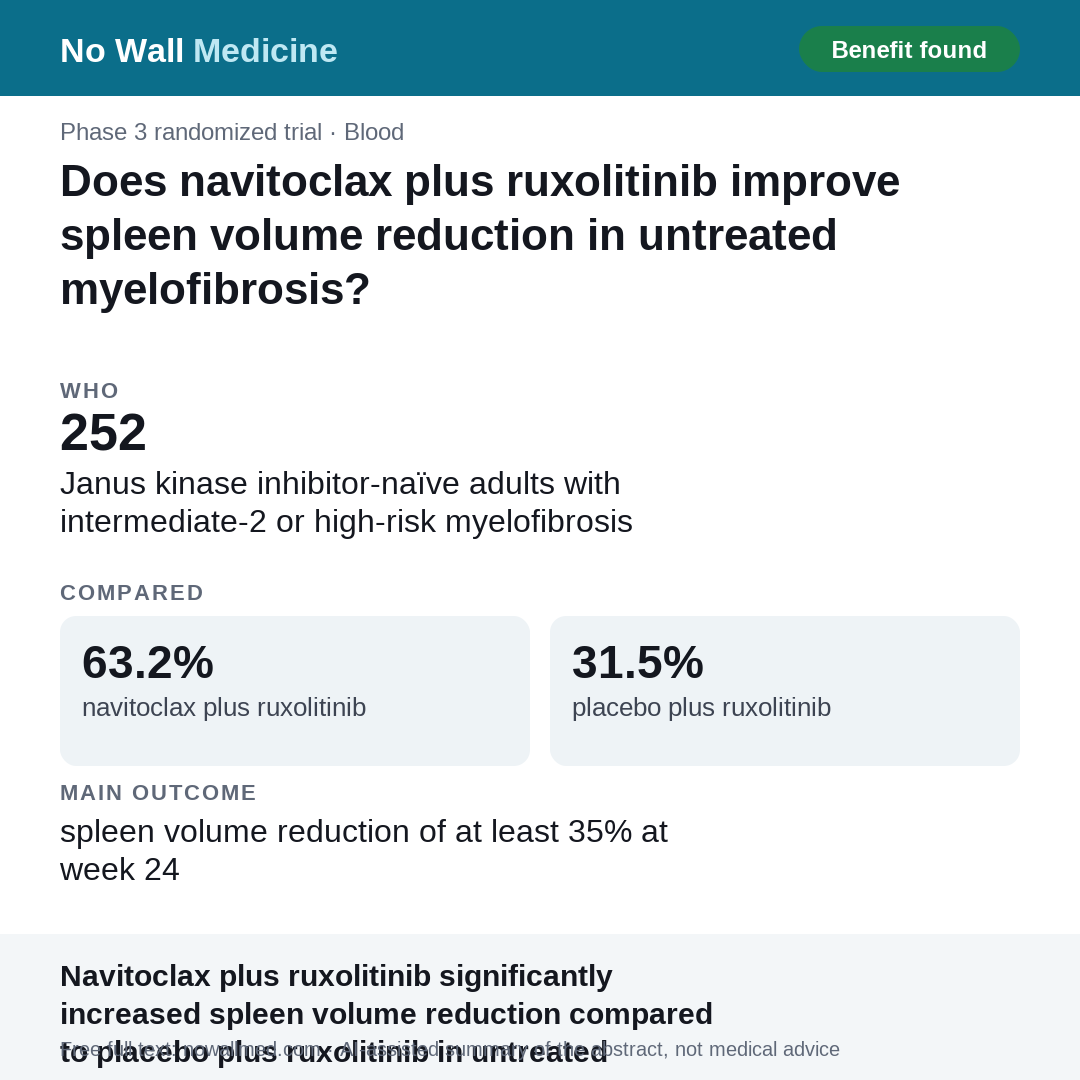
63.2%navitoclax plus ruxolitinib
31.5%placebo plus ruxolitinib
Main outcome
spleen volume reduction of at least 35% at week 24
Bottom line: Navitoclax plus ruxolitinib significantly increased spleen volume reduction compared to placebo plus ruxolitinib in untreated myelofibrosis.
Blood · 2026-06-30Download image
Clinical question: Does navitoclax plus ruxolitinib improve spleen volume reduction in untreated myelofibrosis?
Why it matters: Doctors need to determine if adding navitoclax to ruxolitinib improves spleen volume reduction in patients with untreated myelofibrosis.
In absolute numbers
navitoclax plus ruxolitinib: 63.2% · placebo plus ruxolitinib: 31.5% → a difference of 31.7 percentage points, so about 4 people would need the treatment for 1 more to benefit (number needed to treat) over the trial’s follow-up.
Worked out by us from the two group results above, not reported by the authors. Check the paper for the exact outcome and timing.
Key points
- Researchers studied 252 adults with intermediate-2 or high-risk myelofibrosis, comparing navitoclax plus ruxolitinib to a placebo plus ruxolitinib.
- At week 24, 63.2% of patients achieved a 35% spleen volume reduction compared to 31.5% in the placebo group.
- The combination therapy showed higher rates of grade 3/4 thrombocytopenia (low platelets) at 54.0% versus 19.2% for the placebo group.
Headline and key points written with AI from the paper’s abstract, with every number checked against it. Read the paper before relying on them.
Abstract
The phase 3 TRANSFORM-1 study evaluated ruxolitinib (RUX) in combination with navitoclax (NAV) or placebo (PBO) in Janus kinase inhibitor-naïve adults with intermediate-2 or high-risk myelofibrosis and Eastern Cooperative Oncology Group performance status of ≤2. Patients were randomized 1:1 to NAV (200 mg/d starting dose, or 100 mg escalated to 200 mg/d) or PBO, with RUX dosed per label. The primary end point was ≥35% spleen volume reduction (SVR) at week 24 (SVR35W24). Secondary end points included change from baseline in total symptom score (TSS) at week 24 and SVR35 at any time. A total of 252 patients (NAV+RUX, n = 125; PBO+RUX, n = 127; median follow-up 20.3 months) were randomized; >80% had intermediate-2 risk, and ∼50% had high-molecular risk disease. SVR35W24 was achieved by 63.2% with NAV+RUX vs 31.5% with PBO+RUX (P< .0001). Mean change in TSS at week 24 was not significantly different between NAV+RUX and PBO+RUX (-10.2 vs -11.6; P = .2852). SVR35 at any time was achieved in 76.8% with NAV+RUX vs 44.1% with PBO+RUX (nominal P< .0001). A ≥20% variant allele frequency reduction (exploratory end point) occurred in 58.5% (95% confidence interval [CI], 49.0-67.5) with NAV+RUX and 45.5% (95% CI, 36.4-54.8) with PBO+RUX. NAV+RUX showed higher hematologic toxicity vs PBO+RUX (grade 3/4 thrombocytopenia, 54.0% vs 19.2%; grade 3/4 neutropenia, 40.3% vs 8.8%); diarrhea (any grade, 41.9% vs 16.8%) was also more common. Cytopenias were generally manageable and reversible with dose adjustments. This trial was registered at www.clinicaltrials.gov as NCT04472598.
Abstract reproduced under the article’s CC BY NC ND licence.
Topics
Spotted a mistake? Suggest a correction