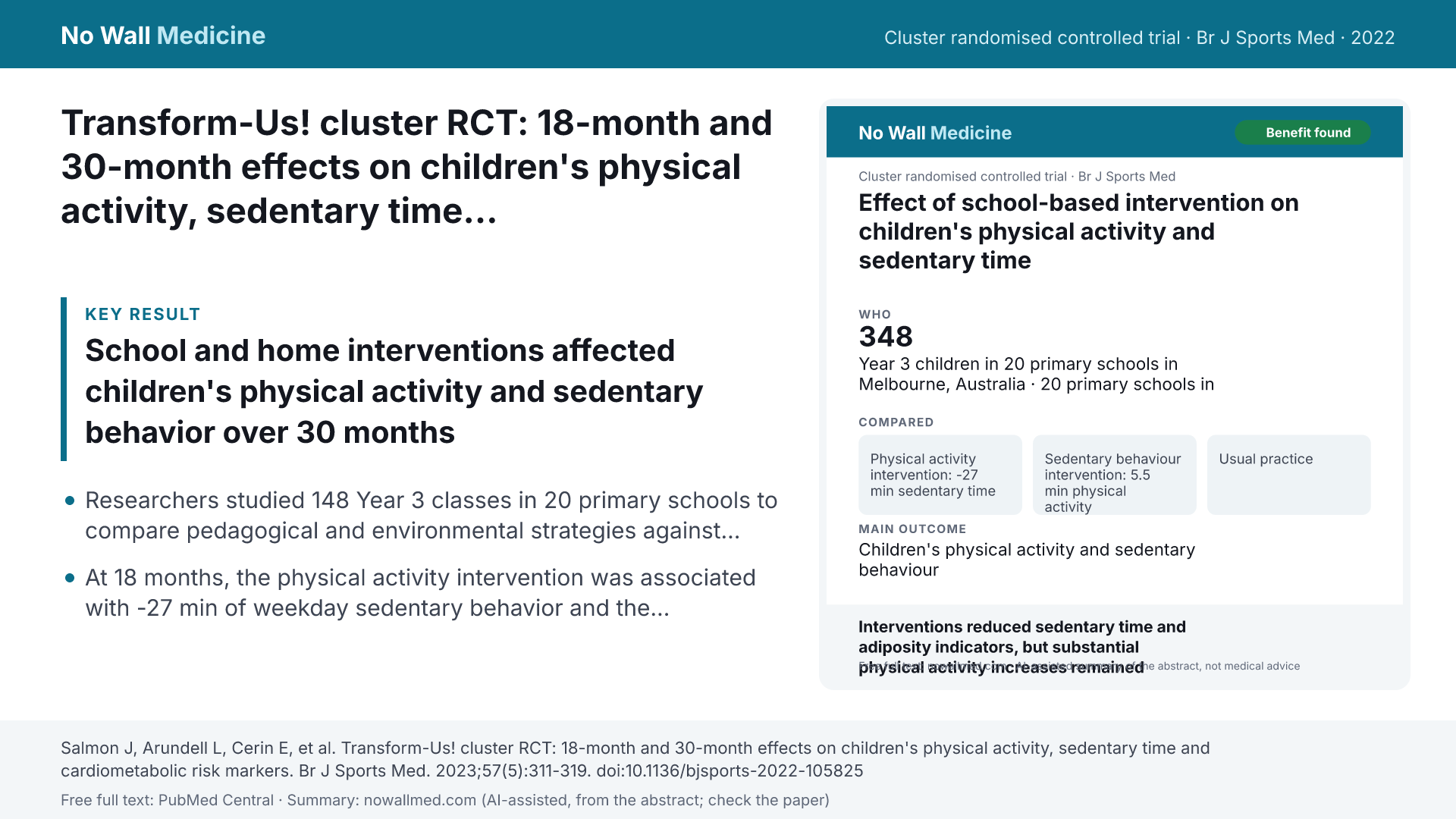
School and home interventions affected children's physical activity and sedentary behavior over 30 months
Transform-Us! cluster RCT: 18-month and 30-month effects on children's physical activity, sedentary time and cardiometabolic risk markers
Cluster randomised controlled trialBenefit found
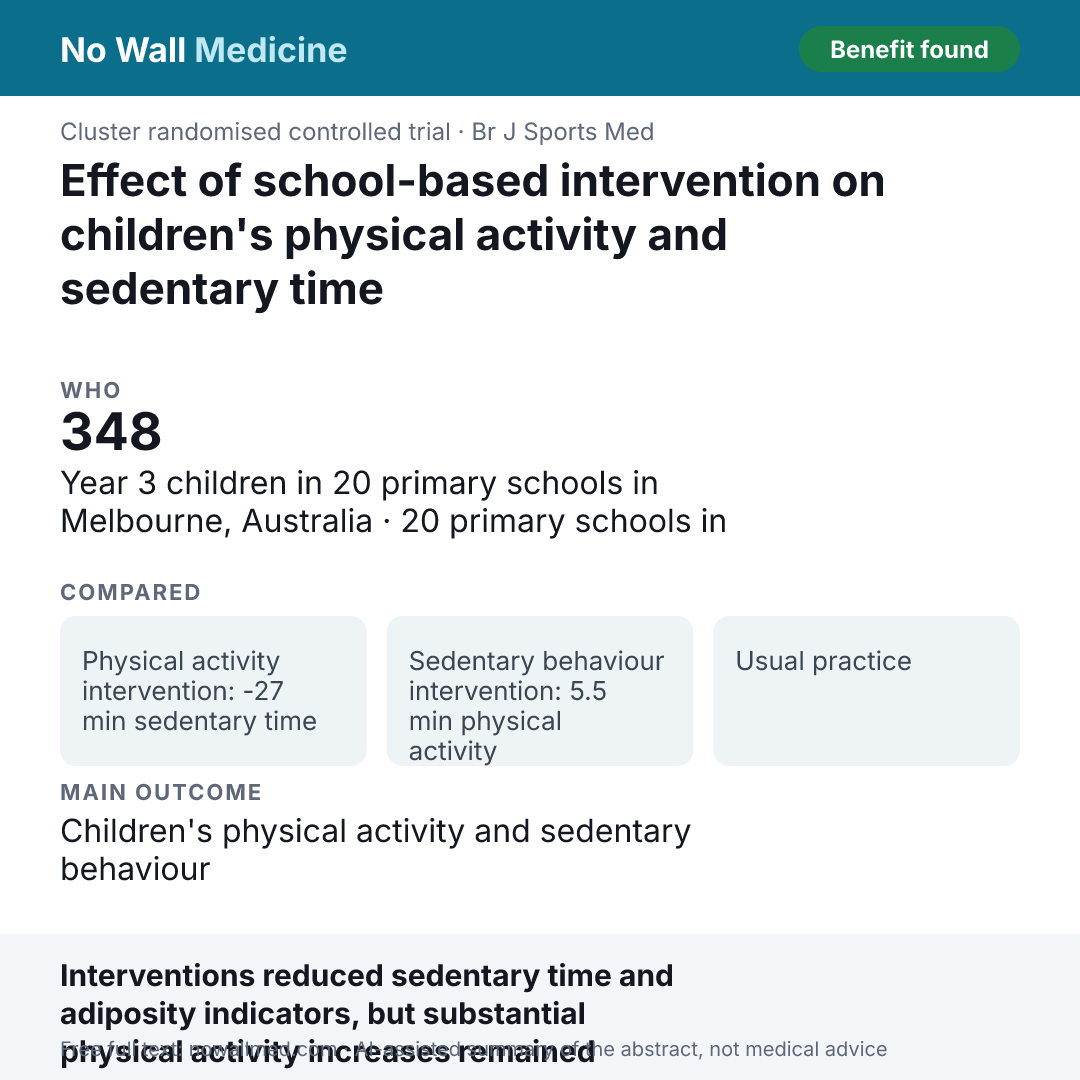
Effect of school-based intervention on children's physical activity and sedentary time
Who
348
Year 3 children in 20 primary schools in Melbourne, Australia · 20 primary schools in Melbourne, Australia
Compared
Physical activity intervention: -27 min sedentary time
Sedentary behaviour intervention: 5.5 min physical activity
Usual practice
Main outcome
Children's physical activity and sedentary behaviour
Result: Sedentary behaviour -27 min (95% CI: -47.3 to -5.3)
Bottom line: Interventions reduced sedentary time and adiposity indicators, but substantial physical activity increases remained challenging.
Br J Sports Med · 2022-11-25 · Save PNG
Key points
- Researchers studied 148 Year 3 classes in 20 primary schools to compare pedagogical and environmental strategies against usual practice.
- At 18 months, the physical activity intervention was associated with -27 min of weekday sedentary behavior and the sedentary behavior intervention was associated with 5.5 min of average day physical activity.
- At 30 months, the sedentary behavior intervention was associated with -33.3 min of average day sedentary behavior.
Headline and key points written with AI from the paper’s abstract, with every number checked against it. Read the paper before relying on them.
Was this summary helpful?
Abstract
Objective
To test the efficacy of the Transform-Us! school- and home-based intervention on children's physical activity (PA), sedentary behaviour (SB) and cardiometabolic risk factor profiles. Methods
A 30-month 2×2 factorial design cluster randomised controlled trial delivered in 20 primary schools (148 Year 3 classes) in Melbourne, Australia (2010-2012), that used pedagogical and environmental strategies to reduce and break up SB, promote PA or a combined approach, compared with usual practice. Primary outcomes (accelerometry data; n=348) were assessed at baseline, 18 and 30 months. Secondary outcomes included body mass index (BMI) and waist circumference (WC) (n=564), blood pressure (BP) (n=537) and biomarkers (minimum n=206). Generalised linear mixed models estimated the interactive effects of the PA and SB interventions on the outcomes. If there was no interaction, the main effects were assessed. Results
At 18 months, there were intervention effects on children's weekday SB (-27 min, 95% CI: -47.3 to -5.3) for the PA intervention, and on children's average day PA (5.5 min, 95% CI: 0.1 to 10.8) for the SB intervention. At 30 months, there was an intervention effect for children's average day SB (-33.3 min, 95% CI: -50.6 and -16.0) for the SB intervention. Children's BMI (PA and SB groups) and systolic BP (combined group) were lower, and diastolic BP (PA group) was higher. There were positive effects on WC at both time points (SB intervention) and mixed effects on blood parameters. Conclusions
The Transform-Us! PA and SB interventions show promise as a pragmatic approach for reducing children's SB and adiposity indicators; but achieving substantial increases in PA remains challenging. Trial registration
ISRCTN83725066; ACTRN12609000715279.
Abstract reproduced under the article’s CC BY NC licence.
Subject terms
Headline, design, result, key points, caveat and citation as plain text.
Cite this article
Salmon J, Arundell L, Cerin E, et al. Transform-Us! cluster RCT: 18-month and 30-month effects on children's physical activity, sedentary time and cardiometabolic risk markers. Br J Sports Med. 2023;57(5):311-319. doi:10.1136/bjsports-2022-105825
Spotted a mistake? Suggest a correction