Transformation to large B-cell lymphoma was associated with increased death risk in marginal zone lymphoma
Transformation in marginal zone lymphoma: results from a prospective cohort and a meta-analysis of the literature
Randomized trial, meta-analysisHarm found
Histologic transformation in marginal zone lymphoma
Who
6161
patients with marginal zone lymphoma
Compared
3%Extranodal MZL
7%Splenic MZL
9%Nodal MZL
Main outcome
cumulative incidence of histologic transformation
Result: hazard ratio 3.95 (95% CI 2.06-7.55)
Bottom line: Histologic transformation is uncommon but harmful
Blood Adv · 2024-09-25Download image
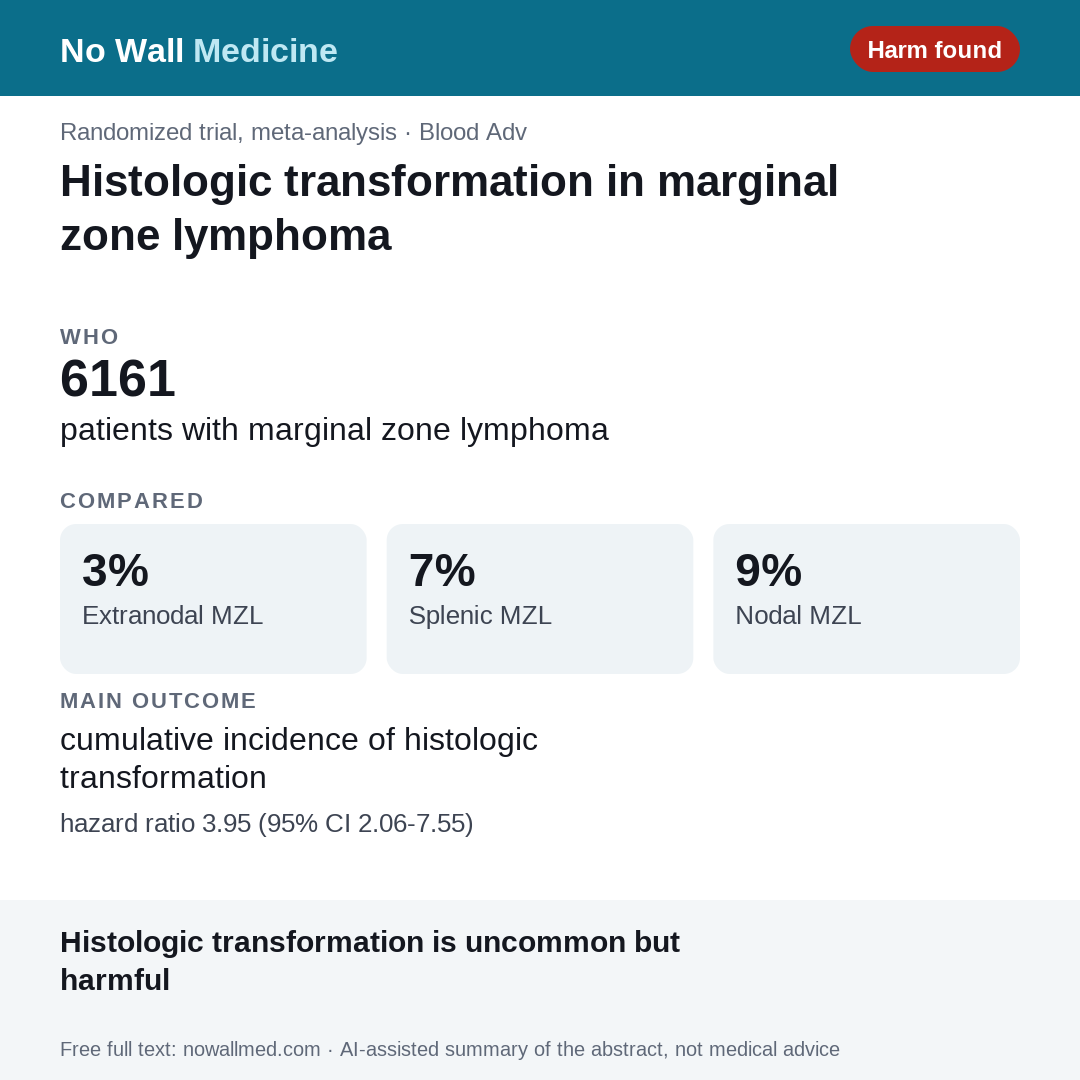
Why it matters: Published cumulative incidence rates for the transformation of marginal zone lymphoma into large B-cell lymphomas show large variability.
Key points
- Researchers studied 529 patients in a cohort and 6161 patients in a meta-analysis to measure how often marginal zone lymphoma transforms into more aggressive large B-cell lymphomas.
- In the cohort, the 10-year cumulative incidence of transformation was 3.6%, while the meta-analysis showed 5-year and 10-year rates of 5% and 8% across all subtypes.
- Transformation was associated with an increased risk for death, with a subdistribution hazard ratio of 3.95, and was linked to having 2 or more extranodal sites.
Headline and key points written with AI from the paper’s abstract, with every number checked against it. Read the paper before relying on them.
Was this summary helpful?
Abstract
Marginal zone lymphoma (MZL) includes extranodal MZL (EMZL), splenic MZL (SMZL), and nodal MZL (NMZL) subtypes. Histologic transformation (HT) to large B-cell lymphomas is well documented but with a large variability in published cumulative incidence rates. We report results from the Molecular Epidemiology Resource (MER) cohort on the cumulative incidence of HT (with death as competing risk) and the associated risk factors and outcomes. We also conducted a meta-analysis of available studies on the cumulative incidence of HT. From 2002 to 2015, 529 patients with MZL were enrolled in the MER study (69% EMZL, 16% SMZL, and 15% NMZL). The 10-year overall survival (OS) from diagnosis was 66%. HT occurred in 21 patients with a 5-year and 10-year cumulative incidence of 2.7% (95% confidence interval [CI], 0.02-0.05) and 3.6% (95% CI, 0.02-0.06), respectively. HT was associated with an increased risk for death (subdistribution hazard ratio [HR], 3.95; 95% CI, 2.06-7.55). Predictors of HT were ≥2 extranodal sites and mucosa-associated lymphoid tissue International Prognostic Index score ≥2. The OS was 79% at 5 years and 55% at 10 years after HT. In the meta-analysis of 12 studies (6161 patients), the 5- and 10-year cumulative incidence of HT across all subtypes were 5% (95% CI, 0.05-0.06) and 8% (95% CI, 0.07-0.09), respectively. These rates were lower in EMZL (3% and 5%) than in SMZL (7% and 13%) and NMZL (9% and 13%). Although HT is relatively uncommon in the first decade after MZL diagnosis, it is associated with an inferior outcome and needs new approaches for prevention and management.
Abstract reproduced under the article’s CC BY NC ND licence.
Subject terms
Cite this article
Bommier C, Link BK, Gysbers BJ, Maurer MJ, Larson MC, Khurana A. Transformation in marginal zone lymphoma: results from a prospective cohort and a meta-analysis of the literature. Blood Adv. 2024. doi:10.1182/bloodadvances.2024013188
Spotted a mistake? Suggest a correction
Top studies every Monday
The week’s key trials and guidelines in your specialties, plus any topics you follow. By email, free.
Get the weekly digest