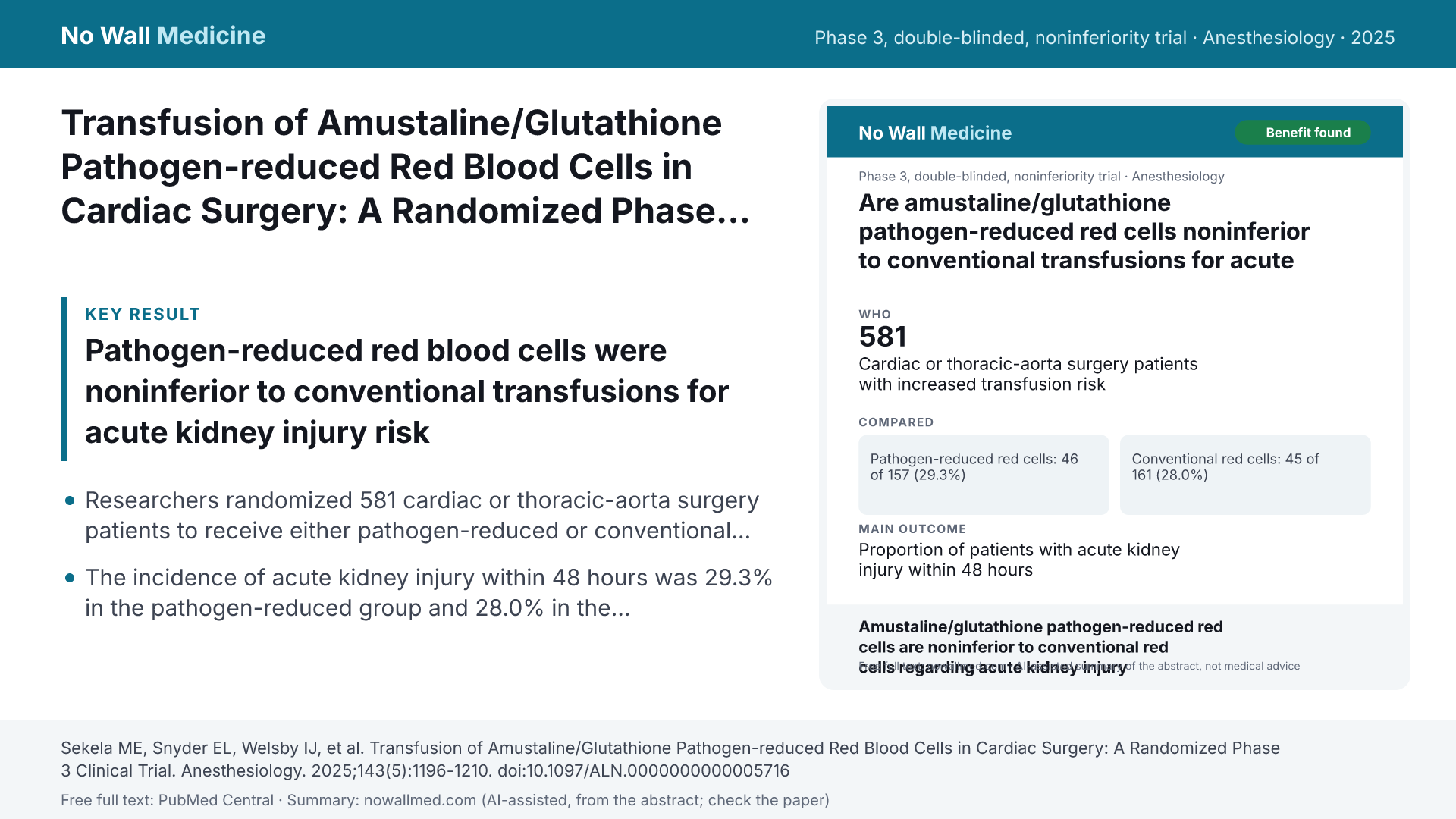
Pathogen-reduced red blood cells were noninferior to conventional transfusions for acute kidney injury risk
Transfusion of Amustaline/Glutathione Pathogen-reduced Red Blood Cells in Cardiac Surgery: A Randomized Phase 3 Clinical Trial
Phase 3, double-blinded, noninferiority trialBenefit found
Are amustaline/glutathione pathogen-reduced red cells noninferior to conventional transfusions for acute surgical blood loss?
Who
581
Cardiac or thoracic-aorta surgery patients with increased transfusion risk
Compared
Pathogen-reduced red cells: 46 of 157 (29.3%)
Conventional red cells: 45 of 161 (28.0%)
Main outcome
Proportion of patients with acute kidney injury within 48 hours
Result: treatment difference, 0.7%; 95% CI, -8.9 to 10.4%
Bottom line: Amustaline/glutathione pathogen-reduced red cells are noninferior to conventional red cells regarding acute kidney injury incidence.
Anesthesiology · 2025-08-12Download image
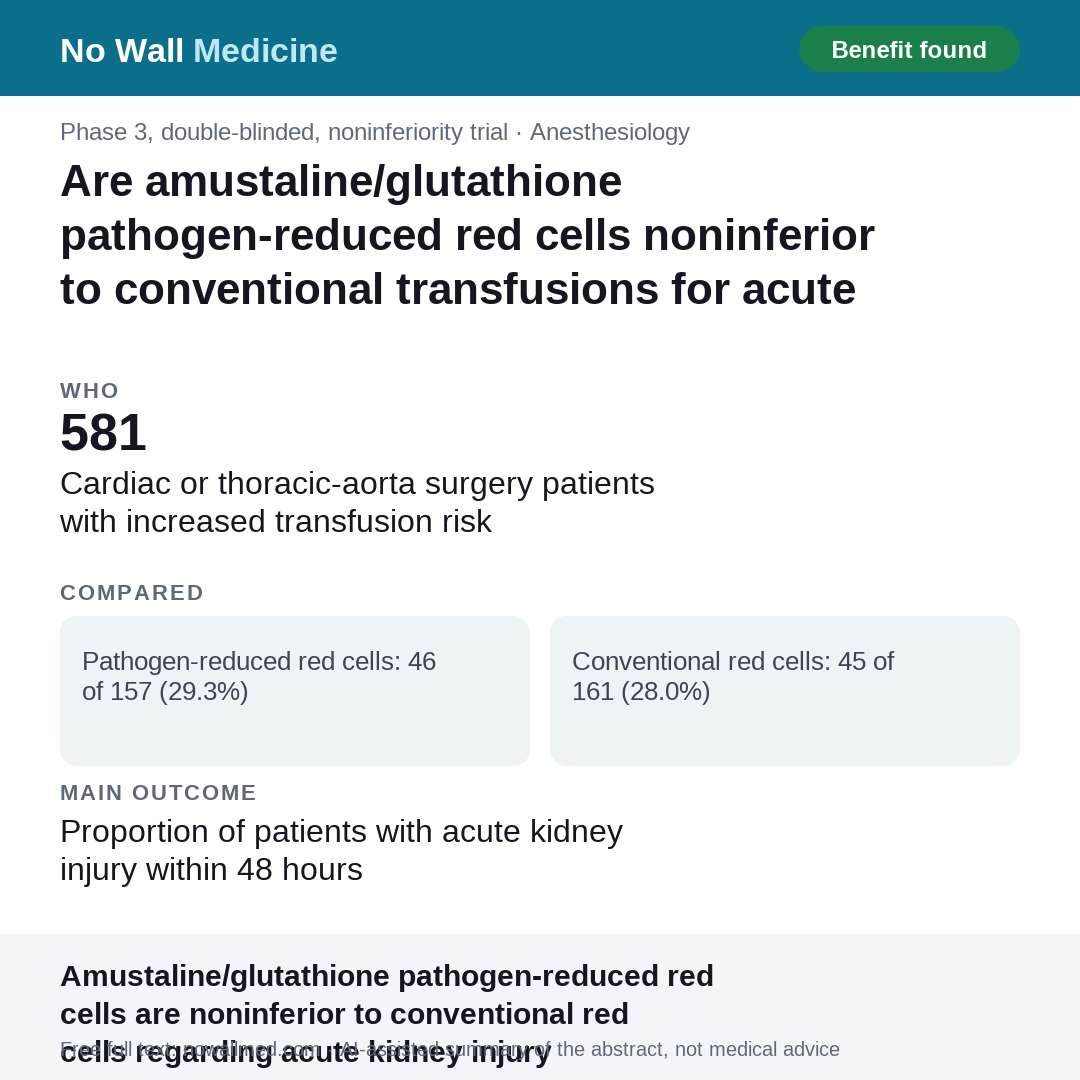
Clinical question: Are amustaline/glutathione pathogen-reduced red cells noninferior to conventional transfusions for acute surgical blood loss?
Why it matters: Transfusion carries a persistent low risk of infection and graft-versus-host disease that may be addressed using pathogen reduction.
Key points
- Researchers randomized 581 cardiac or thoracic-aorta surgery patients to receive either pathogen-reduced or conventional red blood cells during and for 7 days after surgery.
- The incidence of acute kidney injury within 48 hours was 29.3% in the pathogen-reduced group and 28.0% in the conventional group.
- Specific, low-titer antibodies developed in 3.1% of the 159 patients receiving pathogen-reduced red cells, but without evidence of hemolysis.
Headline and key points written with AI from the paper’s abstract, with every number checked against it. Read the paper before relying on them.
Was this summary helpful?
Subject terms
Cite this article
Sekela ME, Snyder EL, Welsby IJ, et al. Transfusion of Amustaline/Glutathione Pathogen-reduced Red Blood Cells in Cardiac Surgery: A Randomized Phase 3 Clinical Trial. Anesthesiology. 2025. doi:10.1097/ALN.0000000000005716
Spotted a mistake? Suggest a correction