Transient Ischaemic attack Emergency Referral (TIER): randomised feasibility trial results
Randomized feasibility trialNo clear difference
Is it feasible to refer low-risk transient ischaemic attack patients to a clinic instead of emergency departments?
Who
53
Patients with suspected transient ischaemic attack calling emergency medical services · South Wales, United Kingdom
Compared
TIA clinic referral: mean 4.8/5 patient satisfaction
Usual care: mean 4.2/5 patient satisfaction
Main outcome
Feasibility of paramedic referral to TIA clinic
Bottom line: The feasibility study did not meet progression criteria due to low patient identification and referral rates.
Emerg Med J · 2024-11-21Download image
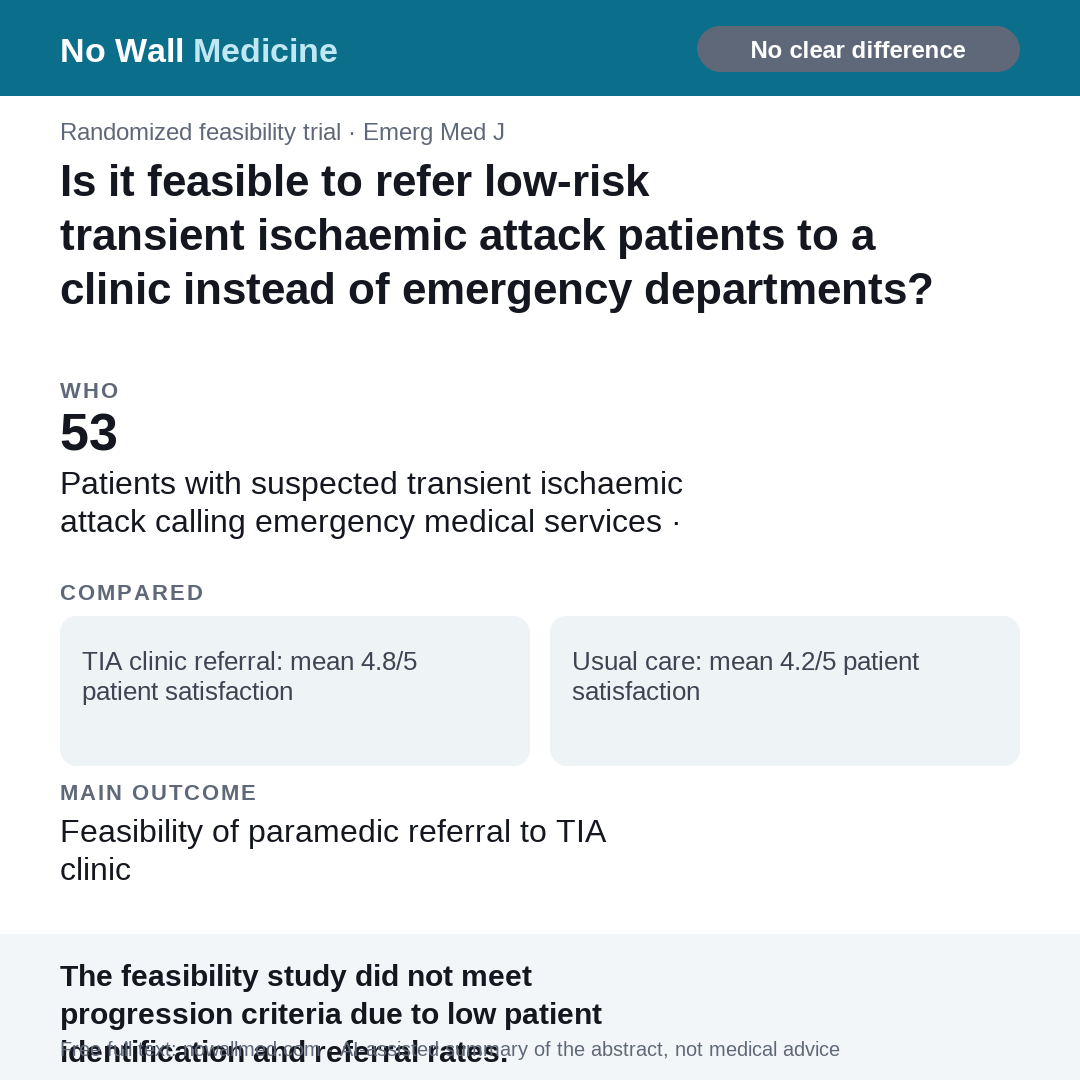
Clinical question: Is it feasible to refer low-risk transient ischaemic attack patients to a clinic instead of emergency departments?
Abstract
Background
Early assessment of patients with suspected transient ischaemic attack (TIA) is crucial to provision of effective care, including initiation of preventive therapies and identification of stroke mimics. Many patients with TIA present to emergency medical services (EMS) but may not require hospitalisation. Paramedics could identify and refer patients with low-risk TIA, without conveyance to the ED. Safety and effectiveness of this model is unknown. Aim
To assess the feasibility of undertaking a fully powered randomised controlled trial (RCT) to evaluate clinical and cost-effectiveness of paramedic referral of patients who call EMS with low-risk TIA to TIA clinic, avoiding transfer to ED. Methods
The Transient Ischaemic attack Emergency Referral (TIER) intervention was developed through a survey of UK ambulance services, a scoping review of evidence of prehospital care of TIA and convening a specialist clinical panel to agree its final form. Paramedics in South Wales, UK, were randomly allocated to trial intervention (TIA clinic referral) or control (usual care) arms, with patients' allocation determined by that of attending paramedics.Predetermined progression criteria considered: proportion of patients referred to TIA clinic, data retrieval, patient satisfaction and potential cost-effectiveness. Results
From December 2016 to September 2017, eighty-nine paramedics recruited 53 patients (36 intervention; 17 control); 48 patients (31 intervention; 17 control) consented to follow-up via routine data. Three intervention patients, of seven deemed eligible, were referred to TIA clinic by paramedics. Contraindications recorded for the other intervention arm patients were: Face/Arms/Speech/Time positive (n=13); ABCD2 score >3 (n=5); already anticoagulated (n=2); crescendo TIA (n=1); other (n=8). Routinely collected electronic health records, used to report further healthcare contacts, were obtained for all consenting patients. Patient-reported satisfaction with care was higher in the intervention arm (mean 4.8/5) than the control arm (mean 4.2/5). Health economic analysis suggests an intervention arm quality-adjusted life-year loss of 0.0094 (95% CI -0.0371, 0.0183), p=0.475. Conclusion
The TIER feasibility study did not meet its progression criteria, largely due to low patient identification and referral rates. A fully powered RCT in this setting is not recommended. Trial registration number
ISRCTN85516498.
Abstract reproduced under the article’s CC BY licence.
Topics
Cite this article
Watkins A, Jones JK, Ali K, Dewar R, Edwards A, Evans BA. Transient Ischaemic attack Emergency Referral (TIER): randomised feasibility trial results. Emerg Med J. 2024. doi:10.1136/emermed-2021-212230
Spotted a mistake? Suggest a correction
Top studies every Monday
The week’s key trials and guidelines in your specialties, by email. Free.
Get the weekly digest