Synthetic tabular data shows potential for healthcare but lacks reporting on privacy and fairness
Translation readiness of model-based synthetic tabular data in healthcare: a systematic review and governance audit
Systematic review and governance auditUnclear result
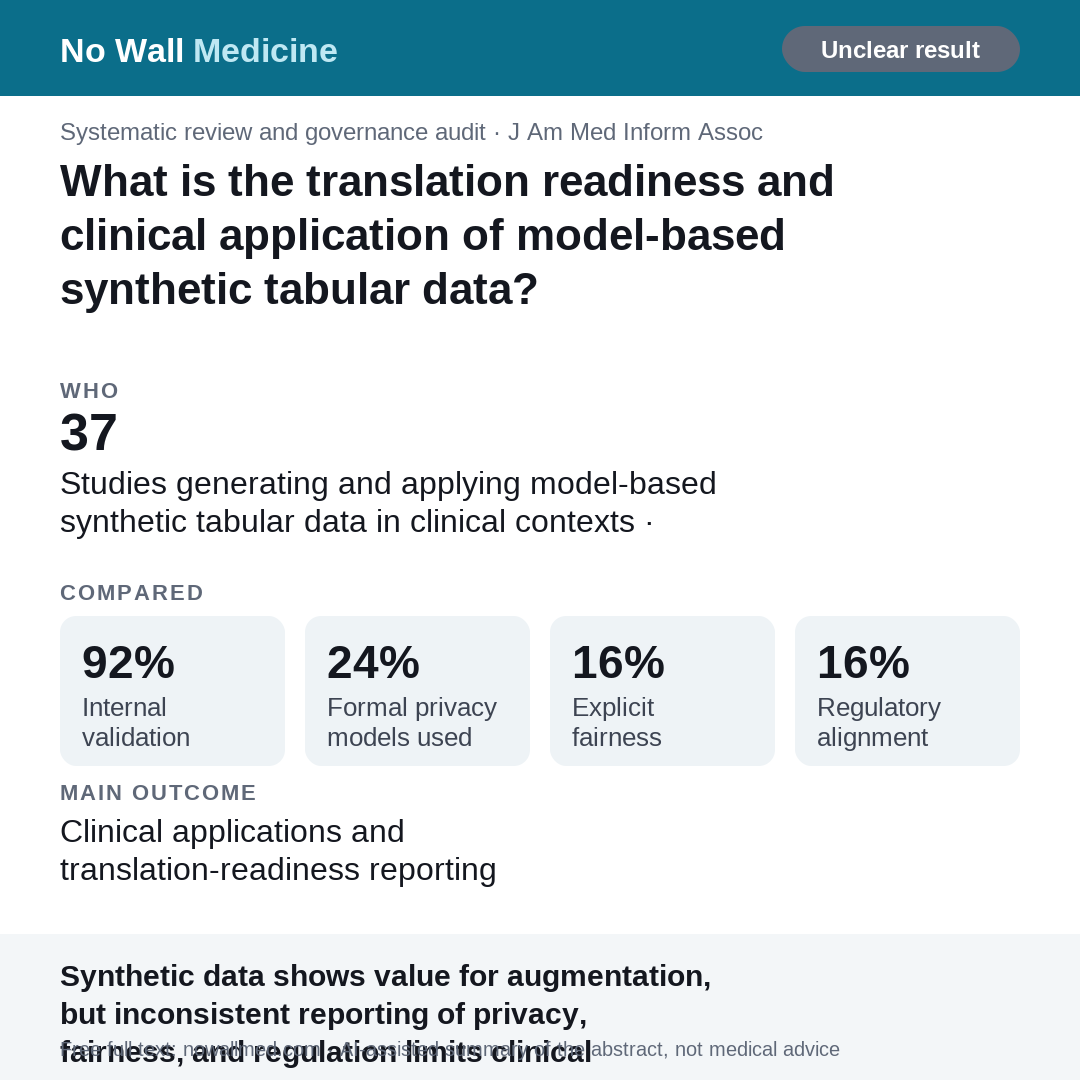
What is the translation readiness and clinical application of model-based synthetic tabular data?
Who
37
Studies generating and applying model-based synthetic tabular data in clinical contexts · Ovid MEDLINE and Embase
Compared
92%Internal validation reporting
24%Formal privacy models used
16%Explicit fairness evaluations reported
16%Regulatory alignment addressed
Main outcome
Clinical applications and translation-readiness reporting
Bottom line: Synthetic data shows value for augmentation, but inconsistent reporting of privacy, fairness, and regulation limits clinical deployment confidence.
Limitation: Inconsistent reporting of validation, privacy, fairness, and regulatory considerations.
J Am Med Inform Assoc · 2026-06-19Download image
Clinical question: What is the translation readiness and clinical application of model-based synthetic tabular data?
Why it matters: There is a gap between the development of synthetic data methods and the reporting required to ensure they are ready for clinical use.
Key points
- Researchers reviewed 37 studies from 2019 to 2025 that used model-based synthetic data, which is artificially generated data that mimics real patient information.
- While synthetic data helped improve model performance for rare outcomes, 92% of studies relied only on internal validation and only 16% reported on fairness.
- Only 24% of the reviewed studies used formal privacy models and 16% addressed how the data aligns with regulatory requirements.
Headline and key points written with AI from the paper’s abstract, with every number checked against it. Read the paper before relying on them.
Topics
Spotted a mistake? Suggest a correction