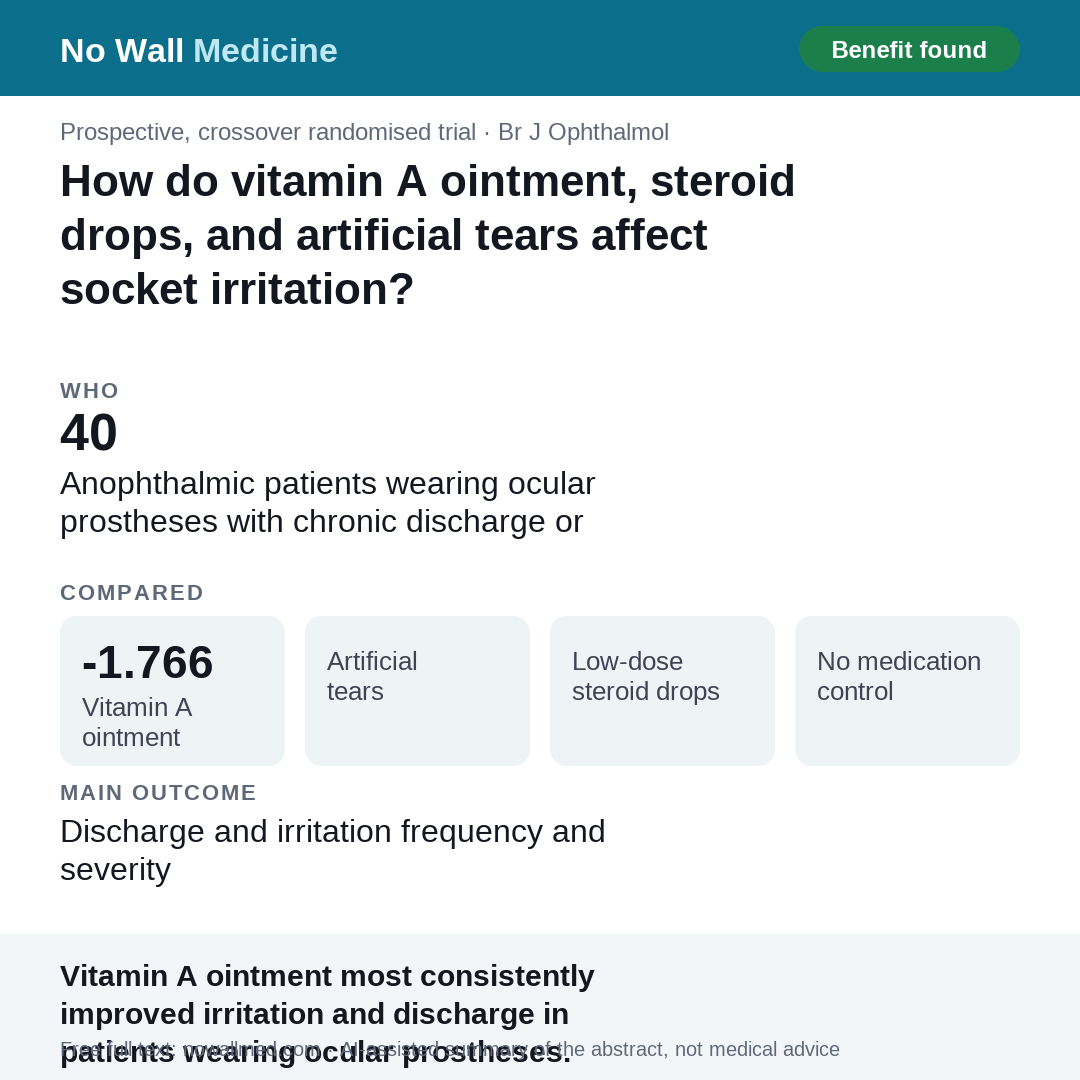
Clinical question: How do vitamin A ointment, steroid drops, and artificial tears affect socket irritation?
Why it matters: Doctors need to know which treatments are most effective for managing chronic irritation and discharge in patients wearing ocular prostheses.
Key points
The study followed 40 participants aged 16 years or older who experienced chronic discharge or discomfort while wearing ocular prostheses.
Vitamin A ointment most consistently improved all outcome parameters, including irritation frequency with a score of -1.766 (95% CI -2.857 to -0.675).
Artificial tears and low-dose steroid drops, such as fluorometholone, provided clinically relevant improvement for a subset of individual patients.
Headline and key points written with AI from the paper’s abstract, with every number checked against it. Read the paper before relying on them.
Purpose
This study evaluated the effects of artificial tears, vitamin A ointment and low-dose steroid drops on chronic irritation and discharge in anophthalmic patients wearing ocular prostheses. It also aimed to identify patient subgroups that may benefit from specific regimens. Methods
This prospective, crossover randomised trial used a Williams design with 40 ocular prostheses wearing participants aged 16 years or older who experienced chronic discharge or discomfort.Each participant underwent four 2-week intervention periods: artificial tears, vitamin A ointment, low-dose steroids (fluorometholone) and no medication as a control, separated by 2-week washout periods. Visual analogue scale questionnaires assessed discharge and irritation frequency and severity. Data were analysed using linear mixed models with Bonferroni correction for multiple comparisons and subgroup analyses were descriptive. Results
In the total group, vitamin A ointment most consistently improved all outcome parameters: irritation frequency (-1.766, 95% CI (-2.857 to -0.675), pConclusions
Vitamin A ointment demonstrated the most consistent benefit in anophthalmic patients wearing ocular prostheses, whereas artificial tears and low-dose steroid drops were associated with clinically relevant improvement in a subset of individual patients with chronic irritation and discharge.
Abstract reproduced under the article’s CC BY NC licence.