Comorbidities were not linked to changes in treatment efficacy across 120 randomized controlled trials
Treatment effect modification due to comorbidity: Individual participant data meta-analyses of 120 randomised controlled trials
Individual participant data meta-analysis of 120 trialsNo clear difference
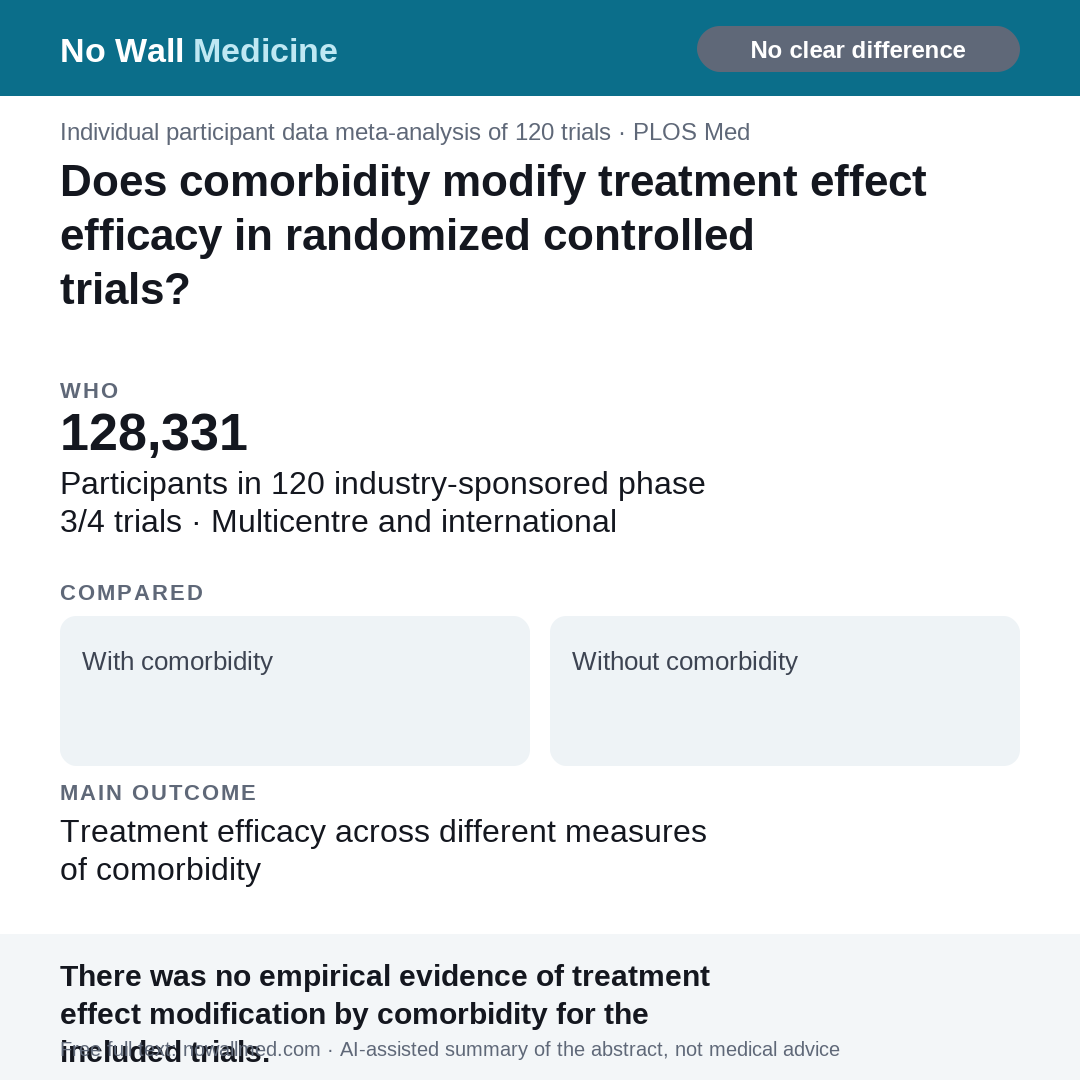
Does comorbidity modify treatment effect efficacy in randomized controlled trials?
Who
128,331
Participants in 120 industry-sponsored phase 3/4 trials · Multicentre and international
Compared
With comorbidity
Without comorbidity
Main outcome
Treatment efficacy across different measures of comorbidity
Bottom line: There was no empirical evidence of treatment effect modification by comorbidity for the included trials.
Limitation: Trials were not designed or powered to assess variation in treatment effect by comorbidity.
Funded by: Industry-sponsored
PLOS Med · 2023-06-06Download image
Clinical question: Does comorbidity modify treatment effect efficacy in randomized controlled trials?
Why it matters: It is unknown if the presence of additional medical conditions changes how well a treatment works compared to the standard assumption that efficacy is constant across subgroups.
Key points
- Researchers analyzed individual participant data from 120 industry-sponsored phase 3/4 trials involving 128,331 people across 22 index conditions.
- The meta-analysis found no evidence that treatment efficacy was modified by the number of comorbidities, specific common diseases, or continuous markers of underlying conditions.
- The percentage of participants with 3 or more comorbidities ranged from 2.3% in allergic rhinitis trials to 57% in systemic lupus erythematosus trials.
Limitation the authors note: The included trials were not designed or powered to assess variation in treatment effect by comorbidity, and relatively few participants had more than 3 comorbidities.
Headline and key points written with AI from the paper’s abstract, with every number checked against it. Read the paper before relying on them.
Was this summary helpful?
Subject terms
Cite this article
Hanlon P, Butterly EW, Shah AS, Hannigan LJ, Lewsey J, Mair FS. Treatment effect modification due to comorbidity: Individual participant data meta-analyses of 120 randomised controlled trials. PLOS Med. 2023. doi:10.1371/journal.pmed.1004176
Spotted a mistake? Suggest a correction
Top studies every Monday
The week’s key trials and guidelines in your specialties, plus any topics you follow. By email, free.
Get the weekly digest