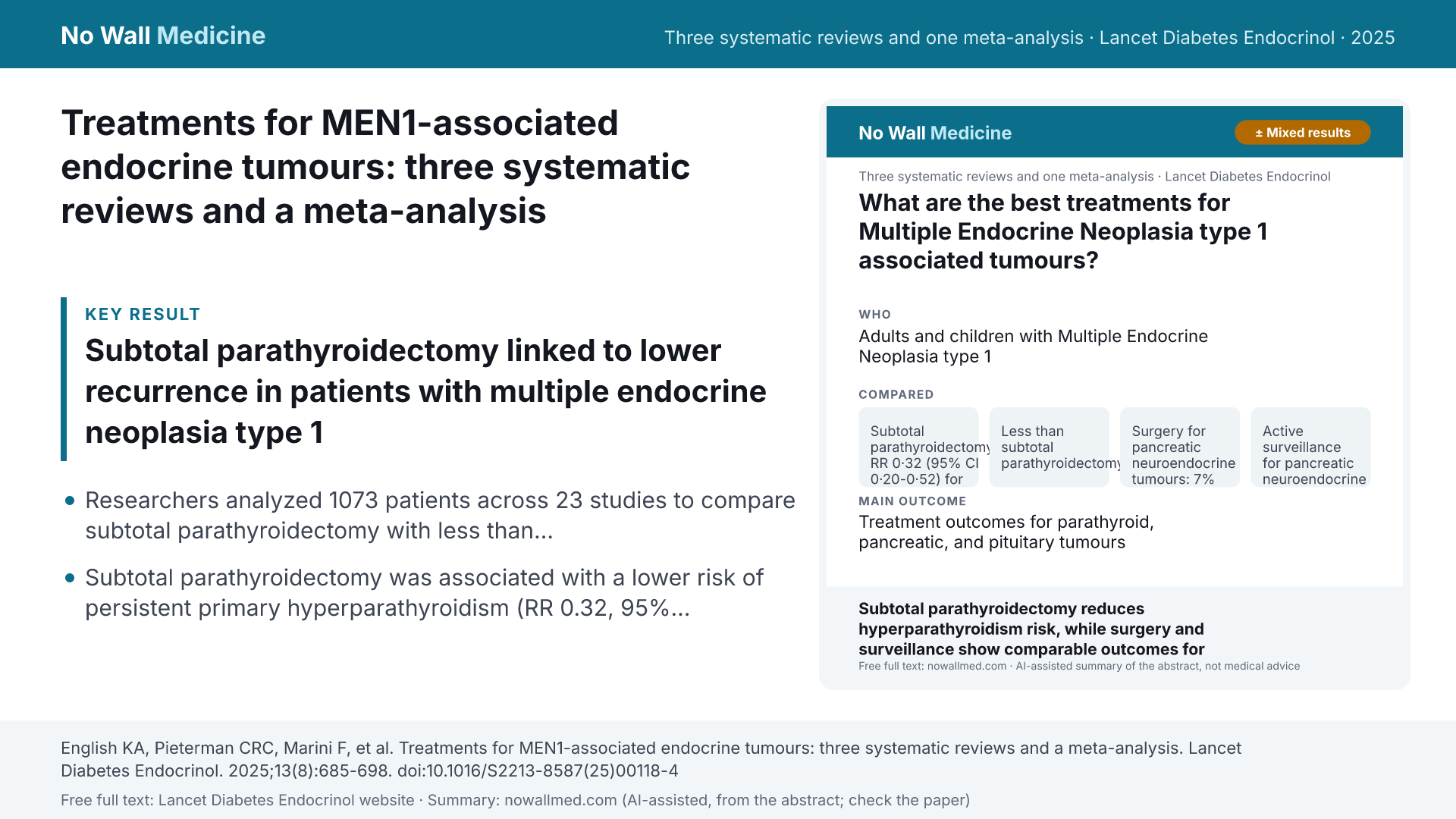
Subtotal parathyroidectomy linked to lower recurrence in patients with multiple endocrine neoplasia type 1
Treatments for MEN1-associated endocrine tumours: three systematic reviews and a meta-analysis
Three systematic reviews and one meta-analysisMixed results
What are the best treatments for Multiple Endocrine Neoplasia type 1 associated tumours?
Who
Adults and children with Multiple Endocrine Neoplasia type 1
Compared
Subtotal parathyroidectomy: RR 0·32 (95% CI 0·20-0·52) for persistent hyperparathyroidism
Less than subtotal parathyroidectomy
Surgery for pancreatic neuroendocrine tumours: 7% (2/27) to 20% (3/15) mortality/metastatic disease
Active surveillance for pancreatic neuroendocrine tumours: 3% (1/33) to 8% (4/50) mortality/metastatic disease
Main outcome
Treatment outcomes for parathyroid, pancreatic, and pituitary tumours
Bottom line: Subtotal parathyroidectomy reduces hyperparathyroidism risk, while surgery and surveillance show comparable outcomes for small pancreatic neuroendocrine tumours.
Lancet Diabetes Endocrinol · 2025-06-13Download image
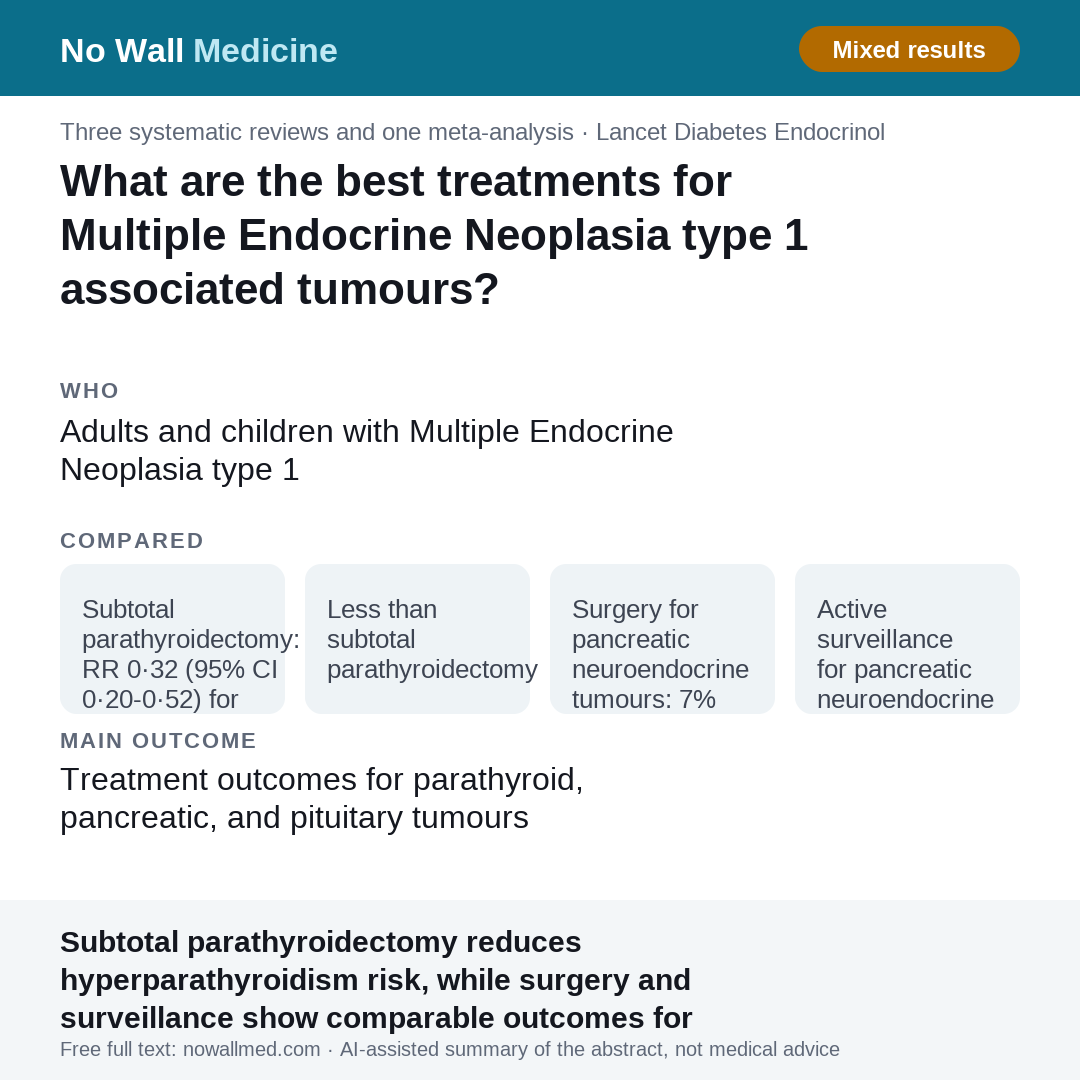
Clinical question: What are the best treatments for Multiple Endocrine Neoplasia type 1 associated tumours?
Why it matters: Current treatment decisions for multiple endocrine neoplasia type 1 are based on very low-quality evidence regarding parathyroid, pancreatic, and pituitary tumours.
Key points
- Researchers analyzed 1073 patients across 23 studies to compare subtotal parathyroidectomy with less than subtotal parathyroidectomy for primary hyperparathyroidism.
- Subtotal parathyroidectomy was associated with a lower risk of persistent primary hyperparathyroidism (RR 0.32, 95% CI 0.20-0.52) and recurrent disease (RR 0.78, 0.62-0.97).
- Subtotal parathyroidectomy was associated with a higher risk of post-operative hypoparathyroidism (RR 2.64, 1.63-4.29) compared to less than subtotal surgery.
Limitation the authors note: The GRADE certainty scores for all findings were low or very low.
Headline and key points written with AI from the paper’s abstract, with every number checked against it. Read the paper before relying on them.
Was this summary helpful?
Abstract
Background
Multiple endocrine neoplasia type 1 (MEN1) is a rare hereditary disorder characterised by the combined occurrence of parathyroid, pancreatic, and pituitary tumours. Current treatments are based on very low-quality evidence. Our aims were to determine treatment outcomes in patients with MEN1 for: subtotal parathyroidectomy versus less than subtotal parathyroidectomy for primary hyperparathyroidism (Q1); surgery versus active surveillance for non-functioning pancreatic neuroendocrine tumours sized 2 cm or less (Q2); and dopamine agonist responses of prolactinomas in patients with MEN1 versus patients without MEN1 (Q3). Methods
We conducted three systematic reviews and one meta-analysis. Four electronic databases (MEDLINE Ovid, Embase Ovid, The Cochrane Library, and Web of Science) were searched from Dec 1, 2001, to Feb 13, 2023, with no language restrictions. Study designs included randomised controlled trials, prospective and retrospective cohort studies, and case-controlled and case series. Adults and children with MEN1-associated tumours were included in all three systematic reviews. For each clinical question, three pairs of authors independently screened abstracts and assessed the full text for final inclusion, discordant views were resolved by senior authors. Dichotomous outcomes were calculated using risk ratios or hazard ratios for time-to-event analyses, with 95% CIs. Continuous outcomes were ascertained using mean difference with 95% CIs. Where feasible, outcomes from individual studies were analysed through meta-analysis, using a random-effects model. The systematic reviews were prospectively registered (PROSPERO reference numbers CRD42023409912, CRD42023409936, and CRD42023409949). Findings
For primary hyperparathyroidism (Q1), 990 non-duplicate records were screened for title and abstract, of which 23 studies with 1073 patients were eligible for meta-analysis. These studies showed that subtotal parathyroidectomy had a significantly lower risk of persistent primary hyperparathyroidism (RR 0·32, 95% CI 0·20-0·52; I2=0%) and recurrent primary hyperparathyroidism (RR 0·78, 0·62-0·97; I2=27%), when compared with less than subtotal parathyroidectomy, although the risk of post-operative hypoparathyroidism was higher (RR 2·64, 1·63-4·29; I2=0%). For non-functioning pancreatic neuroendocrine tumours sized 2 cm and less (Q2), 1583 non-duplicate records were screened for title and abstract, of which three cohort studies were eligible for analysis. These studies showed that combined metastatic disease and mortality rates were comparable between patients in the surgery group (two [7%] of 27 to three [20%] of 15) and patients in the active surveillance group (one [3%] of 33 to four [8%] of 50]). For prolactinomas (Q3), 475 non-duplicate records were screened for title and abstract, of which ten studies with 505 patients were eligible for analysis. These studies showed that dopamine agonist treatment failure rates to normalise serum prolactin were similar between patients with MEN1 (zero of one to one [33%] of three) and patients without MEN1 (four [6%] of 68 to nine (82%) of 11), n=23 studies). GRADE certainty scores for all were low or very low. Interpretation
In patients with MEN1, subtotal parathyroidectomy achieved greater reductions in persistence and recurrence of primary hyperparathyroidism than less than subtotal parathyroidectomy; for non-functioning pancreatic neuroendocrine tumours sized 2 cm or less, the few available studies suggest that active surveillance might be comparable to surgical resection; and for prolactinomas, dopamine agonist therapy appears to have comparable efficacy as in patients without MEN1. Funding
None.
Abstract reproduced under the article’s CC BY licence.
Subject terms
Cite this article
English KA, Pieterman CRC, Marini F, Lines KE, Cuny T, Saulle R. Treatments for MEN1-associated endocrine tumours: three systematic reviews and a meta-analysis. Lancet Diabetes Endocrinol. 2025. doi:10.1016/S2213-8587(25)00118-4
Spotted a mistake? Suggest a correction
Top studies every Monday
The week’s key trials and guidelines in your specialties, plus any topics you follow. By email, free.
Get the weekly digest