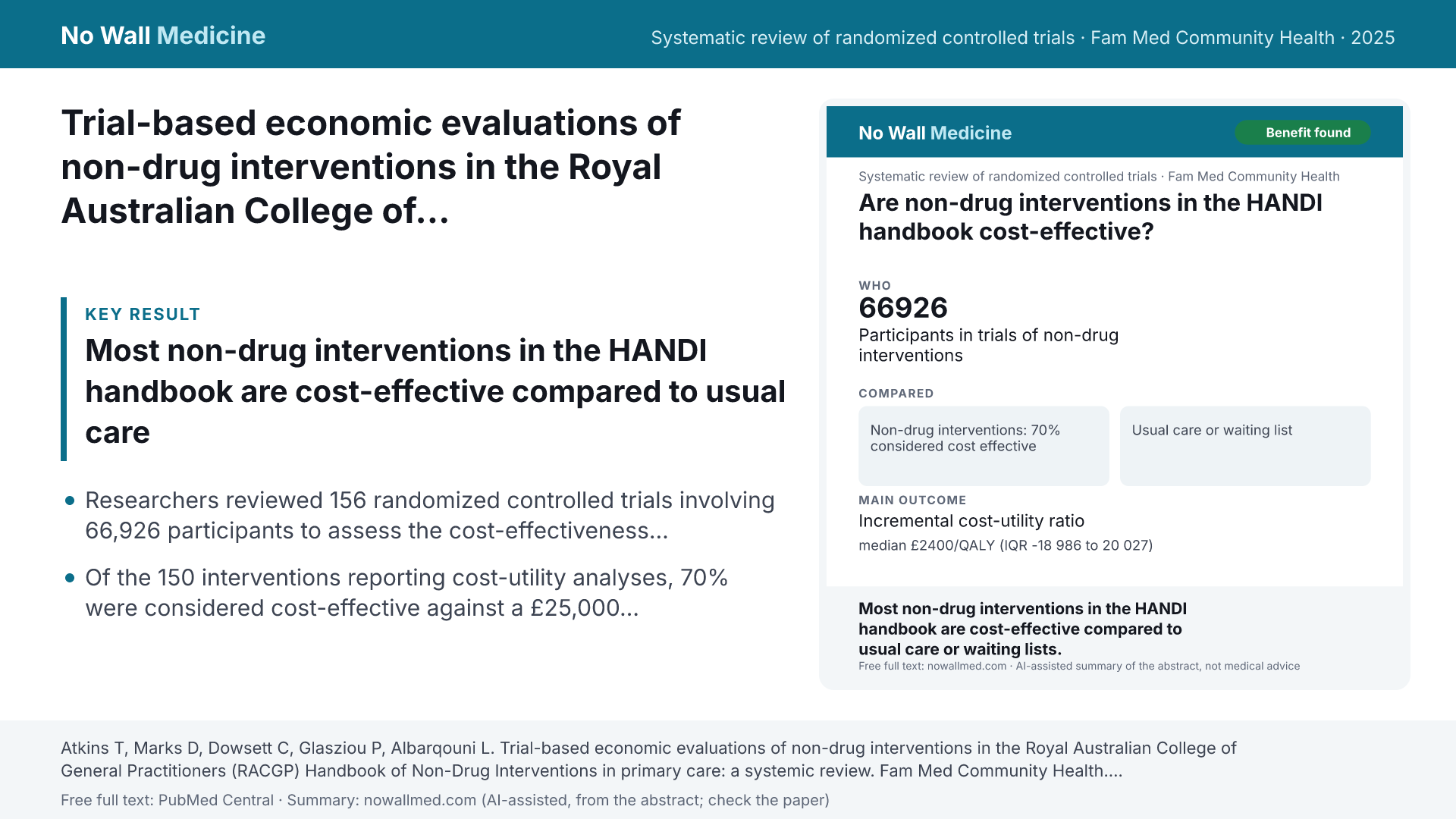
Most non-drug interventions in the HANDI handbook are cost-effective compared to usual care
Trial-based economic evaluations of non-drug interventions in the Royal Australian College of General Practitioners (RACGP) Handbook of Non-Drug Interventions in primary care: a systemic review
Systematic review of randomized controlled trialsBenefit found
Are non-drug interventions in the HANDI handbook cost-effective?
Who
66926
Participants in trials of non-drug interventions
Compared
Non-drug interventions: 70% considered cost effective
Usual care or waiting list
Main outcome
Incremental cost-utility ratio
Result: median £2400/QALY (IQR -18 986 to 20 027)
Bottom line: Most non-drug interventions in the HANDI handbook are cost-effective compared to usual care or waiting lists.
Fam Med Community Health · 2025-08-31 · Save PNG
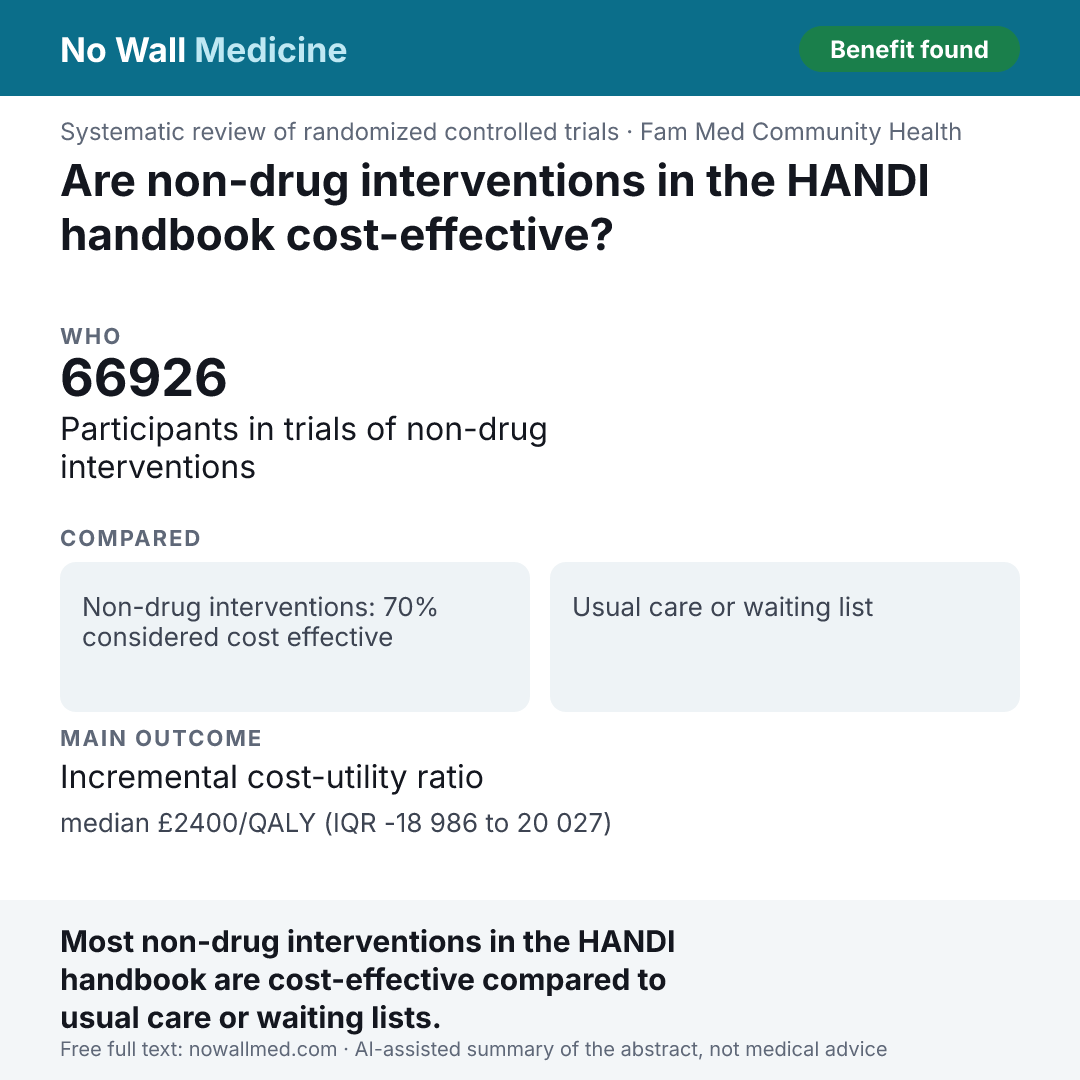
Clinical question: Are non-drug interventions in the HANDI handbook cost-effective?
Key points
- Researchers reviewed 156 randomized controlled trials involving 66,926 participants to assess the cost-effectiveness of non-drug interventions recommended in the HANDI handbook.
- Of the 150 interventions reporting cost-utility analyses, 70% were considered cost-effective against a £25,000 per quality-adjusted life-year willingness to pay threshold.
- The interventions studied were most frequently for mental health conditions (54.0%) and musculoskeletal conditions (29.3%).
Headline and key points written with AI from the paper’s abstract, with every number checked against it. Read the paper before relying on them.
Was this summary helpful?
Abstract
Objective
This systematic review assessed trial-based economic evaluations to provide empirical evidence on the cost-effectiveness of non-drug interventions (NDIs) that are currently recommended within the Royal Australian College of General Practitioners Handbook of Non-Drug Interventions (HANDI). Methods
Medline, CINAHL and PsycINFO along with clinical trial registries (clinicaltrials.gov and WHO International Clinical Trials Registry Platform) were searched from inception to 1 July 2025. Randomised controlled trials (RCTs) that reported cost effectiveness for a prescribed non-drug intervention (NDI) from HANDI were included in the study. The primary outcome was the incremental cost-utility ratio (ICUR) derived from cost-utility analyses (CUAs). Results
A total of 11 187 citations were identified, from which 156 RCTs were included. These RCTs enrolled a total of 66 926 participants (median=214, IQR 139-342), with a median follow-up duration of 12 months (IQR 6-12 months). Over half of the CUA NDIs were for mental health conditions (n=81; 54.0%), one-third were for were for musculoskeletal conditions (n=44; 29.3%), while only 16.0% (n=24) were for those with cardiovascular/metabolic conditions. Out of the 150 NDIs that reported CUAs, 40% were deemed to be in the south-east (SE) quadrant (cheaper and more effective) and 49.3% fell in the north-east (NE) quadrant (more costly but more effective), with 70% considered cost effective against a £25 000/quality-adjusted life-year (QALY) willingness to pay threshold. The overall median ICUR was £2400/QALY (IQR -18 986 to 20 027). Conclusions
Most of the HANDI NDIs that were included within this systematic review are cost-effective compared with a variety of alternatives including usual care or waiting list controls. HANDI NDIs warrant use as a first line of treatment when clinically appropriate.
Abstract reproduced under the article’s CC BY licence.
Subject terms
Headline, design, result, key points, caveat and citation as plain text.
Cite this article
Atkins T, Marks D, Dowsett C, Glasziou P, Albarqouni L. Trial-based economic evaluations of non-drug interventions in the Royal Australian College of General Practitioners (RACGP) Handbook of Non-Drug Interventions in primary care: a systemic review. Fam Med Community Health. 2025;13(3). doi:10.1136/fmch-2025-003312
Spotted a mistake? Suggest a correction