Relationship with clinical staff and information availability drive participation in neurodegenerative disease trials
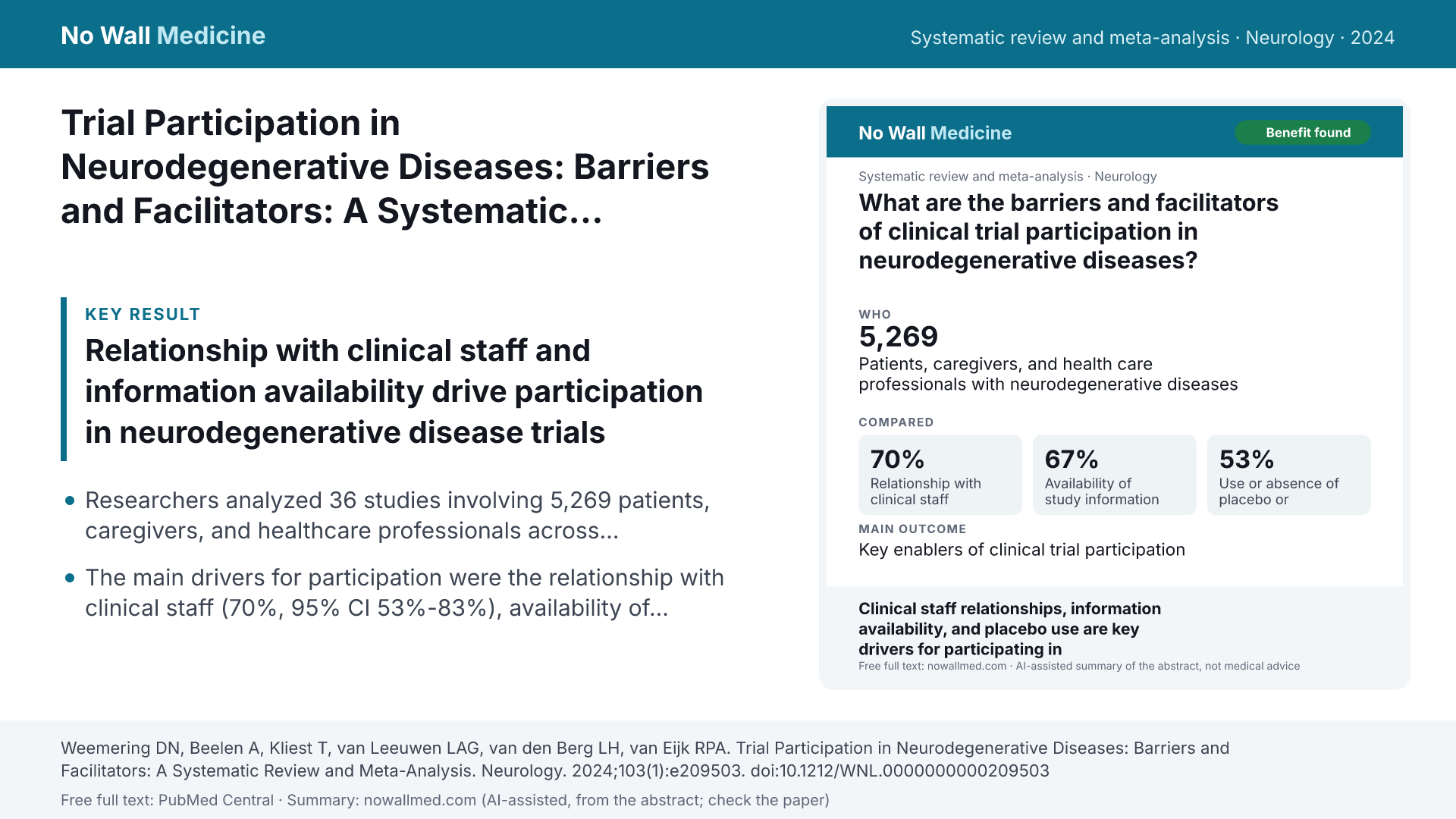
Trial Participation in Neurodegenerative Diseases: Barriers and Facilitators: A Systematic Review and Meta-Analysis
Systematic review and meta-analysisBenefit found
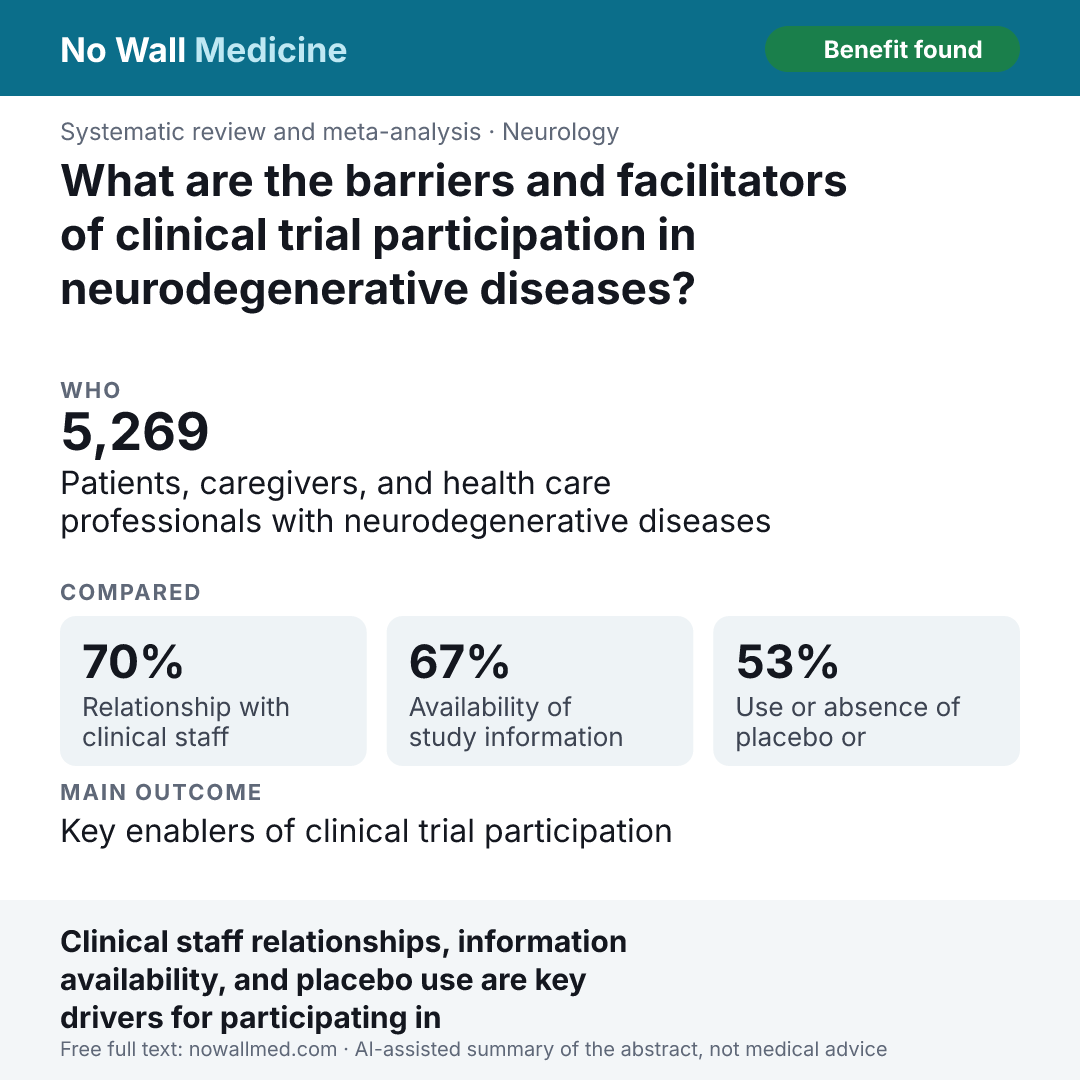
What are the barriers and facilitators of clinical trial participation in neurodegenerative diseases?
Who
5,269
Patients, caregivers, and health care professionals with neurodegenerative diseases
Compared
70%Relationship with clinical staff (95% CI 53%-83%)
67%Availability of study information (95% CI 38%-87%)
53%Use or absence of placebo or sham-control arm (95% CI 32%-72%)
Main outcome
Key enablers of clinical trial participation
Bottom line: Clinical staff relationships, information availability, and placebo use are key drivers for participating in neurodegenerative disease trials.
Limitation: There was significant heterogeneity between studies (all p < 0.001).
Neurology · 2024-06-03 · Save PNG
Clinical question: What are the barriers and facilitators of clinical trial participation in neurodegenerative diseases?
Why it matters: Selective enrollment and under-representation of certain populations in neurodegenerative disease trials can delay drug development and limit how well results apply to the general public.
Key points
- Researchers analyzed 36 studies involving 5,269 patients, caregivers, and healthcare professionals across four neurodegenerative diseases.
- The main drivers for participation were the relationship with clinical staff (70%, 95% CI 53%-83%), availability of study information (67%, 95% CI 38%-87%), and the use of a placebo or sham-control arm (53%, 95% CI 32%-72%).
- The meta-analysis showed significant heterogeneity between the included studies (all p < 0.001).
Limitation the authors note: significant heterogeneity between studies
Headline and key points written with AI from the paper’s abstract, with every number checked against it. Read the paper before relying on them.
Was this summary helpful?
Subject terms
Headline, design, result, key points, caveat and citation as plain text.
Cite this article
Weemering DN, Beelen A, Kliest T, van Leeuwen LAG, van den Berg LH, van Eijk RPA. Trial Participation in Neurodegenerative Diseases: Barriers and Facilitators: A Systematic Review and Meta-Analysis. Neurology. 2024;103(1):e209503. doi:10.1212/WNL.0000000000209503
Spotted a mistake? Suggest a correction