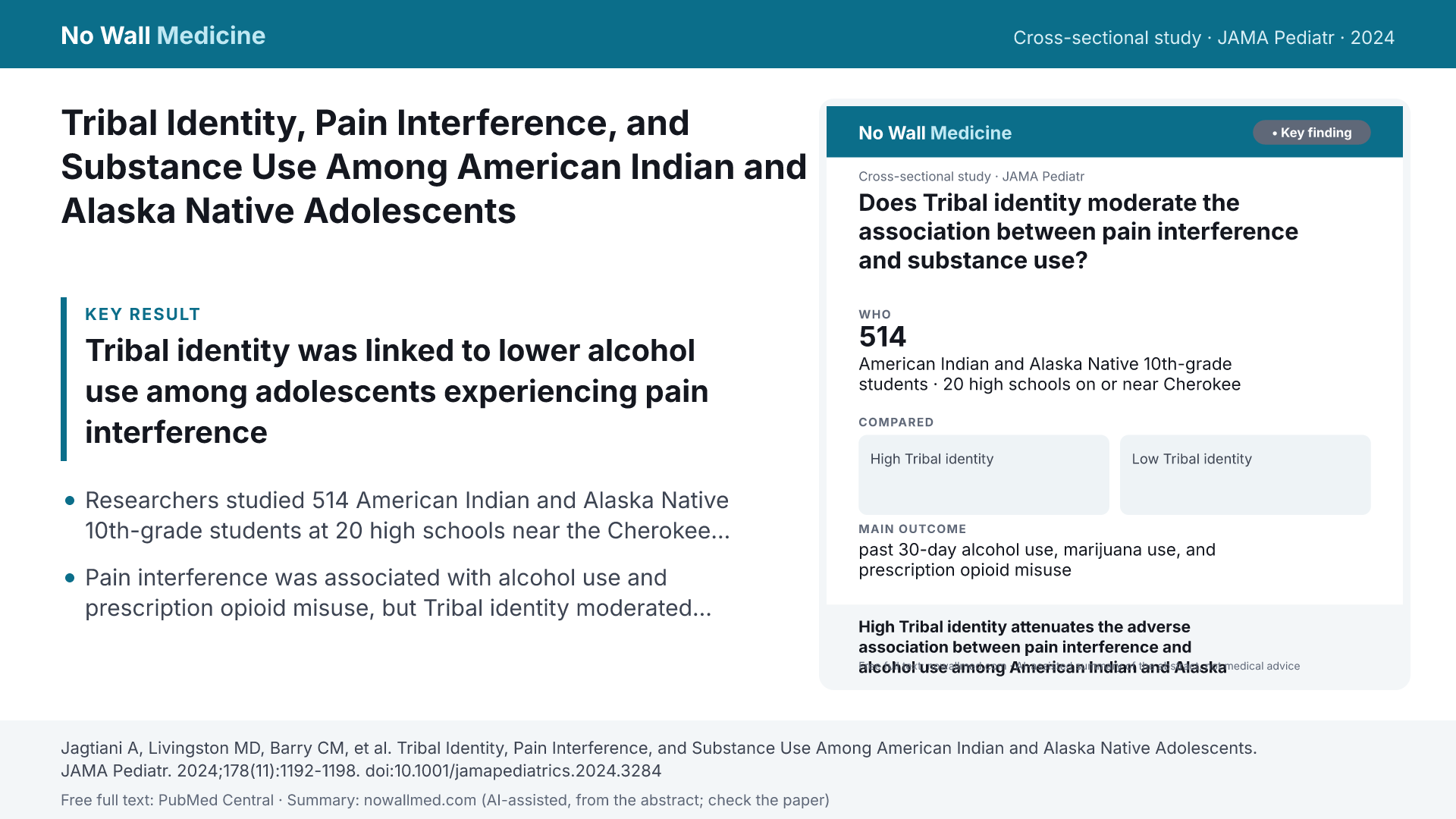
Tribal Identity, Pain Interference, and Substance Use Among American Indian and Alaska Native Adolescents
Key result: Tribal identity was linked to lower alcohol use among adolescents experiencing pain interference
Cross-sectional studyKey finding
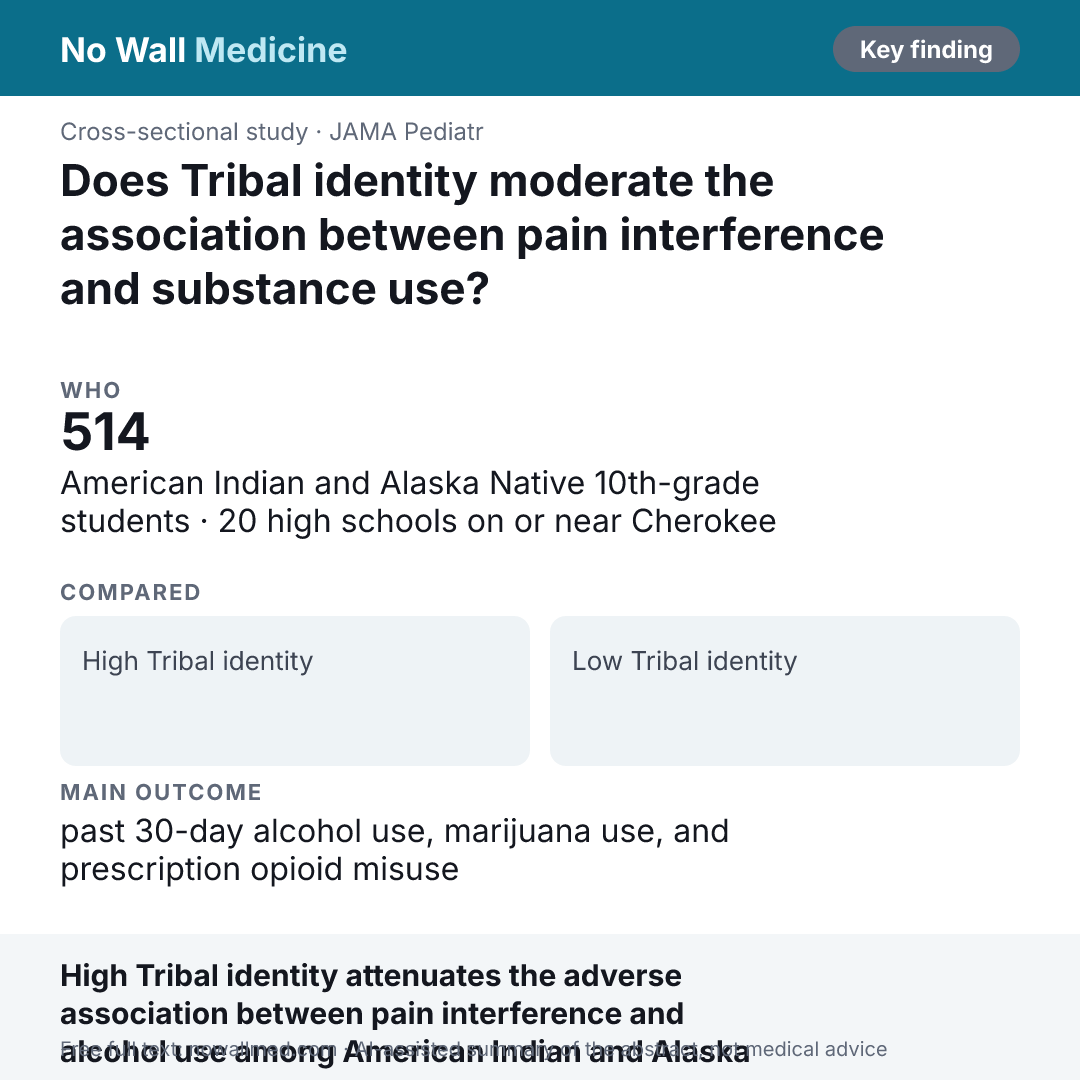
Does Tribal identity moderate the association between pain interference and substance use?
Who
514
American Indian and Alaska Native 10th-grade students · 20 high schools on or near Cherokee Nation Reservation
Compared
High Tribal identity
Low Tribal identity
Main outcome
past 30-day alcohol use, marijuana use, and prescription opioid misuse
Result: coefficient, -0.13 (95% CI, -0.23 to -0.02)
Bottom line: High Tribal identity attenuates the adverse association between pain interference and alcohol use among American Indian and Alaska Native adolescents.
JAMA Pediatr · 2024-09-23 · Save PNG
Key points
- Researchers studied 514 American Indian and Alaska Native 10th-grade students at 20 high schools near the Cherokee Nation Reservation.
- Pain interference was associated with alcohol use and prescription opioid misuse, but Tribal identity moderated the link to alcohol use.
- High Tribal identity was associated with a reduced link between pain interference and alcohol use (coefficient, -0.13; 95% CI, -0.23 to -0.02).
Limitation the authors note: This cross-sectional study used baseline data from a cluster randomized trial.
Discussion prompts
- Would these patients look like yours? Who was left out?
- Is the main outcome one that matters to patients?
- Is the difference large enough to change what you do?
Cite: Jagtiani A, Livingston MD, Barry CM, et al. Tribal Identity, Pain Interference, and Substance Use Among American Indian and Alaska Native Adolescents. JAMA Pediatr. 2024;178(11):1192-1198. doi:10.1001/jamapediatrics.2024.3284
Free full text: PubMed Central · Summary and visual abstract: nowallmed.com/a/tribal-identity-pain-interference-and-substance-use-among-american-pqyevx/ (AI-assisted from the abstract; check the paper before relying on it).