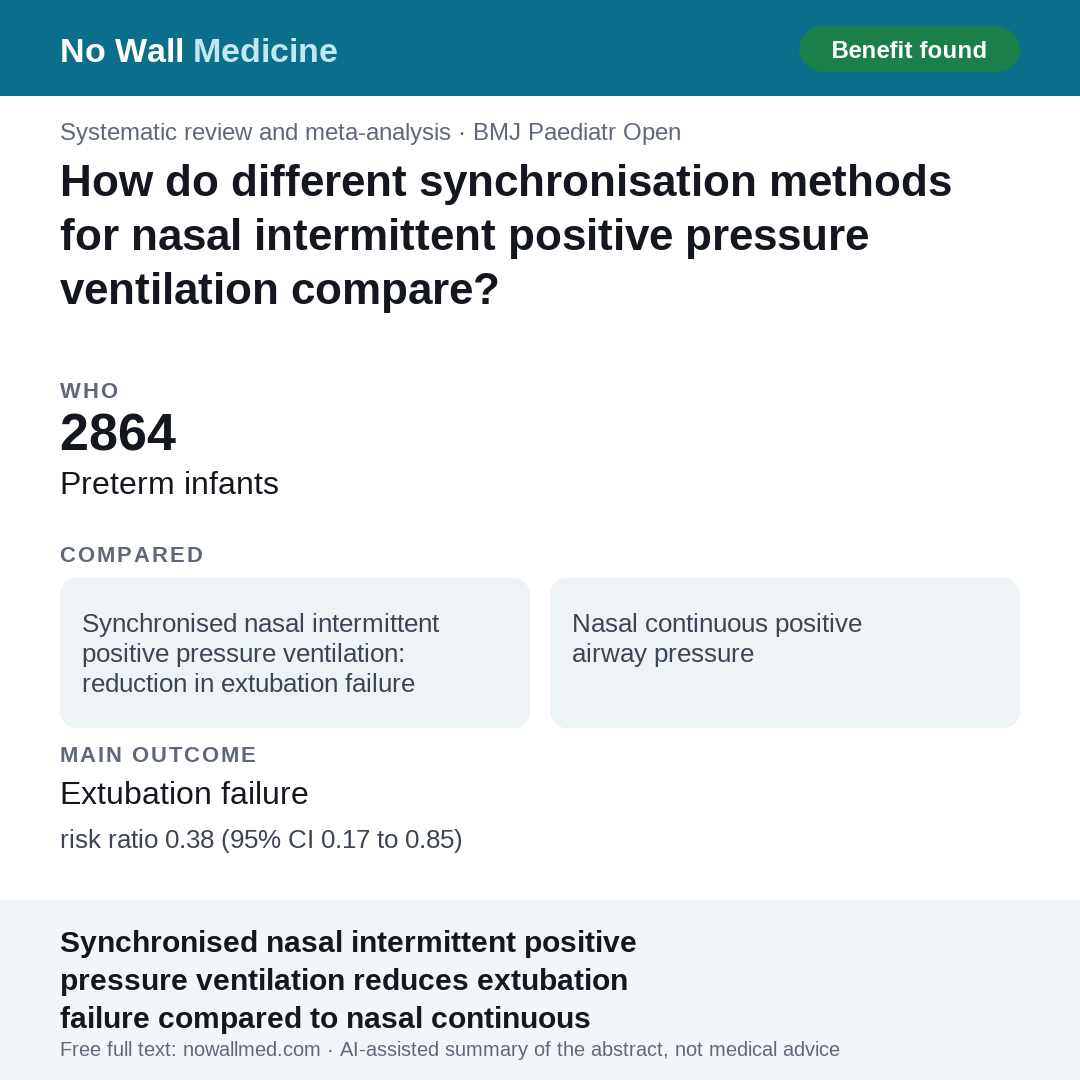
Clinical question: How do different synchronisation methods for nasal intermittent positive pressure ventilation compare?
Why it matters: No comprehensive review existed to compare different synchronization methods for non-invasive respiratory support in preterm infants.
Key points
Researchers analyzed 49 studies involving 2864 preterm infants to compare different methods of non-invasive respiratory support.
Synchronized nasal intermittent positive pressure ventilation reduced extubation failure risk compared to nasal continuous positive airway pressure with a risk ratio of 0.38.
Neurally adjusted ventilatory assist showed a higher synchronization rate of 80%-99% and a shorter trigger delay of 35 ms compared to other modes.
Limitation the authors note: Evidence on positive effects on long-term major clinical outcomes remains limited.
Headline and key points written with AI from the paper’s abstract, with every number checked against it. Read the paper before relying on them.
Background
Increasing evidence suggests that synchronised nasal intermittent positive pressure ventilation (sNIPPV) may be the optimal mode of non-invasive respiratory support. However, no comprehensive review of sNIPPV modes is available. This review aims to describe different synchronisation methods for sNIPPV and compare their effectiveness in clinical, physiological and technical outcomes with other modes of non-invasive respiratory support. Methods
This review identified all clinical studies in preterm infants that compared sNIPPV to other non-invasive respiratory support modes or compared different trigger modalities between 1990 and 2026. A search was carried out in MEDLINE, Embase and the Cochrane Library. Main outcomes were categorised as clinical (eg, extubation failure (EF)), physiological (eg, breathing effort) and technical (eg, synchronisation rate). Results
49 studies (2864 infants) were included, with a low to moderate risk of bias. Meta-analysis showed a reduction in EF (risk ratio=0.38; 95% CI 0.17 to 0.85; p=0.03) in favour of sNIPPV compared with nasal continuous positive airway pressure (nCPAP). Physiological outcomes were significantly improved during sNIPPV compared with nCPAP and nasal intermittent positive pressure ventilation (NIPPV), especially breathing effort. When reviewing technical outcomes, non-invasive neurally adjusted ventilatory assist showed lower patient-ventilator asynchrony (PVA) (index ranging from 7% to 50%), a higher synchronisation rate (80%-99%) and a shorter trigger delay (35 ms) compared with other sNIPPV modes. Conclusions
This review shows that synchronising NIPPV results in consistent physiological (reduced patient effort) and technical benefits (reduced PVA). However, evidence on positive effects on (long-term) major clinical outcomes remains limited and requires further studies. Prospero registration number
CRD420251022479.
Abstract reproduced under the article’s CC BY NC licence.
Exploring outcomes and insights from joint agency response investigations for children with learning disabilities who die unexpectedly: an observational study
Prevalence, clinical characteristics and management of female genital mutilation in paediatric and adolescent patients: a retrospective cohort analysis from a clinic in Vienna, Austria
Evolution of the clinical profile and cardiac outcomes of multisystem inflammatory syndrome in children (MIS-C) across three COVID-19 waves in Central Kerala: a cross-sectional study