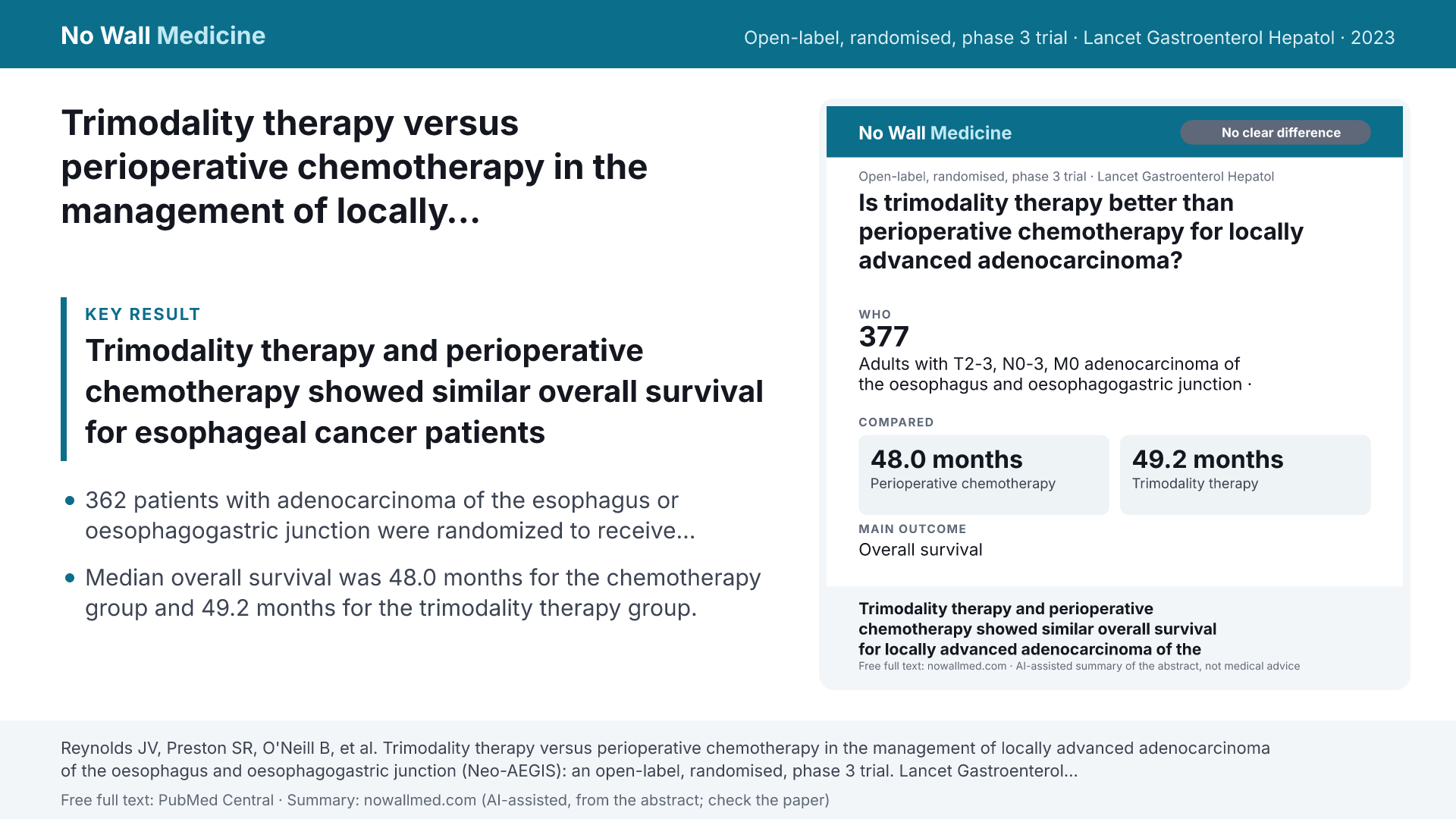
Trimodality therapy and perioperative chemotherapy showed similar overall survival for esophageal cancer patients
Trimodality therapy versus perioperative chemotherapy in the management of locally advanced adenocarcinoma of the oesophagus and oesophagogastric junction (Neo-AEGIS): an open-label, randomised, phase 3 trial
Open-label, randomised, phase 3 trialNo clear difference
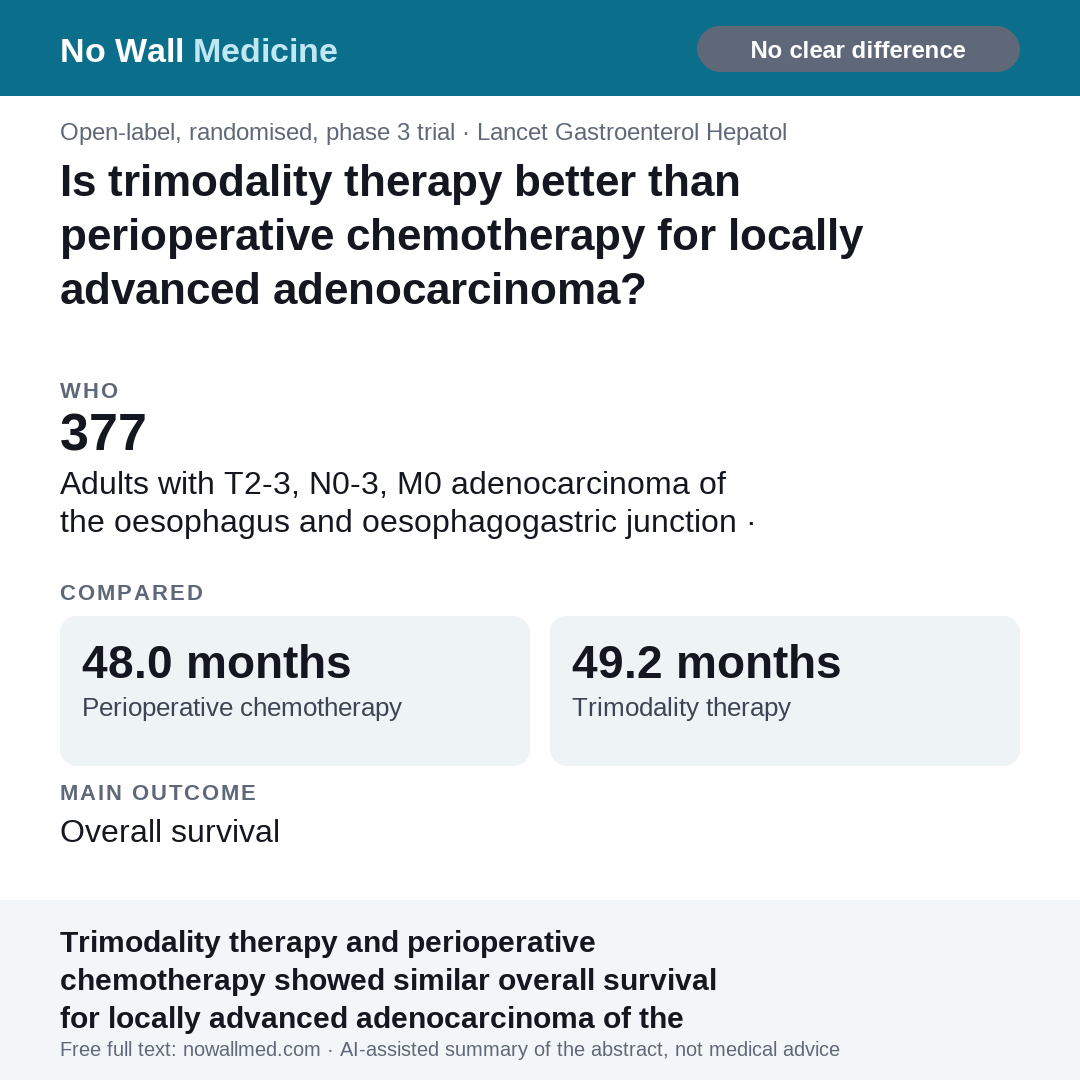
Is trimodality therapy better than perioperative chemotherapy for locally advanced adenocarcinoma?
Who
377
Adults with T2-3, N0-3, M0 adenocarcinoma of the oesophagus and oesophagogastric junction · 24 centres in Europe
Compared
48.0 monthsPerioperative chemotherapy
49.2 monthsTrimodality therapy
Main outcome
Overall survival
Result: hazard ratio 1.03 (95% CI 0.77 to 1.38)
Bottom line: Trimodality therapy and perioperative chemotherapy showed similar overall survival for locally advanced adenocarcinoma of the oesophagus and oesophagogastric junction.
Lancet Gastroenterol Hepatol · 2023-09-18Download image
Clinical question: Is trimodality therapy better than perioperative chemotherapy for locally advanced adenocarcinoma?
Why it matters: The optimum curative approach for adenocarcinoma of the esophagus and oesophagogastric junction is unknown.
Key points
- 362 patients with adenocarcinoma of the esophagus or oesophagogastric junction were randomized to receive either trimodality therapy or perioperative chemotherapy.
- Median overall survival was 48.0 months for the chemotherapy group and 49.2 months for the trimodality therapy group.
- Trimodality therapy was associated with higher rates of pathological complete response and major pathological response compared to chemotherapy.
Headline and key points written with AI from the paper’s abstract, with every number checked against it. Read the paper before relying on them.
Was this summary helpful?
Abstract
Background
The optimum curative approach to adenocarcinoma of the oesophagus and oesophagogastric junction is unknown. We aimed to compare trimodality therapy (preoperative radiotherapy with carboplatin plus paclitaxel [CROSS regimen]) with optimum contemporaneous perioperative chemotherapy regimens (epirubicin plus cisplatin or oxaliplatin plus fluorouracil or capecitabine [a modified MAGIC regimen] before 2018 and fluorouracil, leucovorin, oxaliplatin, and docetaxel [FLOT] subsequently). Methods
Neo-AEGIS (CTRIAL-IE 10-14) was an open-label, randomised, phase 3 trial done at 24 centres in Europe. Patients aged 18 years or older with clinical tumour stage T2-3, nodal stage N0-3, and M0 adenocarcinoma of the oesophagus and oesophagogastric junction were randomly assigned to perioperative chemotherapy (three preoperative and three postoperative 3-week cycles of intravenous 50 mg/m2 epirubicin on day 1 plus intravenous 60 mg/m2 cisplatin or intravenous 130 mg/m2 oxaliplatin on day 1 plus continuous infusion of 200 mg/m2 fluorouracil daily or oral 625 mg/m2 capecitabine twice daily up to 2018, with four preoperative and four postoperative 2-week cycles of 2600 mg/m2 fluorouracil, 85 mg/m2 oxaliplatin, 200 mg/m2 leucovorin, and 50 mg/m2 docetaxel intravenously on day 1 as an option from 2018) or trimodality therapy (41·4 Gy in 23 fractions on days 1-5, 8-12, 15-19, 22-26, and 29-31 with intravenous area under the curve 2 mg/mL per min carboplatin plus intravenous 50 mg/m2 paclitaxel on days 1, 8, 15, 22, and 29). The primary endpoint was overall survival, assessed in all randomly assigned patients who received at least one dose of study drug, regardless of which study drug they received, by intention to treat. Secondary endpoints were disease-free survival, site of treatment failure, operative complications, toxicity, pathological response (complete [ypT0N0] and major [tumour regression grade 1 and 2]), margin-free resection (R0), and health-related quality of life. Toxicity and safety data were analysed in the safety population, defined as patients who took at least one dose of study drug, according to treatment actually received. The initial power calculation was based on superiority of trimodality therapy (n=366 patients); it was adjusted after FLOT became an option to a non-inferiority design with a margin of 5% for perioperative chemotherapy (n=540). This study is registered with ClinicalTrials.gov, NCT01726452. Findings
Between Jan 24, 2013, and Dec 23, 2020, 377 patients were randomly assigned, of whom 362 were included in the intention-to treat population (327 [90%] male and 360 [99%] White): 184 in the perioperative chemotherapy group and 178 in the trimodality therapy group. The trial closed prematurely in December, 2020, after the second interim futility analysis (143 deaths), on the basis of similar survival metrics and the impact of the COVID-19 pandemic. At a median follow-up of 38·8 months (IQR 16·3-55·1), median overall survival was 48·0 months (95% CI 33·6-64·8) in the perioperative chemotherapy group and 49·2 months (34·8-74·4) in the trimodality therapy group (3-year overall survival 55% [95% CI 47-62] vs 57% [49-64]; hazard ratio 1·03 [95% CI 0·77-1·38]; log-rank p=0·82). Median disease-free survival was 32·4 months (95% CI 22·8-64·8) in the perioperative chemotherapy group and 24·0 months (18·0-40·8) in the trimodality therapy group [hazard ratio 0·89 [95% CI 0·68-1·17]; log-rank p=0·41). The pattern of recurrence, locoregional or systemic, was not significantly different (odds ratio 1·35 [95% CI 0·63-2·91], p=0·44). Pathological complete response (odds ratio 0·33 [95% CI 0·14-0·81], p=0·012), major pathological response (0·21 [0·12-0·38], p<0·0001), and R0 rates (0·21 [0·08-0·53], p=0·0003) favoured trimodality therapy. The most common grade 3-4 adverse event was neutropenia (49 [27%] of 183 patients in the perioperative chemotherapy group vs 11 [6%] of 178 patients in the trimodality therapy group), followed by diarrhoea (20 [11%] vs none), and pulmonary embolism (ten [5%] vs nine [5%]). One (1%) patient in the perioperative chemotherapy group and three (2%) patients in the trimodality therapy group died from serious adverse events, two (one in each group) of which were possibly related to treatment. No differences were seen in operative mortality (five [3%] deaths in the perioperative chemotherapy group vs four [2%] in the trimodality therapy group), major morbidity, or in global health status at 1 and 3 years. Interpretation
Although underpowered and incomplete, Neo-AEGIS provides the largest comprehensive randomised dataset for patients with adenocarcinoma of the oesophagus and oesophagogastric junction treated with perioperative chemotherapy (predominantly the modified MAGIC regimen), and CROSS trimodality therapy, and reports similar 3-year survival and no major differences in operative and health-related quality of life outcomes. We suggest that these data support continued clinical equipoise. Funding
Health Research Board, Cancer Research UK, Irish Cancer Society, Oesophageal Cancer Fund, and French National Cancer Institute.
Abstract reproduced under the article’s CC BY licence.
Subject terms
Cite this article
Reynolds JV, Preston SR, O'Neill B, Lowery MA, Baeksgaard L, Crosby T. Trimodality therapy versus perioperative chemotherapy in the management of locally advanced adenocarcinoma of the oesophagus and oesophagogastric junction (Neo-AEGIS): an open-label, randomised, phase 3 trial. Lancet Gastroenterol Hepatol. 2023. doi:10.1016/S2468-1253(23)00243-1
Spotted a mistake? Suggest a correction