Retatrutide was associated with greater reductions in liver fat compared to placebo in a phase 2a trial
Triple hormone receptor agonist retatrutide for metabolic dysfunction-associated steatotic liver disease: a randomized phase 2a trial
Randomized, double-blind, placebo-controlled trialBenefit found
What is the effect of retatrutide on liver fat in patients with metabolic dysfunction-associated steatotic liver disease?
Who
98
Participants with metabolic dysfunction-associated steatotic liver disease and at least 10% liver fat
Compared
-42.9%1 mg retatrutide
-57.0%4 mg retatrutide
-81.4%8 mg retatrutide
-82.4%12 mg retatrutide
Main outcome
mean relative change from baseline in liver fat at 24 weeks
Bottom line: Retatrutide dose-dependently reduced liver fat in participants with metabolic dysfunction-associated steatotic liver disease.
Nat Med · 2024-06-10Download image
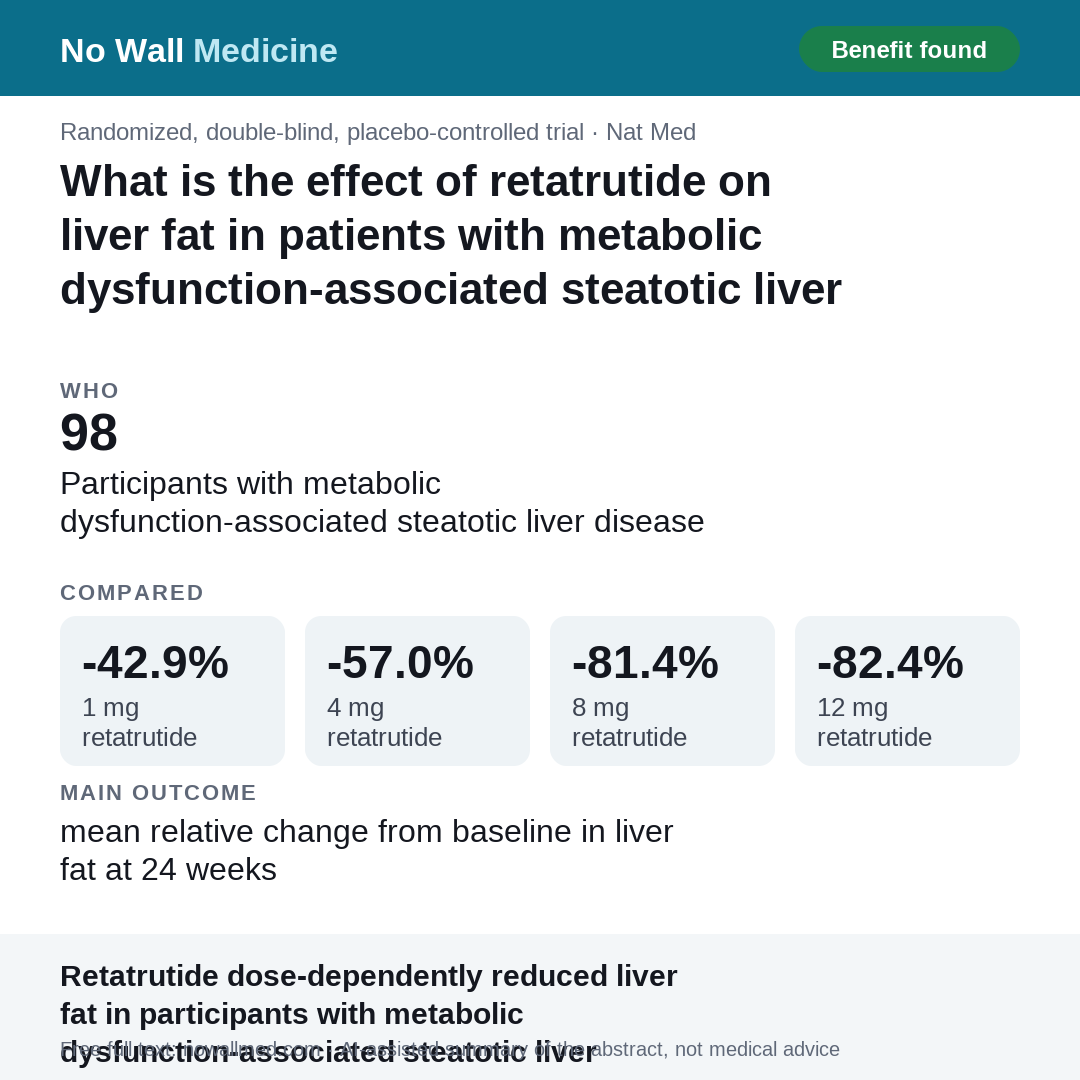
Clinical question: What is the effect of retatrutide on liver fat in patients with metabolic dysfunction-associated steatotic liver disease?
Why it matters: Researchers investigated how retatrutide, a drug targeting three different hormone receptors, affects liver fat in people with metabolic dysfunction-associated steatotic liver disease.
Key points
- The study included 98 participants with metabolic dysfunction-associated steatotic liver disease who were randomized to receive once-weekly subcutaneous retatrutide at doses of 1, 4, 8, or 12 mg or a placebo.
- At 24 weeks, the mean relative change in liver fat from baseline was -42.9% (1 mg), -57.0% (4 mg), -81.4% (8 mg), -82.4% (12 mg), and +0.3% (placebo).
- Normal liver fat levels of less than 5% were achieved by 27% (1 mg), 52% (4 mg), 79% (8 mg), and 86% (12 mg) of participants at 24 weeks.
Headline and key points written with AI from the paper’s abstract, with every number checked against it. Read the paper before relying on them.
Topics
Cite this article
Sanyal AJ, Kaplan LM, Frias JP, Brouwers B, Wu Q, Thomas MK. Triple hormone receptor agonist retatrutide for metabolic dysfunction-associated steatotic liver disease: a randomized phase 2a trial. Nat Med. 2024. doi:10.1038/s41591-024-03018-2
Spotted a mistake? Suggest a correction