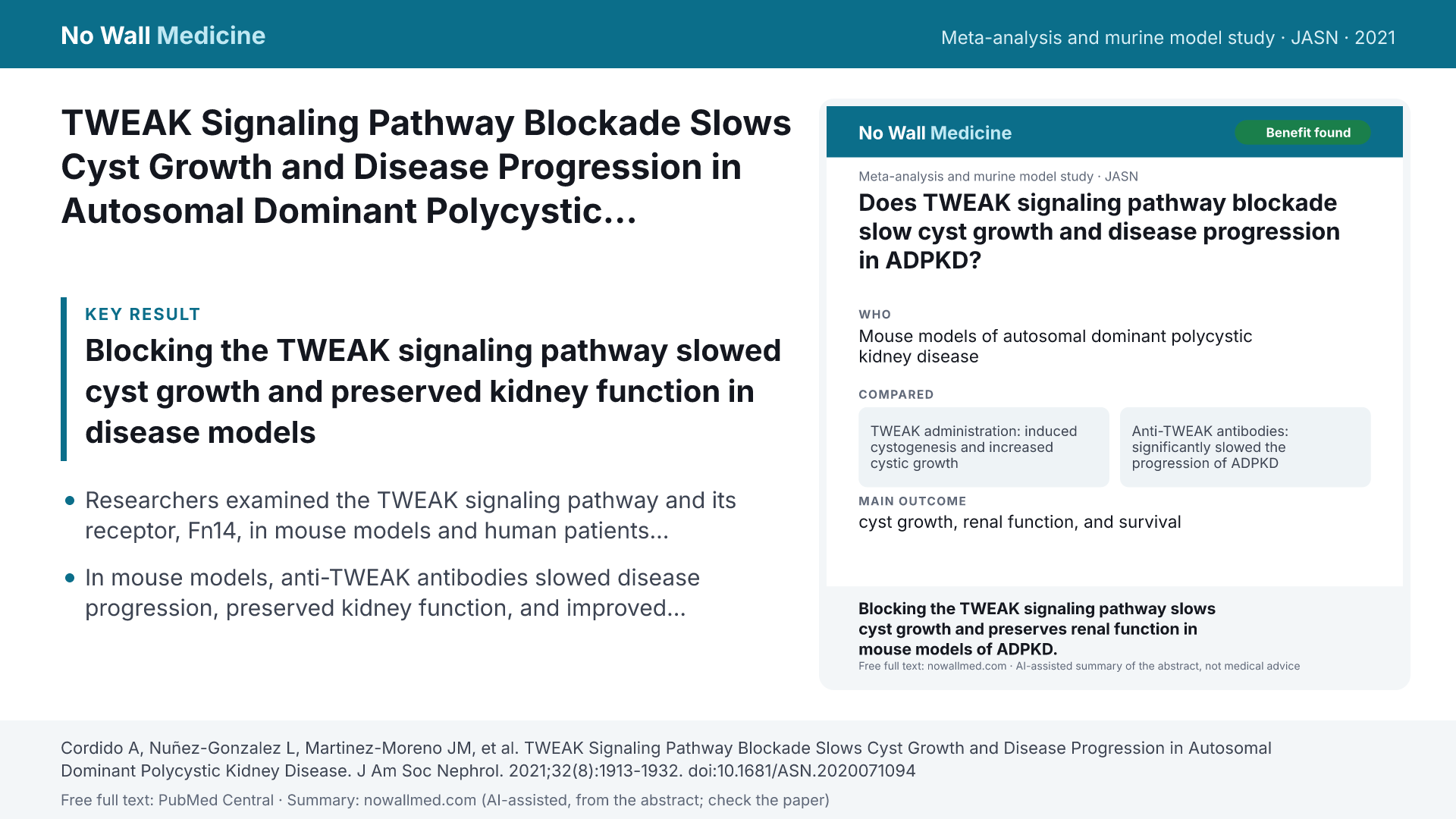
TWEAK Signaling Pathway Blockade Slows Cyst Growth and Disease Progression in Autosomal Dominant Polycystic Kidney Disease
Key result: Blocking the TWEAK signaling pathway slowed cyst growth and preserved kidney function in disease models
Meta-analysis and murine model studyBenefit found
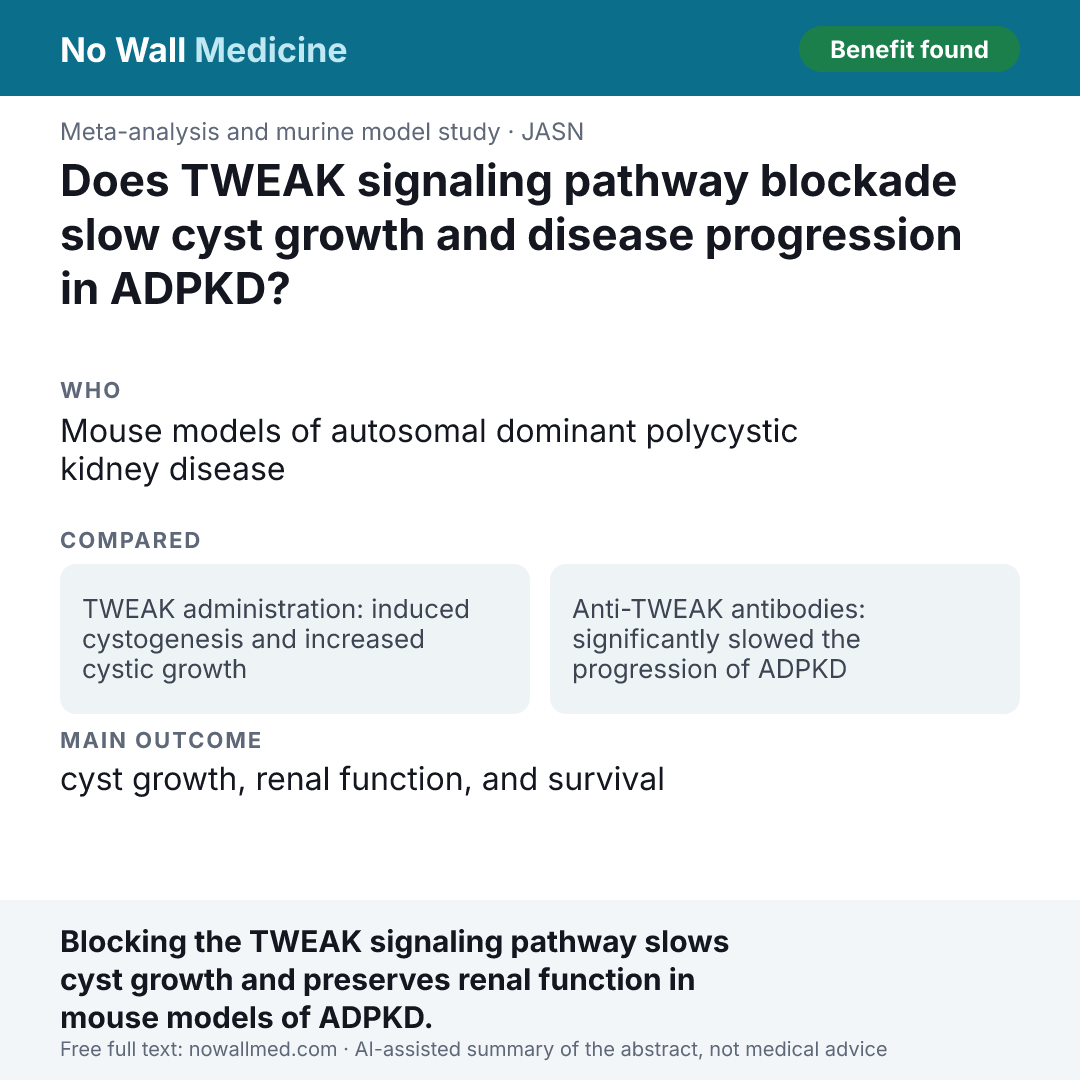
Does TWEAK signaling pathway blockade slow cyst growth and disease progression in ADPKD?
Who
Mouse models of autosomal dominant polycystic kidney disease
Compared
TWEAK administration: induced cystogenesis and increased cystic growth
Anti-TWEAK antibodies: significantly slowed the progression of ADPKD
Main outcome
cyst growth, renal function, and survival
Bottom line: Blocking the TWEAK signaling pathway slows cyst growth and preserves renal function in mouse models of ADPKD.
JASN · 2021-06-21 · Save PNG
Key points
- Researchers examined the TWEAK signaling pathway and its receptor, Fn14, in mouse models and human patients with autosomal dominant polycystic kidney disease.
- In mouse models, anti-TWEAK antibodies slowed disease progression, preserved kidney function, and improved survival compared to TWEAK administration which increased cyst growth.
- The reduction in cyst formation was associated with decreased cell proliferation signaling, decreased NF-κB pathway activation, and an indirect decrease in macrophage recruitment.
Discussion prompts
- Would these patients look like yours? Who was left out?
- Is the main outcome one that matters to patients?
- Is the difference large enough to change what you do?
Cite: Cordido A, Nuñez-Gonzalez L, Martinez-Moreno JM, et al. TWEAK Signaling Pathway Blockade Slows Cyst Growth and Disease Progression in Autosomal Dominant Polycystic Kidney Disease. J Am Soc Nephrol. 2021;32(8):1913-1932. doi:10.1681/ASN.2020071094
Free full text: PubMed Central · Summary and visual abstract: nowallmed.com/a/tweak-signaling-pathway-blockade-slows-cyst-growth-and-disease-16blcwy/ (AI-assisted from the abstract; check the paper before relying on it).