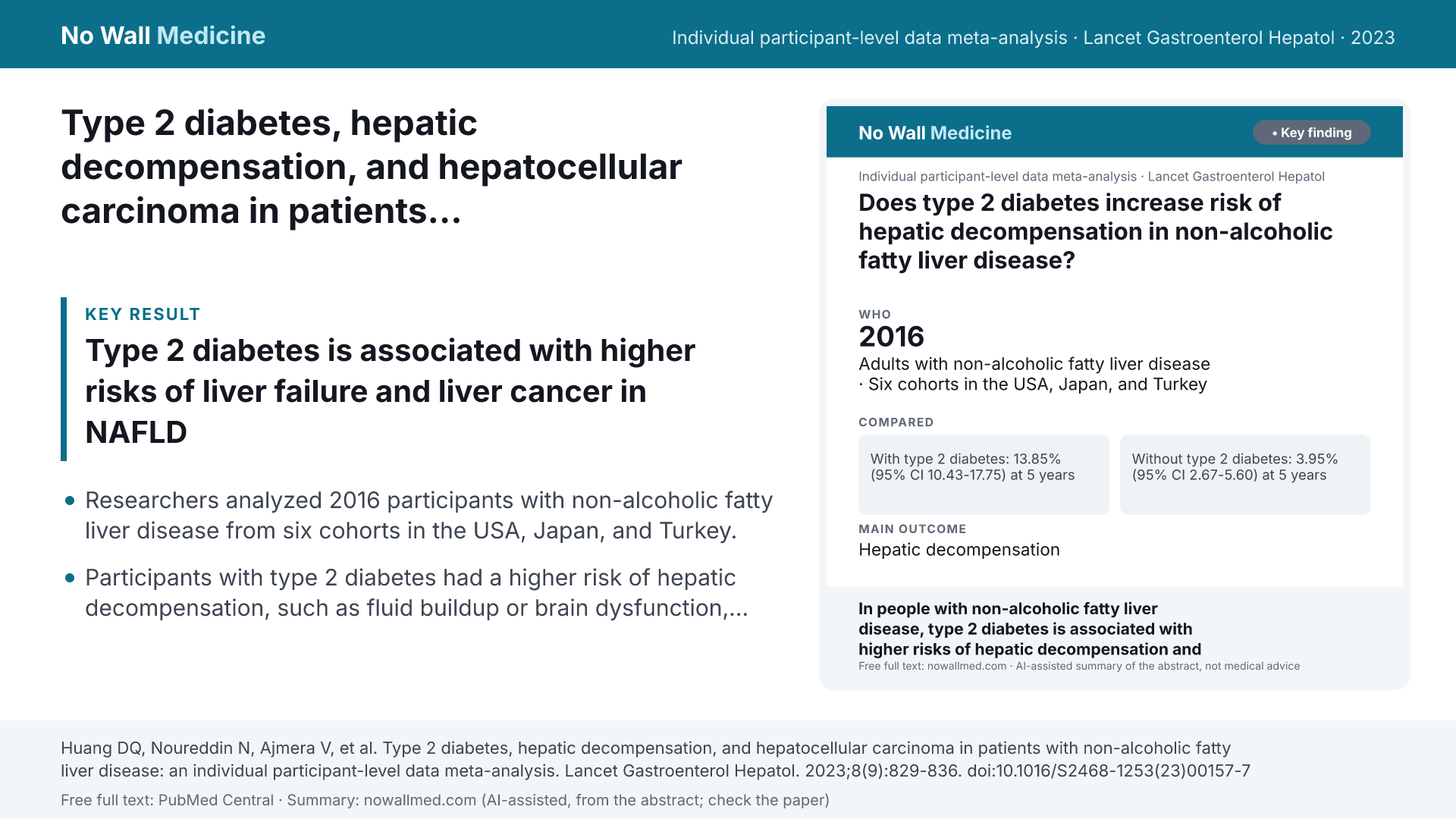
Type 2 diabetes is associated with higher risks of liver failure and liver cancer in NAFLD
Type 2 diabetes, hepatic decompensation, and hepatocellular carcinoma in patients with non-alcoholic fatty liver disease: an individual participant-level data meta-analysis
Individual participant-level data meta-analysisHarm found
Does type 2 diabetes increase risk of hepatic decompensation in non-alcoholic fatty liver disease?
Who
2016
Adults with non-alcoholic fatty liver disease · Six cohorts in the USA, Japan, and Turkey
Compared
With type 2 diabetes: 13.85% (95% CI 10.43-17.75) at 5 years
Without type 2 diabetes: 3.95% (95% CI 2.67-5.60) at 5 years
Main outcome
Hepatic decompensation
Result: subdistribution hazard ratio 2.15 (95% CI 1.39 to 3.34)
Bottom line: In people with non-alcoholic fatty liver disease, type 2 diabetes is associated with higher risks of hepatic decompensation and hepatocellular carcinoma.
Funded by: National Institute of Diabetes and Digestive and Kidney Diseases
Lancet Gastroenterol Hepatol · 2023-07-04Download image
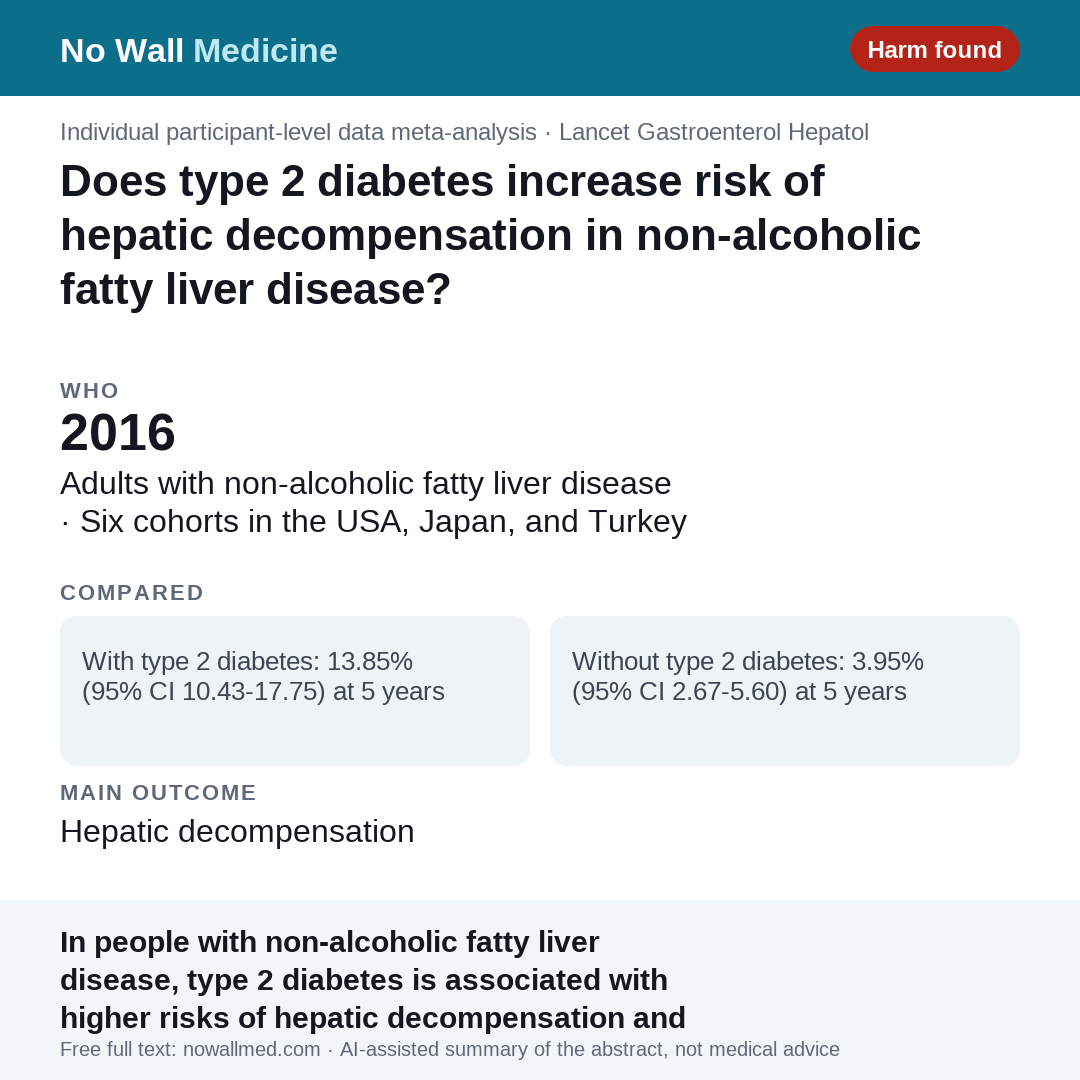
Clinical question: Does type 2 diabetes increase risk of hepatic decompensation in non-alcoholic fatty liver disease?
Why it matters: It was unknown how type 2 diabetes affects the risk of liver failure and liver cancer in people with non-alcoholic fatty liver disease.
Key points
- Researchers analyzed 2016 participants with non-alcoholic fatty liver disease from six cohorts in the USA, Japan, and Turkey.
- Participants with type 2 diabetes had a higher risk of hepatic decompensation, such as fluid buildup or brain dysfunction, at 5 years (13.85% vs 3.95%).
- Type 2 diabetes was also associated with a higher risk of hepatocellular carcinoma, or primary liver cancer, at 5 years (3.68% vs 0.44%).
Headline and key points written with AI from the paper’s abstract, with every number checked against it. Read the paper before relying on them.
Was this summary helpful?
Abstract
Background
Data are scarce regarding the development of hepatic decompensation in patients with non-alcoholic fatty liver disease (NAFLD) with and without type 2 diabetes. We aimed to assess the risk of hepatic decompensation in people with NAFLD with and without type 2 diabetes. Methods
We did a meta-analysis of individual participant-level data from six cohorts in the USA, Japan, and Turkey. Included participants had magnetic resonance elastography between Feb 27, 2007, and June 4, 2021. Eligible studies included those with liver fibrosis characterisation by magnetic resonance elastography, longitudinal assessment for hepatic decompensation and death, and included adult patients (aged ≥18 years) with NAFLD, for whom data were available regarding the presence of type 2 diabetes at baseline. The primary outcome was hepatic decompensation, defined as ascites, hepatic encephalopathy, or variceal bleeding. The secondary outcome was the development of hepatocellular carcinoma. We used competing risk regression using the Fine and Gray subdistribution hazard ratio (sHR) to compare the likelihood of hepatic decompensation in participants with and without type 2 diabetes. Death without hepatic decompensation was a competing event. Findings
Data for 2016 participants (736 with type 2 diabetes; 1280 without type 2 diabetes) from six cohorts were included in this analysis. 1074 (53%) of 2016 participants were female with a mean age of 57·8 years (SD 14·2) years and BMI of 31·3 kg/m2 (SD 7·4). Among 1737 participants (602 with type 2 diabetes and 1135 without type 2 diabetes) with available longitudinal data, 105 participants developed hepatic decompensation over a median follow-up time of 2·8 years (IQR 1·4-5·5). Participants with type 2 diabetes had a significantly higher risk of hepatic decompensation at 1 year (3·37% [95% CI 2·10-5·11] vs 1·07% [0·57-1·86]), 3 years (7·49% [5·36-10·08] vs 2·92% [1·92-4·25]), and 5 years (13·85% [10·43-17·75] vs 3·95% [2·67-5·60]) than participants without type 2 diabetes (p<0·0001). After adjustment for multiple confounders (age, BMI, and race), type 2 diabetes (sHR 2·15 [95% CI 1·39-3·34]; p=0·0006) and glycated haemoglobin (1·31 [95% CI 1·10-1·55]; p=0·0019) were independent predictors of hepatic decompensation. The association between type 2 diabetes and hepatic decompensation remained consistent after adjustment for baseline liver stiffness determined by magnetic resonance elastography. Over a median follow-up of 2·9 years (IQR 1·4-5·7), 22 of 1802 participants analysed (18 of 639 with type 2 diabetes and four of 1163 without type 2 diabetes) developed incident hepatocellular carcinoma. The risk of incident hepatocellular carcinoma was higher in those with type 2 diabetes at 1 year (1·34% [95% CI 0·64-2·54] vs 0·09% [0·01-0·50], 3 years (2·44% [1·36-4·05] vs 0·21% [0·04-0·73]), and 5 years (3·68% [2·18-5·77] vs 0·44% [0·11-1·33]) than in those without type 2 diabetes (p<0·0001). Type 2 diabetes was an independent predictor of hepatocellular carcinoma development (sHR 5·34 [1·67-17·09]; p=0·0048). Interpretation
Among people with NAFLD, the presence of type 2 diabetes is associated with a significantly higher risk of hepatic decompensation and hepatocellular carcinoma. Funding
National Institute of Diabetes and Digestive and Kidney Diseases.
Abstract reproduced under the article’s CC BY licence.
Subject terms
Cite this article
Huang DQ, Noureddin N, Ajmera V, Amangurbanova M, Bettencourt R, Truong E. Type 2 diabetes, hepatic decompensation, and hepatocellular carcinoma in patients with non-alcoholic fatty liver disease: an individual participant-level data meta-analysis. Lancet Gastroenterol Hepatol. 2023. doi:10.1016/S2468-1253(23)00157-7
Spotted a mistake? Suggest a correction