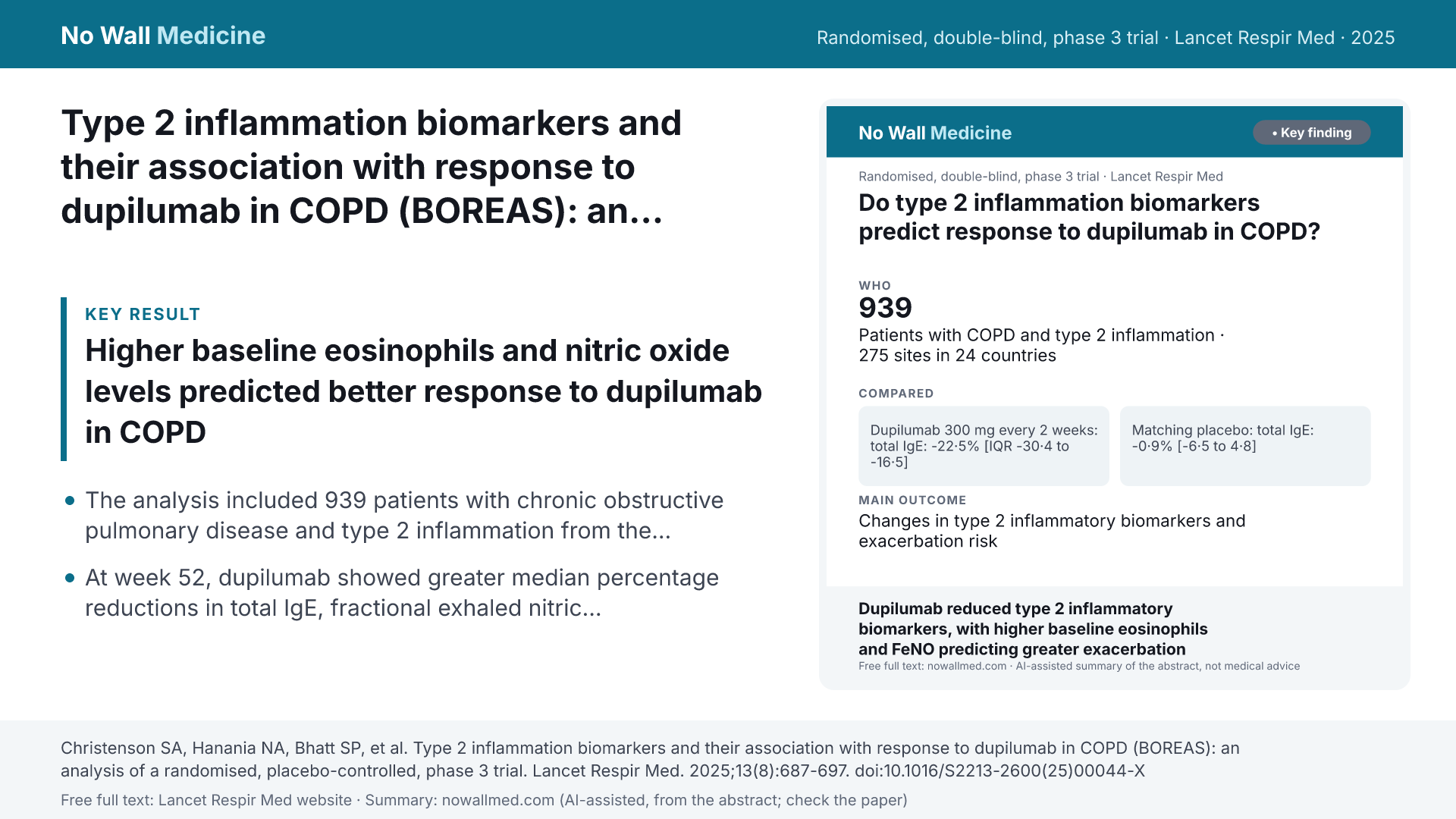
Higher baseline eosinophils and nitric oxide levels predicted better response to dupilumab in COPD
Type 2 inflammation biomarkers and their association with response to dupilumab in COPD (BOREAS): an analysis of a randomised, placebo-controlled, phase 3 trial
Randomised, double-blind, phase 3 trialBenefit found
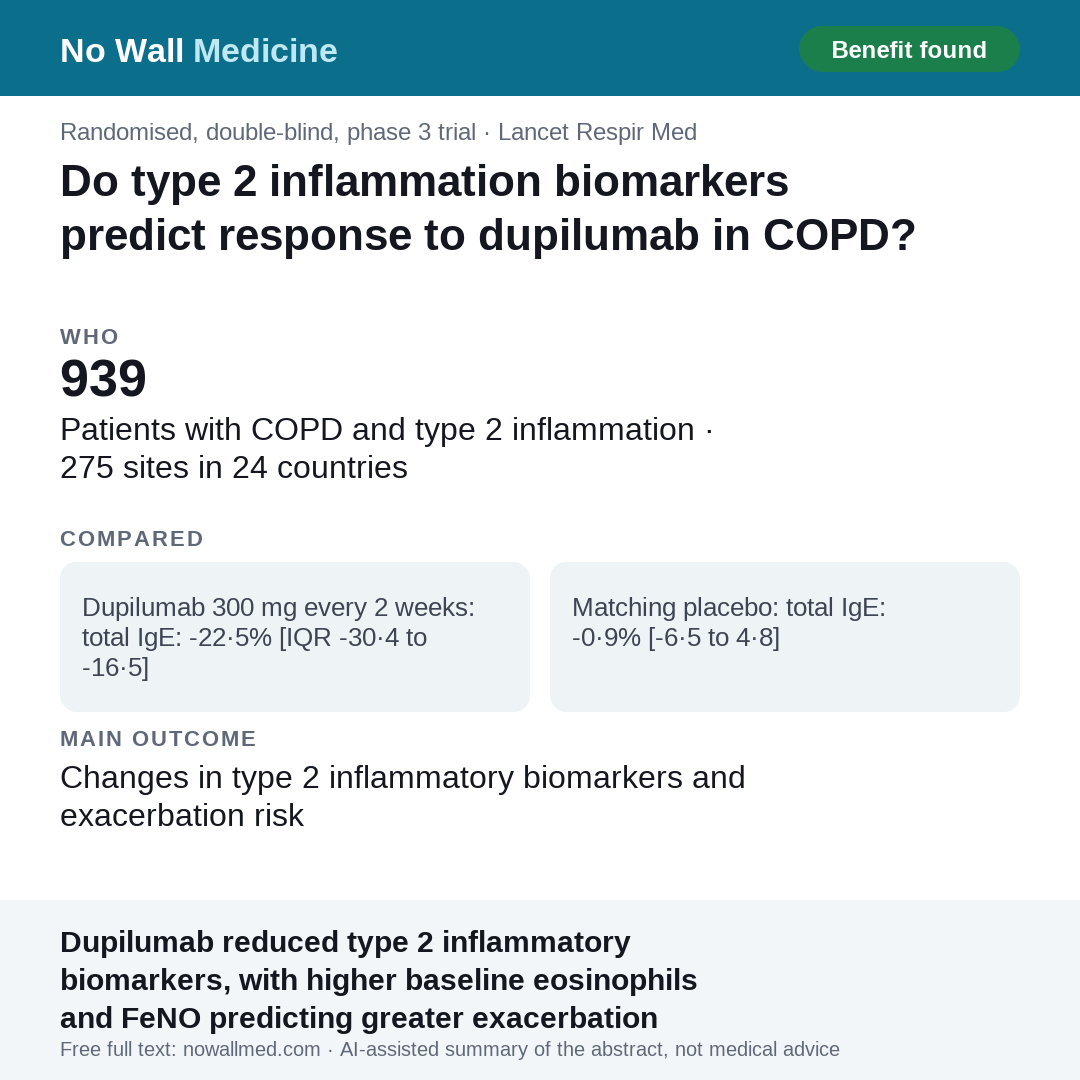
Do type 2 inflammation biomarkers predict response to dupilumab in COPD?
Who
939
Patients with COPD and type 2 inflammation · 275 sites in 24 countries
Compared
Dupilumab 300 mg every 2 weeks: total IgE: -22·5% [IQR -30·4 to -16·5]
Matching placebo: total IgE: -0·9% [-6·5 to 4·8]
Main outcome
Changes in type 2 inflammatory biomarkers and exacerbation risk
Bottom line: Dupilumab reduced type 2 inflammatory biomarkers, with higher baseline eosinophils and FeNO predicting greater exacerbation reduction.
Funded by: Sanofi and Regeneron Pharmaceuticals
Lancet Respir Med · 2025-07-09Download image
Clinical question: Do type 2 inflammation biomarkers predict response to dupilumab in COPD?
Why it matters: It was unknown if specific biomarkers could predict how well patients with chronic obstructive pulmonary disease respond to dupilumab treatment.
Key points
- The analysis included 939 patients with chronic obstructive pulmonary disease and type 2 inflammation from the BOREAS randomized trial.
- At week 52, dupilumab showed greater median percentage reductions in total IgE, fractional exhaled nitric oxide, eotaxin-3, and PARC compared to placebo.
- A greater magnitude of exacerbation risk reduction was associated with higher baseline blood eosinophil counts and baseline fractional exhaled nitric oxide levels.
Headline and key points written with AI from the paper’s abstract, with every number checked against it. Read the paper before relying on them.
Was this summary helpful?
Abstract
Background
A raised blood eosinophil count (≥300 cells per μL), a marker of type 2 inflammation, can identify patients with chronic obstructive pulmonary disease (COPD) with higher exacerbation risk. Dupilumab reduced exacerbations in patients with COPD and type 2 inflammation in the BOREAS trial. In this post-hoc analysis, we evaluated the predictive value and longitudinal changes in type 2 inflammatory biomarkers in patients with COPD and type 2 inflammation from the BOREAS trial who received dupilumab treatment. Methods
BOREAS, a phase 3, multicentre, double-blind, randomised trial was conducted at 275 sites in 24 countries and included patients with COPD and type 2 inflammation (screening blood eosinophils ≥300 cells per μL). Patients were randomly assigned (1:1) to receive 300 mg of dupilumab every 2 weeks for 52 weeks or matching placebo. Randomisation was stratified by country and inhaled corticosteroid dose at baseline. This post-hoc analysis assessed blood eosinophil counts, fractional exhaled nitric oxide (FeNO), serum eotaxin-3, total plasma immunoglobulin E (IgE), and serum pulmonary and activation-regulated chemokine (PARC) concentrations in the safety population. The study was registered at ClinicalTrials.gov, NCT03930732 and is complete. Findings
BOREAS was conducted between April 15, 2019, and May 2, 2023, and included 939 patients with COPD and type 2 inflammation. 468 patients were randomly assigned to receive 300 mg of dupilumab every 2 weeks for 52 weeks and 471 were randomly assigned to receive matching placebo. 319 (34%) participants were female and 620 (66%) were male. 657 (70%) were former smokers and 282 (30%) were current smokers. At week 52, greater median percentage reductions were observed in dupilumab versus placebo for most biomarkers (total IgE: -22·5% [IQR -30·4 to -16·5] vs -0·9% [-6·5 to 4·8]; FeNO: -28·6% [-57·1 to 0] vs -6·9% [-35·7 to 25·0]; eotaxin-3: -8·8% [-15·6 to -2·9] vs -0·4% [-5·6 to 5·0]; and PARC: -14·4% [-29·2 to 2·1] vs -0·8% [-13·9 to 17·2]). Reductions were similar across treatment groups by blood eosinophil counts. Exacerbation risk overall was reduced, with a greater magnitude of reduction in those with higher baseline blood eosinophil count (p=0·0056) and baseline FeNO (p=0·043). Interpretation
Patients with COPD and type 2 inflammation who were given dupilumab showed reduced type 2 inflammatory biomarkers, with elevated blood eosinophil count and FeNO predicting greater treatment response. These findings support biomarker-driven treatment strategies to optimise therapy. Funding
Sanofi and Regeneron Pharmaceuticals.
Abstract reproduced under the article’s CC BY NC ND licence.
Subject terms
Cite this article
Christenson SA, Hanania NA, Bhatt SP, et al. Type 2 inflammation biomarkers and their association with response to dupilumab in COPD (BOREAS): an analysis of a randomised, placebo-controlled, phase 3 trial. Lancet Respir Med. 2025. doi:10.1016/S2213-2600(25)00044-X
Spotted a mistake? Suggest a correction