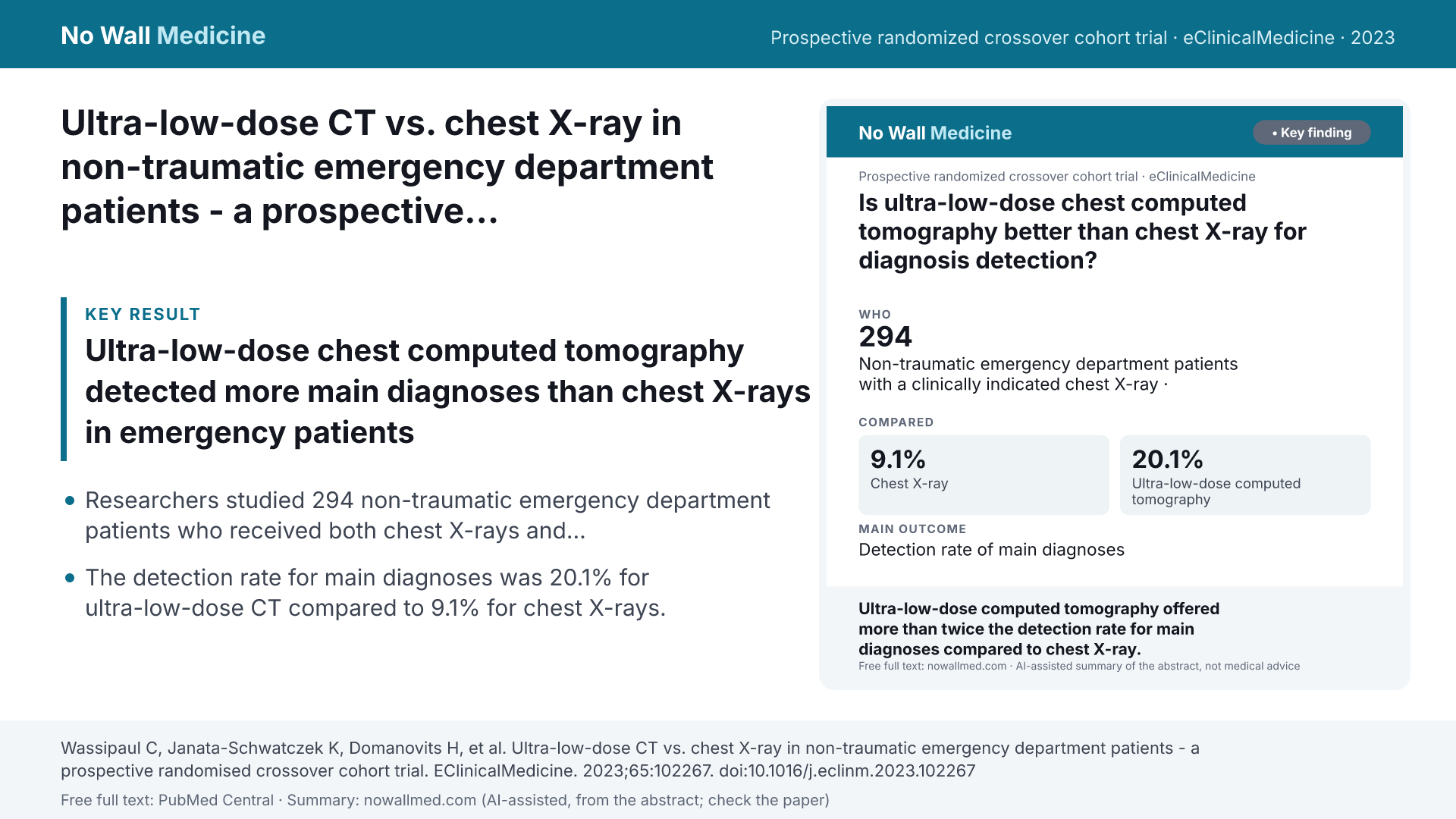
Ultra-low-dose chest computed tomography detected more main diagnoses than chest X-rays in emergency patients
Ultra-low-dose CT vs. chest X-ray in non-traumatic emergency department patients - a prospective randomised crossover cohort trial
Prospective randomized crossover cohort trialBenefit found
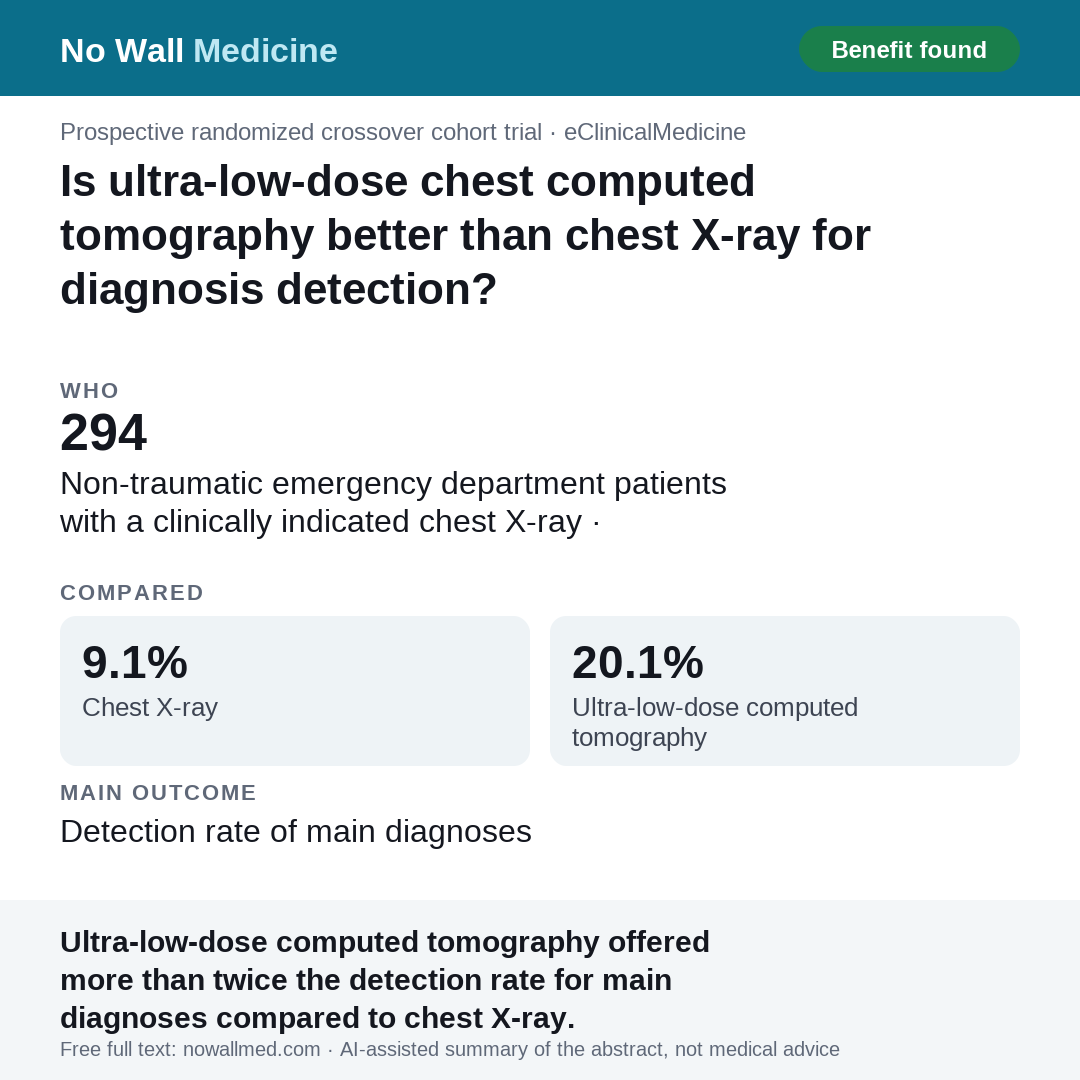
Is ultra-low-dose chest computed tomography better than chest X-ray for diagnosis detection?
Who
294
Non-traumatic emergency department patients with a clinically indicated chest X-ray · Emergency department
Compared
9.1%Chest X-ray (CI [5.2, 15.5]; 11/121)
20.1%Ultra-low-dose computed tomography (CI [14.2, 27.7]; 27/134)
Main outcome
Detection rate of main diagnoses
Result: P = 0.016
Bottom line: Ultra-low-dose computed tomography offered more than twice the detection rate for main diagnoses compared to chest X-ray.
Funded by: Siemens Healthineers
eClinicalMedicine · 2023-10-17Download image
Clinical question: Is ultra-low-dose chest computed tomography better than chest X-ray for diagnosis detection?
Why it matters: It is unknown if ultra-low-dose chest computed tomography provides a higher detection rate of clinically relevant diagnoses than standard chest X-rays in non-traumatic emergency department patients.
Key points
- Researchers studied 294 non-traumatic emergency department patients who received both chest X-rays and ultra-low-dose computed tomography (CT) scans.
- The detection rate for main diagnoses was 20.1% for ultra-low-dose CT compared to 9.1% for chest X-rays.
- Ultra-low-dose CT added 9.1% of main diagnoses to prior chest X-rays, while chest X-rays added 0/134 main diagnoses.
Headline and key points written with AI from the paper’s abstract, with every number checked against it. Read the paper before relying on them.
Was this summary helpful?
Cite this article
Wassipaul C, Janata-Schwatczek K, Domanovits H, et al. Ultra-low-dose CT vs. chest X-ray in non-traumatic emergency department patients - a prospective randomised crossover cohort trial. eClinicalMedicine. 2023. doi:10.1016/j.eclinm.2023.102267
Spotted a mistake? Suggest a correction