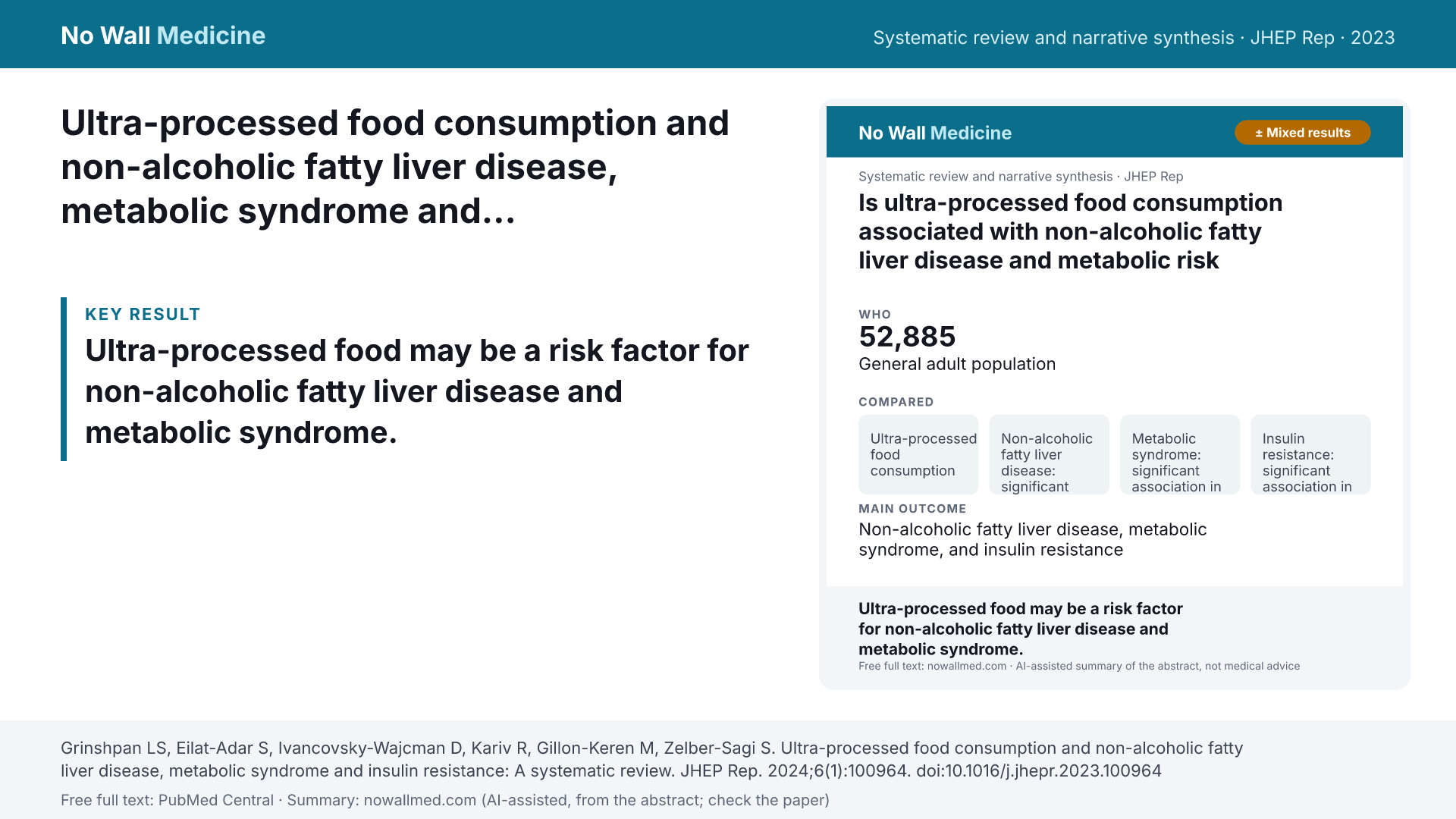
Ultra-processed food consumption and non-alcoholic fatty liver disease, metabolic syndrome and insulin resistance: A systematic review
Systematic review and narrative synthesisMixed results
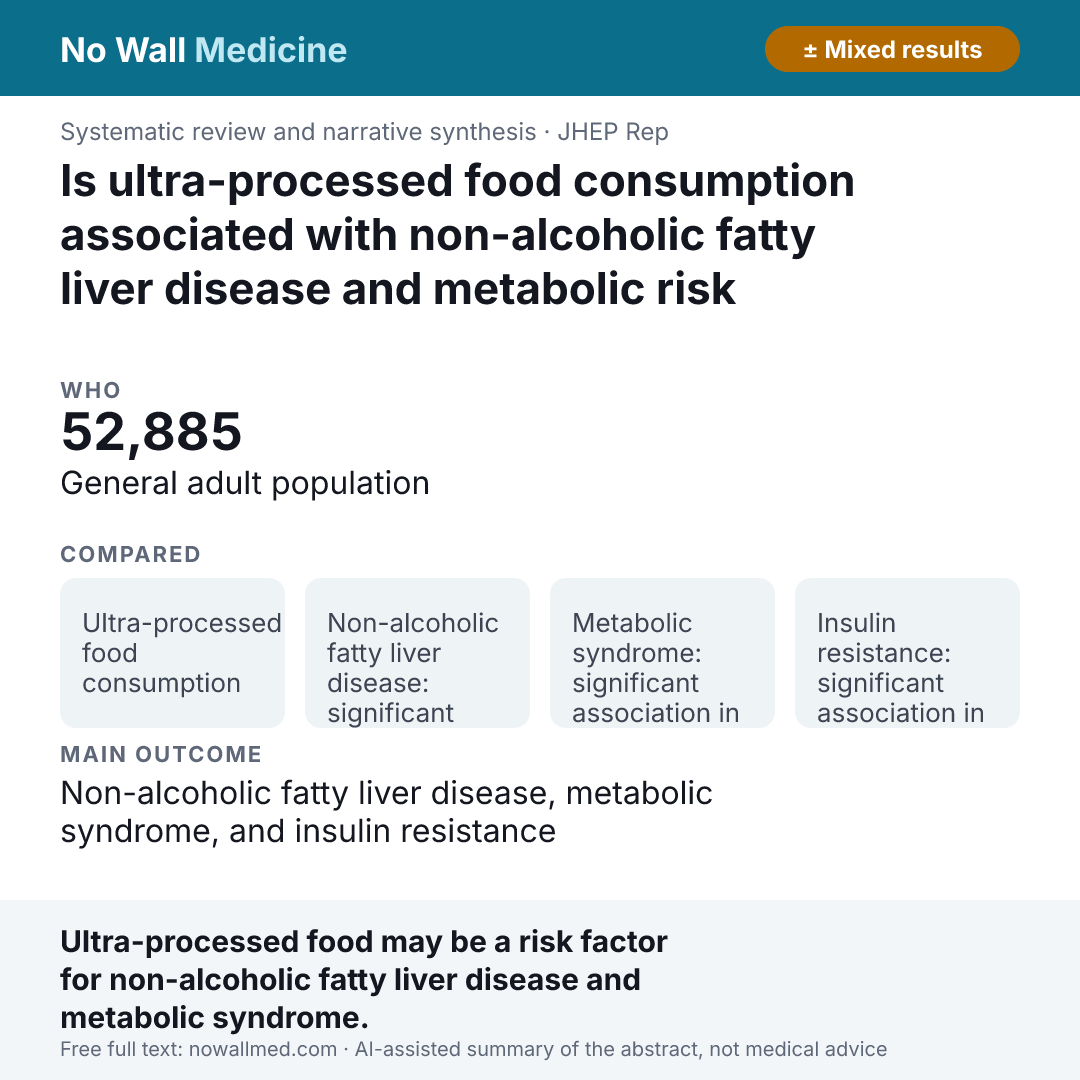
Is ultra-processed food consumption associated with non-alcoholic fatty liver disease and metabolic risk factors?
Who
52,885
General adult population
Compared
Ultra-processed food consumption
Non-alcoholic fatty liver disease: significant association in three studies out of six
Metabolic syndrome: significant association in five studies out of eight
Insulin resistance: significant association in one study out of three
Main outcome
Non-alcoholic fatty liver disease, metabolic syndrome, and insulin resistance
Bottom line: Ultra-processed food may be a risk factor for non-alcoholic fatty liver disease and metabolic syndrome.
Limitation: Studies are few, observational, and based upon self-reported dietary assessment tools.
JHEP Rep · 2023-11-17 · Save PNG
Clinical question: Is ultra-processed food consumption associated with non-alcoholic fatty liver disease and metabolic risk factors?
Abstract
Background
High ultra-processed food (UPF) consumption is associated with the development of various diet-related non-communicable diseases, especially obesity and type 2 diabetes. The present study aimed to systematically review the association between UPF consumption and non-alcoholic fatty liver disease (NAFLD) and its leading risk factors; metabolic syndrome (MetS) and insulin resistance (IR). Methods
A comprehensive search was conducted in PubMed, Scopus, Embase, Web of Science, CINAHL, and Cochrane (March 2023), and references of the identified articles were checked. The search keywords were defined through an exploratory investigation in addition to MeSH and similarly controlled vocabulary thesauruses. Observational and interventional studies were included. Studies that focused only on specific groups of processed foods or overlapping dietary patterns were excluded. The quality assessment was conducted using the Joanna Briggs Institute's critical appraisal tools for observational studies and Cochrane's risk of bias 2 tool for randomized-control trials. A narrative synthesis was employed to report the results. Results
Fifteen studies were included, with a total of 52,885 participants, one randomized-controlled trial, and fourteen observational studies (nine cross-sectional and five prospective). The review has shown a significant association between UPF consumption and NAFLD in three studies out of six, MetS in five out of eight, and IR in one out of three. All large-scale prospective cohorts that studied NAFLD or MetS outcomes demonstrated a positive association. In contrast, studies that did not demonstrate significant associations were mostly cross-sectional and small. The evidence for an association with IR was insufficient and conflicting. Conclusion
The included studies are few, observational, and based upon self-reported dietary assessment tools. However, current evidence indicates that UPF is not only associated with obesity and type 2 diabetes but may also be a risk factor for NAFLD and MetS. UPF is a worldwide concern deserving further longitudinal research. Impact and implications
Overconsumption of ultra-processed food (UPF) may lead to the development of obesity and type 2 diabetes, but the association with non-alcoholic fatty liver disease (NAFLD) is not well established. The present systematic review shows that UPF may be associated with NAFLD, although more large prospective studies are needed. These findings emphasize the importance of minimizing the consumption of UPF to prevent NAFLD and other metabolic diseases among the general adult population. This systematic review and further prospective studies, epidemiological or interventional, can help physicians provide patients with evidence-based nutritional recommendations and will support policymakers in restricting the marketing of UPF as well as promoting affordable, healthy, and minimally processed foods.
Headline, design, result, key points, caveat and citation as plain text.
Cite this article
Grinshpan LS, Eilat-Adar S, Ivancovsky-Wajcman D, Kariv R, Gillon-Keren M, Zelber-Sagi S. Ultra-processed food consumption and non-alcoholic fatty liver disease, metabolic syndrome and insulin resistance: A systematic review. JHEP Rep. 2024;6(1):100964. doi:10.1016/j.jhepr.2023.100964
Spotted a mistake? Suggest a correction