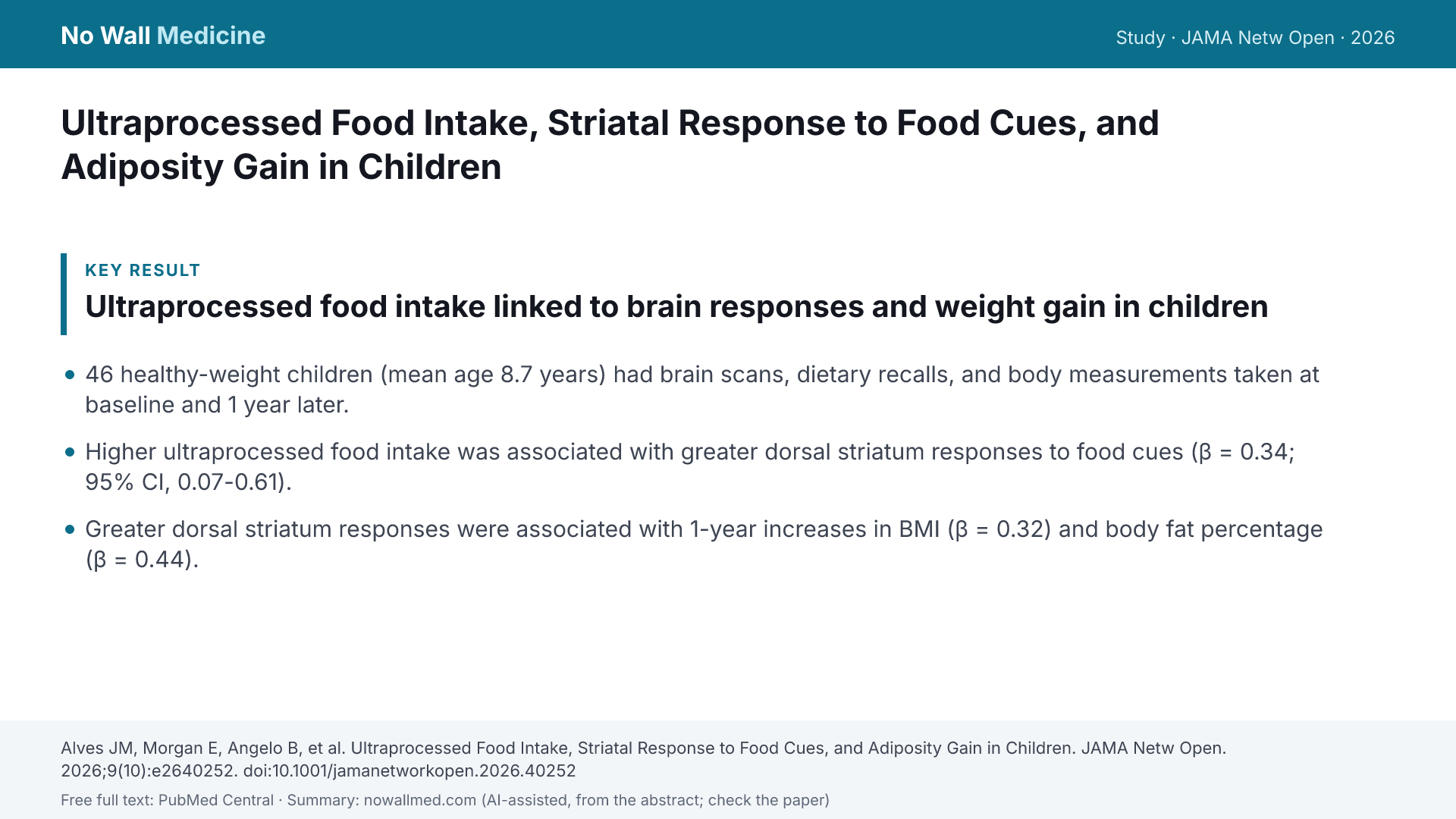
Ultraprocessed food intake linked to brain responses and weight gain in children
Ultraprocessed Food Intake, Striatal Response to Food Cues, and Adiposity Gain in Children
Key points
- 46 healthy-weight children (mean age 8.7 years) had brain scans, dietary recalls, and body measurements taken at baseline and 1 year later.
- Higher ultraprocessed food intake was associated with greater dorsal striatum responses to food cues (β = 0.34; 95% CI, 0.07-0.61).
- Greater dorsal striatum responses were associated with 1-year increases in BMI (β = 0.32) and body fat percentage (β = 0.44).
Study type: Observational study: it can show a link, but not prove that one thing causes another.
Headline and key points written with AI from the paper’s abstract, with every number checked against it. Read the paper before relying on them.
Was this summary helpful?
Subject terms
Headline, design, result, key points, caveat and citation as plain text.
Cite this article
Alves JM, Morgan E, Angelo B, et al. Ultraprocessed Food Intake, Striatal Response to Food Cues, and Adiposity Gain in Children. JAMA Netw Open. 2026;9(10):e2640252. doi:10.1001/jamanetworkopen.2026.40252
Spotted a mistake? Suggest a correction