Elastography-guided pleural biopsy was more sensitive than traditional ultrasound-guided biopsy for detecting malignant effusion
Ultrasonic elastography-guided pleural biopsy versus traditional thoracic ultrasound-guided pleural biopsy for the diagnosis of pleural effusion: a multicentre, randomised trial
Multicentre, randomised trialBenefit found
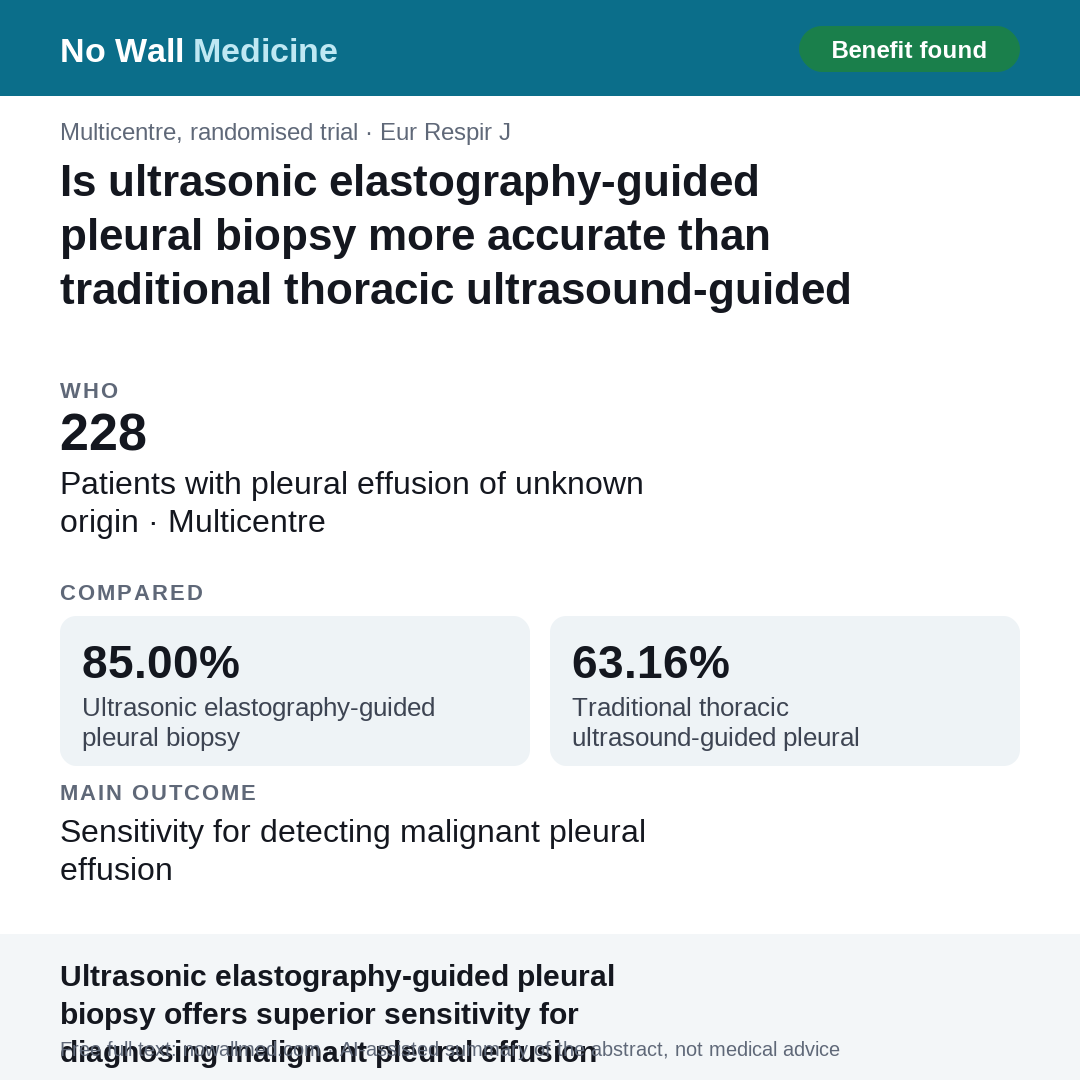
Is ultrasonic elastography-guided pleural biopsy more accurate than traditional thoracic ultrasound-guided pleural biopsy?
Who
228
Patients with pleural effusion of unknown origin · Multicentre
Compared
85.00%Ultrasonic elastography-guided pleural biopsy (51/60)
63.16%Traditional thoracic ultrasound-guided pleural biopsy (36/57)
Main outcome
Sensitivity for detecting malignant pleural effusion
Bottom line: Ultrasonic elastography-guided pleural biopsy offers superior sensitivity for diagnosing malignant pleural effusion compared to traditional thoracic ultrasound-guided biopsy.
Eur Respir J · 2025-12-18Download image
Clinical question: Is ultrasonic elastography-guided pleural biopsy more accurate than traditional thoracic ultrasound-guided pleural biopsy?
Why it matters: Traditional thoracic ultrasound-guided pleural biopsy has limited sensitivity for detecting malignant pleural effusion, and it is unclear if adding elastography to evaluate pleural stiffness improves diagnostic accuracy.
Key points
- Researchers conducted a multicentre, randomized trial involving 228 patients with pleural effusion of unknown origin to compare two ultrasound-guided biopsy methods.
- The sensitivity for detecting malignant pleural effusion was 85.00% (51/60) with ultrasonic elastography-guided biopsy compared to 63.16% (36/57) with traditional thoracic ultrasound-guided pleural biopsy.
- Procedure-related complication rates were similar between the two groups at 6.36% for the elastography group and 8.33% for the traditional group.
Headline and key points written with AI from the paper’s abstract, with every number checked against it. Read the paper before relying on them.
Topics
Cite this article
Deng M, Xia Y, Ye X, Ma J, Zhao S, Zhang Q. Ultrasonic elastography-guided pleural biopsy versus traditional thoracic ultrasound-guided pleural biopsy for the diagnosis of pleural effusion: a multicentre, randomised trial. Eur Respir J. 2025. doi:10.1183/13993003.01062-2025
Spotted a mistake? Suggest a correction
Top studies every Monday
The week’s key trials and guidelines in your specialties, plus any topics you follow. By email, free.
Get the weekly digest