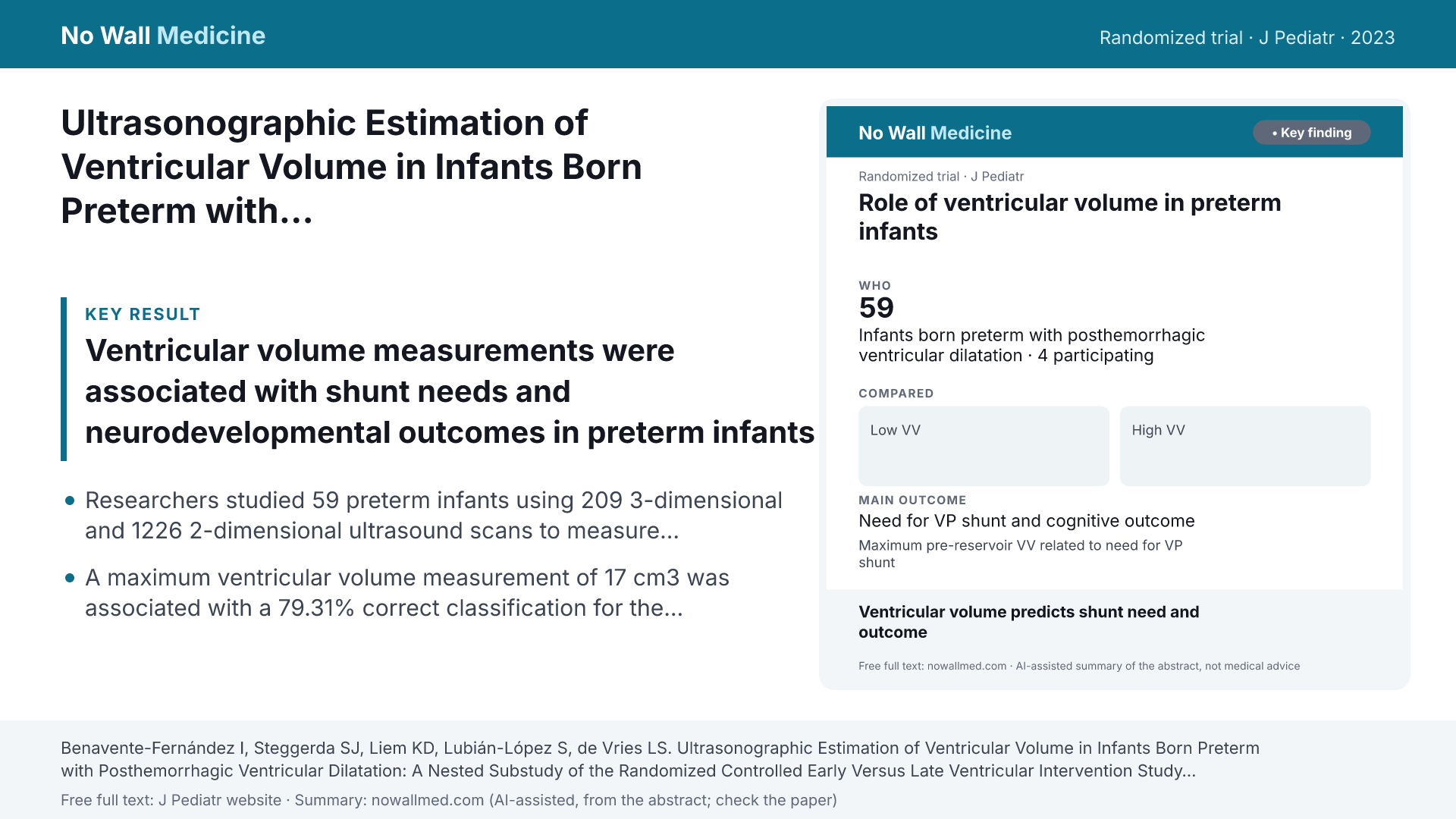
Ventricular volume measurements were associated with shunt needs and neurodevelopmental outcomes in preterm infants
Ultrasonographic Estimation of Ventricular Volume in Infants Born Preterm with Posthemorrhagic Ventricular Dilatation: A Nested Substudy of the Randomized Controlled Early Versus Late Ventricular Intervention Study (ELVIS) Trial
Randomized trialKey finding
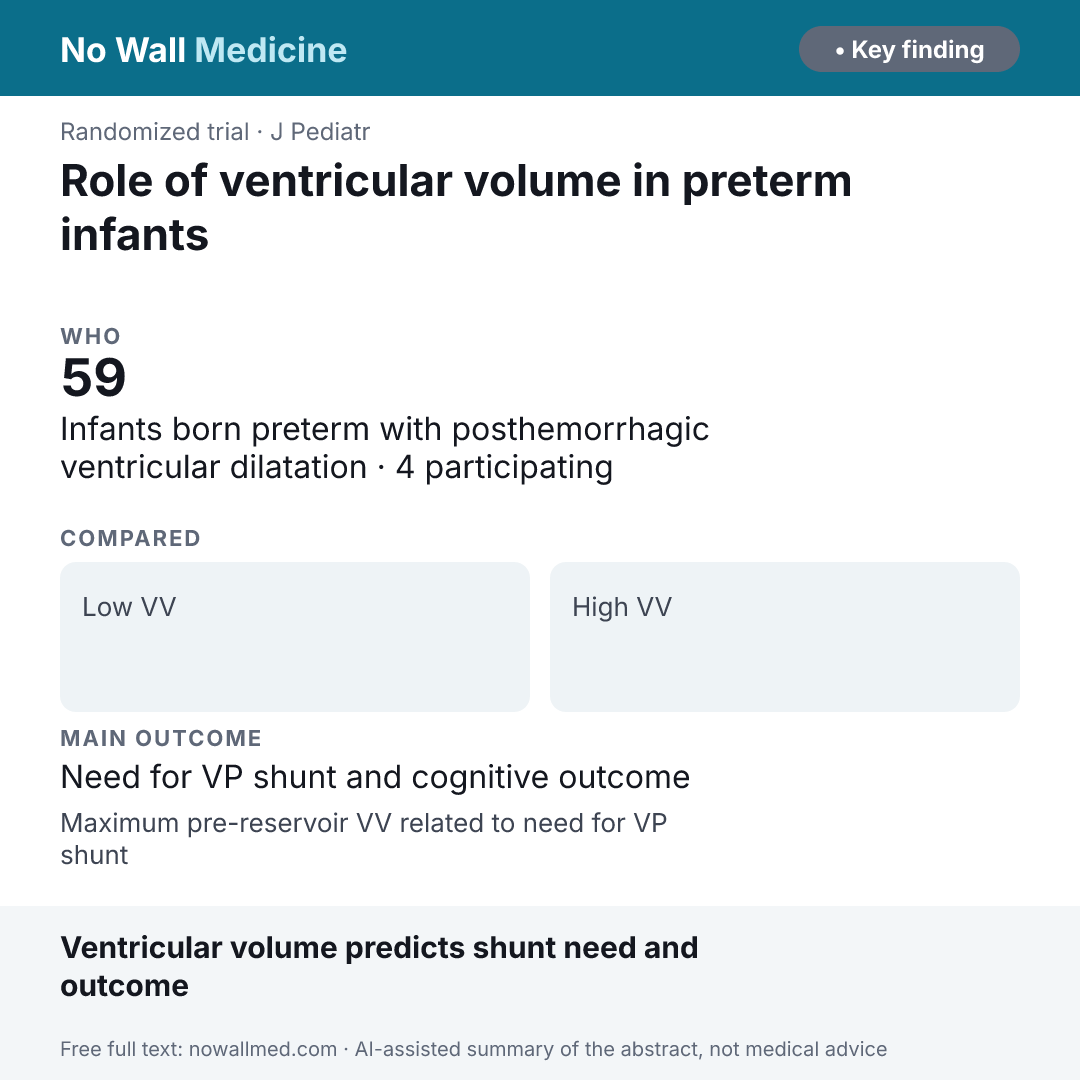
Role of ventricular volume in preterm infants
Who
59
Infants born preterm with posthemorrhagic ventricular dilatation · 4 participating centers
Compared
Low VV
High VV
Main outcome
Need for VP shunt and cognitive outcome
Result: Maximum pre-reservoir VV related to need for VP shunt
Bottom line: Ventricular volume predicts shunt need and outcome
J Pediatr · 2023-06-22 · Save PNG
Key points
- Researchers studied 59 preterm infants using 209 3-dimensional and 1226 2-dimensional ultrasound scans to measure ventricular volume, which is the space inside the brain's ventricles.
- A maximum ventricular volume measurement of 17 cm3 was associated with a 79.31% correct classification for the need for a ventriculoperitoneal shunt, a tube used to drain fluid.
- Maximum ventricular volume, gestational age at birth, and the need for a shunt were all related to cognitive outcomes at 2 years of age.
Headline and key points written with AI from the paper’s abstract, with every number checked against it. Read the paper before relying on them.
Was this summary helpful?
Subject terms
Headline, design, result, key points, caveat and citation as plain text.
Cite this article
Benavente-Fernández I, Steggerda SJ, Liem KD, Lubián-López S, de Vries LS. Ultrasonographic Estimation of Ventricular Volume in Infants Born Preterm with Posthemorrhagic Ventricular Dilatation: A Nested Substudy of the Randomized Controlled Early Versus Late Ventricular Intervention Study (ELVIS) Trial. J Pediatr. 2023;261:113578. doi:10.1016/j.jpeds.2023.113578
Spotted a mistake? Suggest a correction