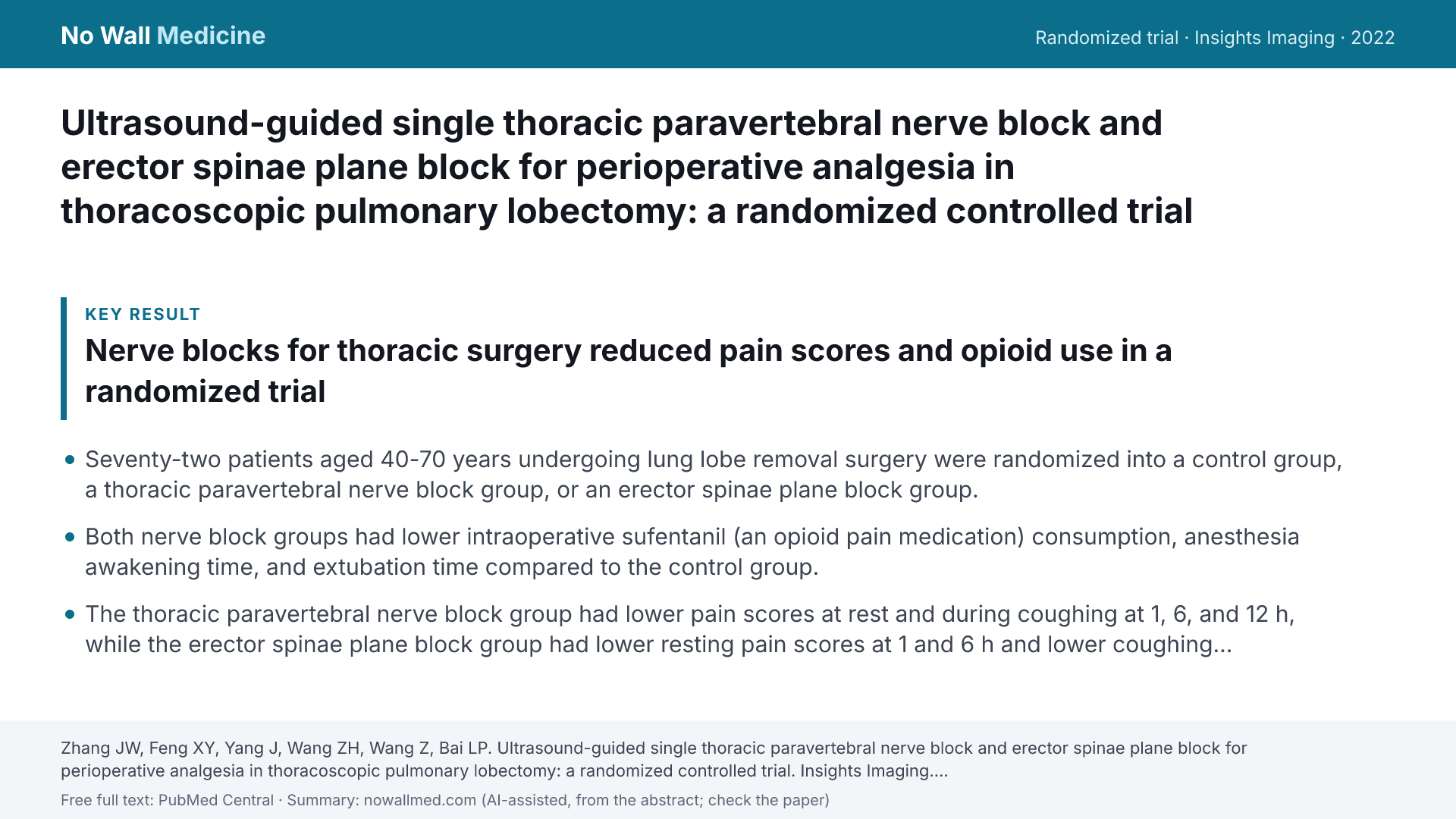
Nerve blocks for thoracic surgery reduced pain scores and opioid use in a randomized trial
Ultrasound-guided single thoracic paravertebral nerve block and erector spinae plane block for perioperative analgesia in thoracoscopic pulmonary lobectomy: a randomized controlled trial
Key points
- Seventy-two patients aged 40-70 years undergoing lung lobe removal surgery were randomized into a control group, a thoracic paravertebral nerve block group, or an erector spinae plane block group.
- Both nerve block groups had lower intraoperative sufentanil (an opioid pain medication) consumption, anesthesia awakening time, and extubation time compared to the control group.
- The thoracic paravertebral nerve block group had lower pain scores at rest and during coughing at 1, 6, and 12 h, while the erector spinae plane block group had lower resting pain scores at 1 and 6 h and lower coughing pain scores at 1, 6, and 12 h.
Headline and key points written with AI from the paper’s abstract, with every number checked against it. Read the paper before relying on them.
Was this summary helpful?
Headline, design, result, key points, caveat and citation as plain text.
Cite this article
Zhang JW, Feng XY, Yang J, Wang ZH, Wang Z, Bai LP. Ultrasound-guided single thoracic paravertebral nerve block and erector spinae plane block for perioperative analgesia in thoracoscopic pulmonary lobectomy: a randomized controlled trial. Insights Imaging. 2022;13(1):16. doi:10.1186/s13244-021-01151-x
Spotted a mistake? Suggest a correction