Ultrasound or laparoscopic guided nerve blocks reduced pain and nausea after gallbladder removal surgery
Ultrasound-guided versus laparoscopic-guided subcostal transversus abdominis plane (TAP) block versus No TAP block in laparoscopic cholecystectomy; a randomized double-blind controlled trial
Randomized, double-blind controlled trialBenefit found
Are ultrasound-guided or laparoscopic-guided subcostal TAP blocks effective for laparoscopic cholecystectomy?
Who
110
Patients undergoing laparoscopic cholecystectomy
Compared
Ultrasound-guided subcostal TAP block: significantly lower pain scores, lower paracetamol dose, less nausea and vomiting
Laparoscopic-guided subcostal TAP block: significantly lower pain scores, lower paracetamol dose, less nausea and vomiting
Control group
Main outcome
Pain scores, analgesic consumption, nausea, vomiting, ambulation, and flatus
Bottom line: Both ultrasound-guided and laparoscopic-guided TAP blocks effectively reduce pain and improve recovery after laparoscopic cholecystectomy.
Int J Surg · 2022-04-27Download image
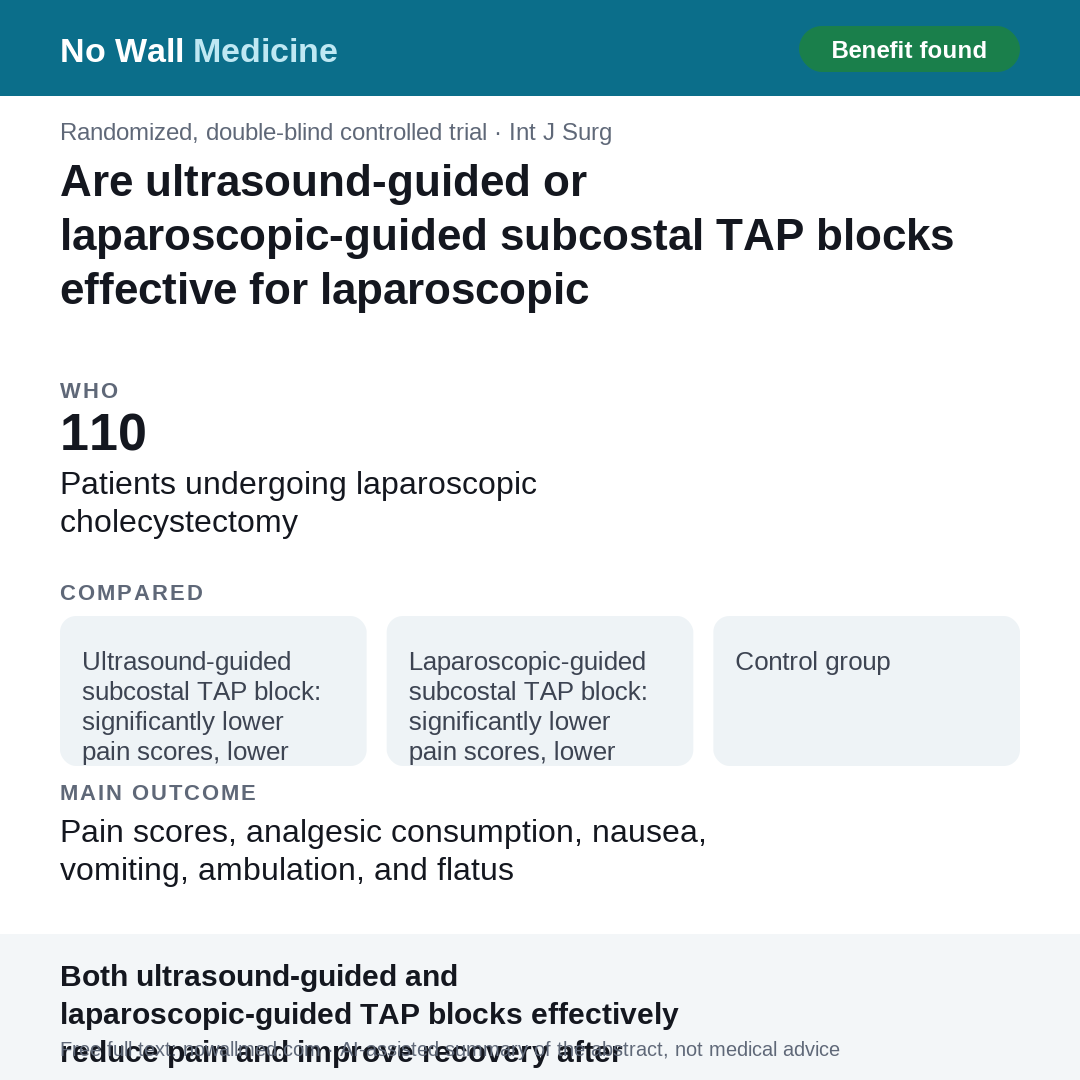
Clinical question: Are ultrasound-guided or laparoscopic-guided subcostal TAP blocks effective for laparoscopic cholecystectomy?
Why it matters: It is unknown whether ultrasound-guided or laparoscopic-guided subcostal transversus abdominis plane blocks are more effective for managing pain and recovery after laparoscopic gallbladder removal.
Key points
- Researchers studied 110 patients, 90% of whom were female, comparing ultrasound-guided subcostal transversus abdominis plane (TAP) block, laparoscopic-guided TAP block, and no TAP block.
- Both types of TAP block, which involve injecting anesthetic near the abdominal muscles, were associated with lower pain scores at 2, 6, 12, and 24 h, less paracetamol use, and less postoperative nausea and vomiting.
- The two different methods of performing the TAP block showed similar results for pain relief, medication needs, nausea, time to walking, and time to passing gas.
Headline and key points written with AI from the paper’s abstract, with every number checked against it. Read the paper before relying on them.
Was this summary helpful?
Subject terms
Cite this article
Emile SH, Elfeki H, Elbahrawy K, Sakr A, Shalaby M. Ultrasound-guided versus laparoscopic-guided subcostal transversus abdominis plane (TAP) block versus No TAP block in laparoscopic cholecystectomy; a randomized double-blind controlled trial. Int J Surg. 2022. doi:10.1016/j.ijsu.2022.106639
Spotted a mistake? Suggest a correction
Top studies every Monday
The week’s key trials and guidelines in your specialties, plus any topics you follow. By email, free.
Get the weekly digest