Umbilical cord milking did not significantly reduce intensive care admission for nonvigorous newborns
Umbilical cord milking in nonvigorous infants: a cluster-randomized crossover trial
Pragmatic cluster-randomized crossover trialMixed results
Does umbilical cord milking reduce neonatal intensive care unit admission in nonvigorous newborns?
Who
1730
Nonvigorous infants born between 35 and 42 weeks' gestation · 10 medical centers in 3 countries
Compared
23%Umbilical cord milking
28%Early cord clamping
Main outcome
Admission to the neonatal intensive care unit
Result: modeled odds ratio 0.69 (95% confidence interval 0.41-1.14)
Bottom line: Umbilical cord milking did not reduce intensive care admission but was associated with higher hemoglobin and lower hypoxic-ischemic encephalopathy.
AJOG · 2022-08-13Download image
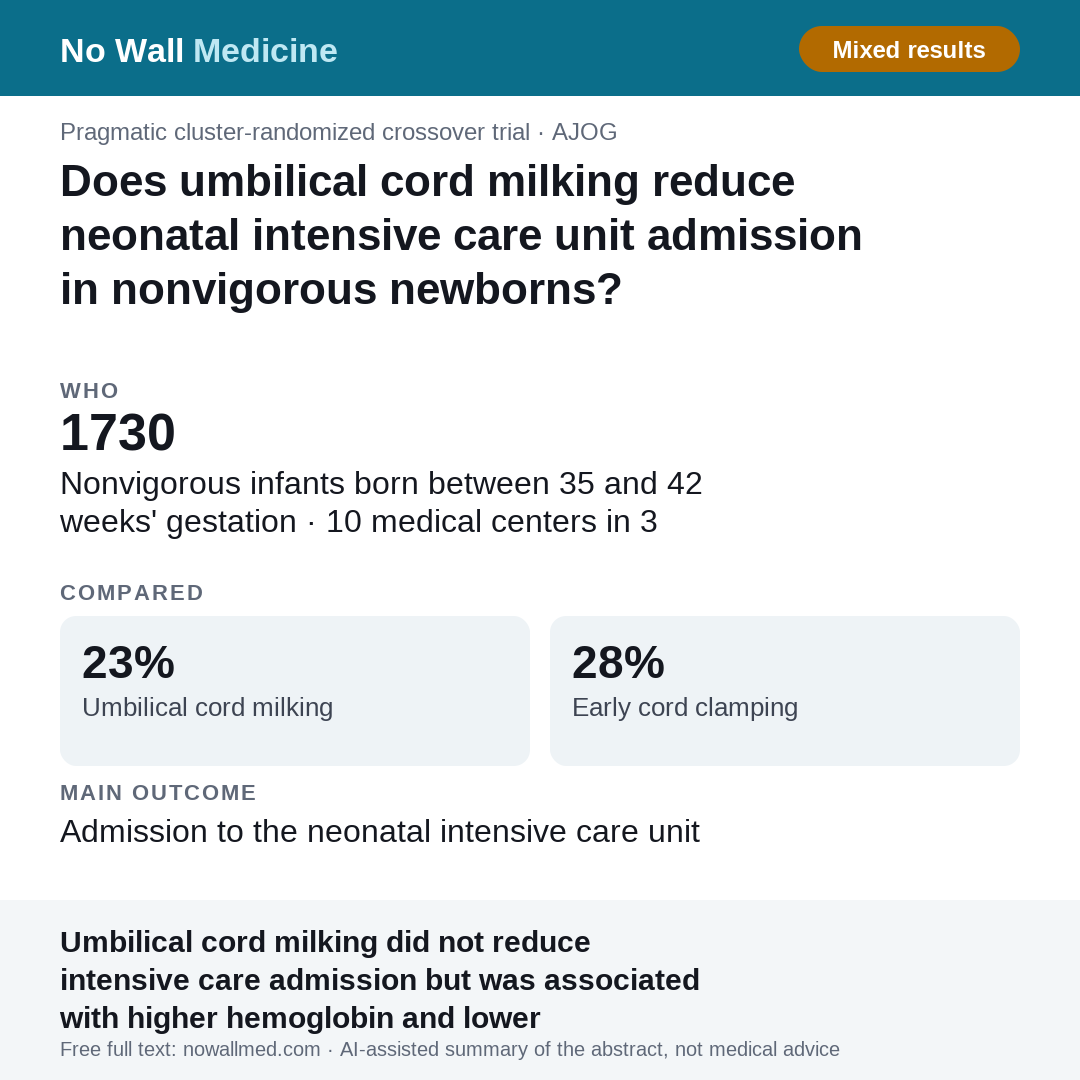
Clinical question: Does umbilical cord milking reduce neonatal intensive care unit admission in nonvigorous newborns?
Why it matters: It is unknown if umbilical cord milking, an alternative to delayed cord clamping, provides benefits for nonvigorous newborns who may require immediate resuscitation.
Key points
- Researchers studied 1,730 nonvigorous infants born between 35 and 42 weeks' gestation across 10 medical centers in 3 countries.
- Umbilical cord milking was associated with 23% intensive care unit admission compared to 28% for early cord clamping, but this difference was not statistically significant.
- Umbilical cord milking was associated with higher hemoglobin, lower odds of needing cardiorespiratory support, and a lower incidence of moderate-to-severe hypoxic-ischemic encephalopathy.
Headline and key points written with AI from the paper’s abstract, with every number checked against it. Read the paper before relying on them.
Topics
Cite this article
Katheria AC, Clark E, Yoder B, Schmölzer GM, Yan Law BH, El-Naggar W. Umbilical cord milking in nonvigorous infants: a cluster-randomized crossover trial. AJOG. 2022. doi:10.1016/j.ajog.2022.08.015
Spotted a mistake? Suggest a correction
Top studies every Monday
The week’s key trials and guidelines in your specialties, plus any topics you follow. By email, free.
Get the weekly digest