Disease uncertainty was the most important influence on ventilation decisions during the COVID-19 pandemic
Uncertainty and decision-making in critical care: lessons from managing COVID-19 ARDS in preparation for the next pandemic
Systematic review and international questionnaireMixed results
What factors influence decision-making regarding mechanical ventilation for COVID-19 acute respiratory distress syndrome?
Who
371
Critical care professionals · United Kingdom, Italy, Germany and Netherlands
Compared
Disease uncertainty: ranked as the most important influence
Decision-making confidence: median score: 9/20
Main outcome
Factors influencing ventilation decision-making
Bottom line: Disease uncertainty was the most important influence on ventilation decision-making, with professionals expressing underconfidence in their decisions.
BMJ Open Respir Res · 2025-05-11Download image
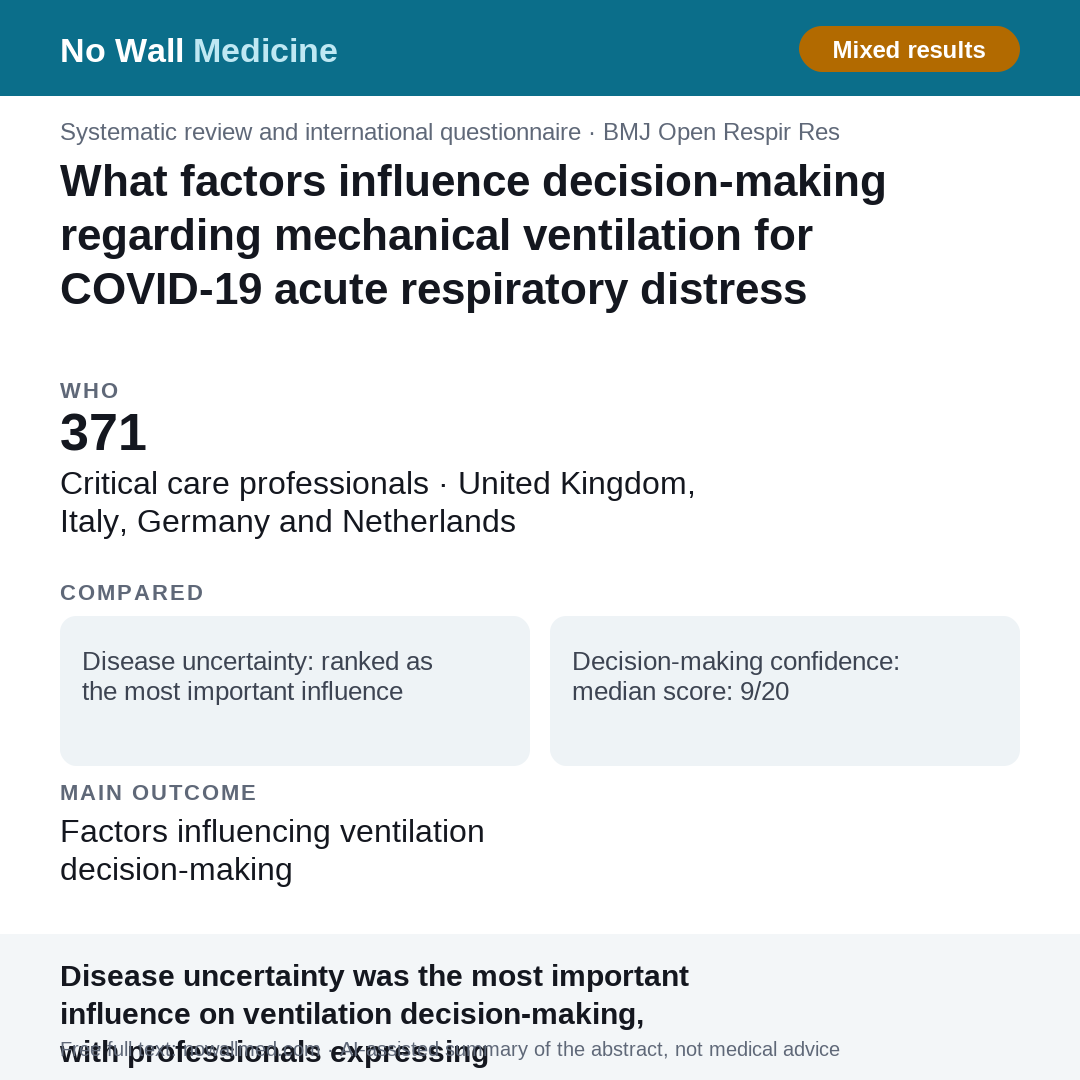
Clinical question: What factors influence decision-making regarding mechanical ventilation for COVID-19 acute respiratory distress syndrome?
Why it matters: Clinicians faced high volumes of critically ill patients with an emergent syndrome, creating a need to identify modifiable factors that influence decision-making during pandemics.
Key points
- Researchers surveyed 371 critical care professionals from the UK, Italy, Germany, and the Netherlands regarding factors influencing mechanical ventilation decisions for COVID-19 acute respiratory distress syndrome.
- Disease uncertainty, such as lack of guidelines and unfamiliarity with how the disease works, was ranked as the most important influence across all regions and professions (p<0.001).
- Participants reported underconfidence in their decision-making with a median score of 9/20, which was not affected by profession (p=0.58) or experience level (p=0.79).
Headline and key points written with AI from the paper’s abstract, with every number checked against it. Read the paper before relying on them.
Was this summary helpful?
Abstract
Purpose
Coronavirus disease 2019 (COVID-19) acute respiratory distress syndrome (ARDS) was an emergent syndrome that led to high volumes of critically ill ventilated patients. We explored influences on decision-making regarding management of COVID-19 ARDS mechanical ventilation to identify modifiable factors to improve preparedness for future pandemics. Methods
A systematic review and small group interviews informed the development of an international questionnaire (UK, Italy, Germany and Netherlands) on factors influencing COVID-19 ARDS ventilation decision-making in critical care professionals. Participants ranked four themes in order of importance: disease (uncertainties around COVID-19 ARDS), contextual (cognitive strain), environmental (structural logistics) and team factors. Participants also ranked the subthemes within each theme. Thematic analysis was used to derive findings from qualitative data. Kruskal-Wallis, Mann-Whitney U and Kendall's tau were used for quantitative data analysis. Results
Patient factors (comorbidities, clinical/biochemical parameters) were the most studied influences in the extant literature on decision-making; uncertainty was one of the least studied. 371 critical care professionals responded to the questionnaire. Disease uncertainty (lack of applicable guidelines, unfamiliarity with pathophysiology) was ranked as the most important influence on ventilation decision-making for COVID-19 ARDS across regions, professions and experience levels (p<0.001). Participants expressed underconfidence in their decision-making (median score: 9/20); this was unaffected by experience (p=0.79) or profession (p=0.58). Qualitative findings supported and extended the initial proposed influences, including the impact of team factors (+ve) and resource limitations (-ve) on disease uncertainty. Conclusion
Future pandemic preparedness programmes should target modifiable influences such as information sharing, teamworking and resource limitations to mitigate against the negative influence of uncertainty and thereby improve decision-making overall.
Abstract reproduced under the article’s CC BY NC licence.
Subject terms
Cite this article
Matsumoto K, Prowle JR, Puthucheary Z, Cecconi M, Fazzini B, Malcolm H. Uncertainty and decision-making in critical care: lessons from managing COVID-19 ARDS in preparation for the next pandemic. BMJ Open Respir Res. 2025. doi:10.1136/bmjresp-2024-002637
Spotted a mistake? Suggest a correction
Top studies every Monday
The week’s key trials and guidelines in your specialties, plus any topics you follow. By email, free.
Get the weekly digest