Understanding Autonomy in Patients with Moderate to Severe Asthma
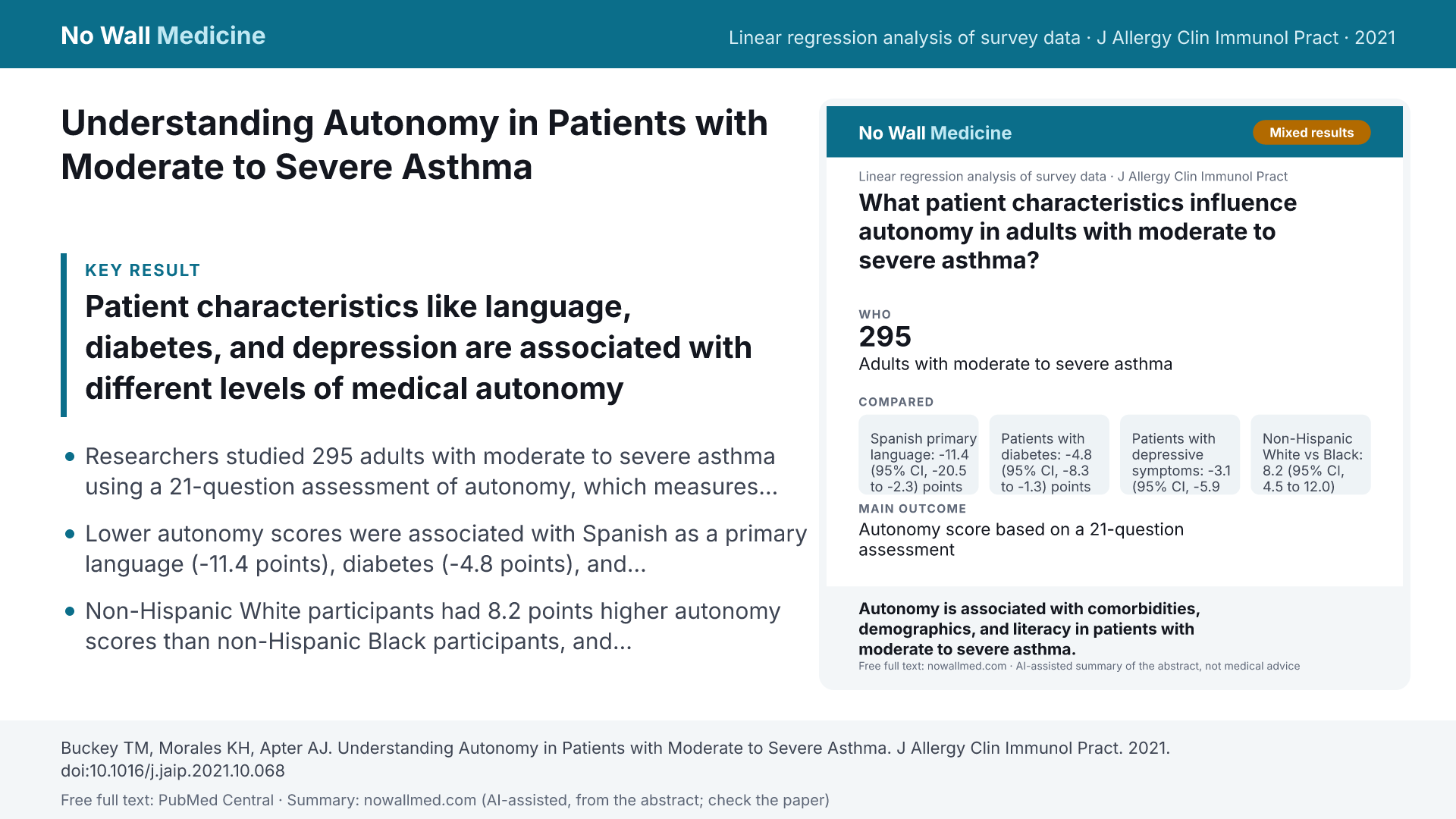
Key result: Patient characteristics like language, diabetes, and depression are associated with different levels of medical autonomy
Linear regression analysis of survey dataMixed results
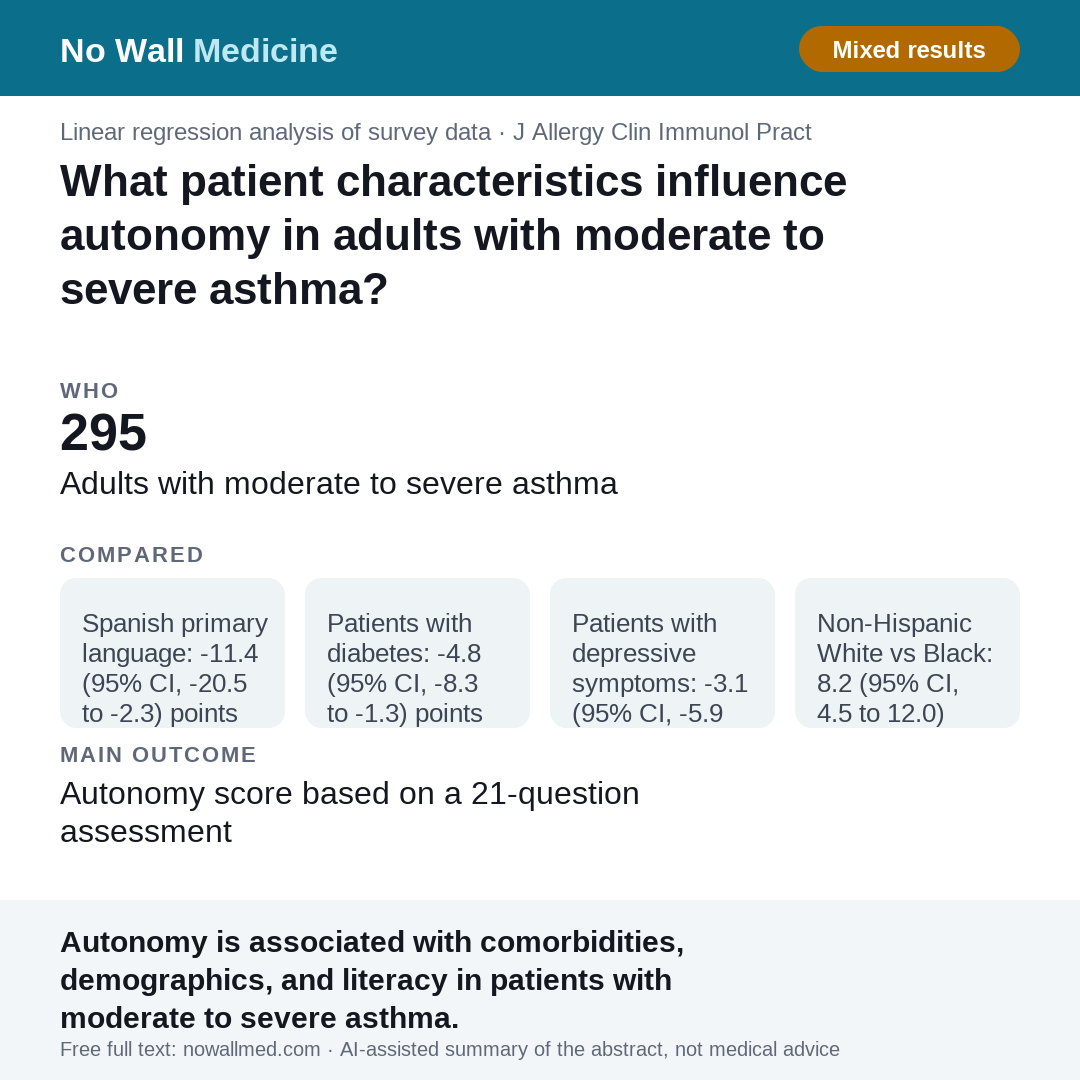
What patient characteristics influence autonomy in adults with moderate to severe asthma?
Who
295
Adults with moderate to severe asthma
Compared
Spanish primary language: -11.4 (95% CI, -20.5 to -2.3) points
Patients with diabetes: -4.8 (95% CI, -8.3 to -1.3) points
Patients with depressive symptoms: -3.1 (95% CI, -5.9 to -0.3) points
Non-Hispanic White vs Black: 8.2 (95% CI, 4.5 to 12.0) points higher
Main outcome
Autonomy score based on a 21-question assessment
Bottom line: Autonomy is associated with comorbidities, demographics, and literacy in patients with moderate to severe asthma.
J Allergy Clin Immunol Pract · 2021-11-14Download image
Key points
- Researchers studied 295 adults with moderate to severe asthma using a 21-question assessment of autonomy, which measures the ability to make informed medical decisions.
- Lower autonomy scores were associated with Spanish as a primary language (-11.4 points), diabetes (-4.8 points), and depressive symptoms (-3.1 points).
- Non-Hispanic White participants had 8.2 points higher autonomy scores than non-Hispanic Black participants, and higher functional health literacy was associated with higher scores.
Discussion prompts
- Would these patients look like yours? Who was left out?
- Is the main outcome one that matters to patients?
- Is the difference large enough to change what you do?
Cite: Buckey TM, Morales KH, Apter AJ. Understanding Autonomy in Patients with Moderate to Severe Asthma. J Allergy Clin Immunol Pract. 2021. doi:10.1016/j.jaip.2021.10.068
Free full text: PubMed Central · Summary and visual abstract: nowallmed.com/a/understanding-autonomy-in-patients-with-moderate-to-severe-1tsx63d/ (AI-assisted from the abstract; check the paper before relying on it).