Baricitinib was associated with higher eyebrow and eyelash hair regrowth rates in alopecia areata patients
Understanding eyebrow and eyelash involvement in patients with alopecia areata and responsiveness to treatment with baricitinib
Randomized, double-blind, placebo-controlled trialsBenefit found
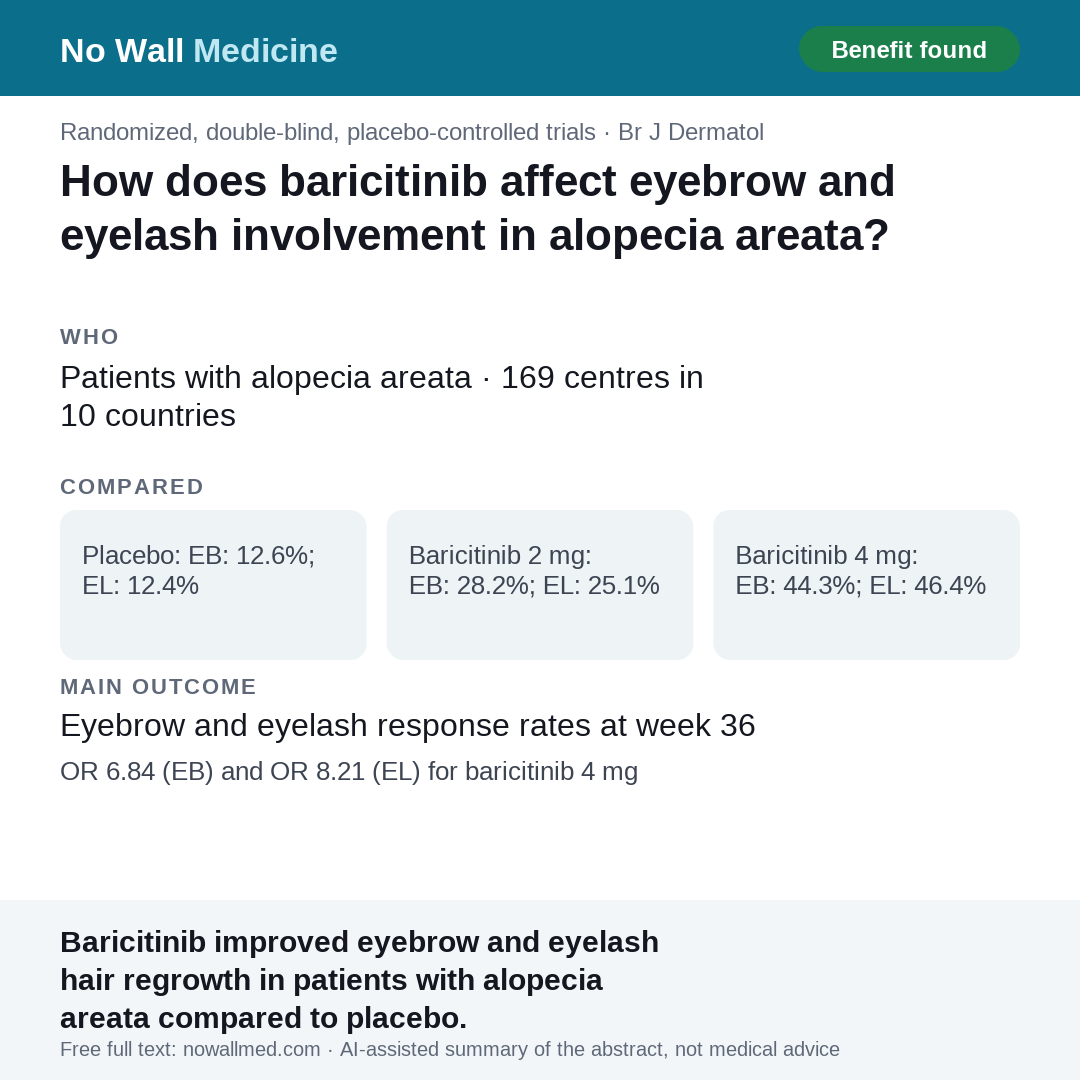
How does baricitinib affect eyebrow and eyelash involvement in alopecia areata?
Who
Patients with alopecia areata · 169 centres in 10 countries
Compared
Placebo: EB: 12.6%; EL: 12.4%
Baricitinib 2 mg: EB: 28.2%; EL: 25.1%
Baricitinib 4 mg: EB: 44.3%; EL: 46.4%
Main outcome
Eyebrow and eyelash response rates at week 36
Result: OR 6.84 (EB) and OR 8.21 (EL) for baricitinib 4 mg
Bottom line: Baricitinib improved eyebrow and eyelash hair regrowth in patients with alopecia areata compared to placebo.
Br J Dermatol · 2025-04-03Download image
Clinical question: How does baricitinib affect eyebrow and eyelash involvement in alopecia areata?
Why it matters: The severity of eyebrow and eyelash involvement is an important factor in assessing alopecia areata, but its relationship to scalp hair loss and treatment response was not fully detailed.
Key points
- Researchers analyzed pooled data from two randomized trials involving patients with alopecia areata treated with placebo, 2 mg baricitinib, or 4 mg baricitinib.
- At week 36, baricitinib 4 mg showed eyebrow response rates of 44.3% and eyelash response rates of 46.4% compared to 12.6% and 12.4% for placebo.
- Among patients who responded on the scalp at week 52, 71.1% achieved hair regrowth in both the eyebrows and eyelashes with 4 mg baricitinib.
Headline and key points written with AI from the paper’s abstract, with every number checked against it. Read the paper before relying on them.
Was this summary helpful?
Subject terms
Cite this article
Mostaghimi A, Craiglow B, King B, Shapiro J, Ko J, Tosti A. Understanding eyebrow and eyelash involvement in patients with alopecia areata and responsiveness to treatment with baricitinib. Br J Dermatol. 2025. doi:10.1093/bjd/ljaf088
Spotted a mistake? Suggest a correction
Top studies every Monday
The week’s key trials and guidelines in your specialties, plus any topics you follow. By email, free.
Get the weekly digest