Higher self-monitoring adherence was associated with greater weight loss and lower blood sugar levels
Understanding Heterogeneity in Individual Responses to Digital Lifestyle Intervention Through Self-Monitoring Adherence Trajectories in Adults With Overweight or Obesity: Secondary Analysis of a 6-Month Randomized Controlled Trial
Secondary analysis of a 6-month randomized controlled trialBenefit found
How do self-monitoring adherence trajectories relate to weight loss and clinical outcomes?
Who
50
Adults with overweight or obesity
Compared
Lower self-monitoring group: no improvements
Higher self-monitoring group: body weight reduction estimate: -6.06, SD 0.87 kg
Main outcome
body weight and hemoglobin A1c
Bottom line: Higher self-monitoring adherence trajectories are associated with significant reductions in body weight and hemoglobin A1c.
J Med Internet Res · 2024-03-20Download image
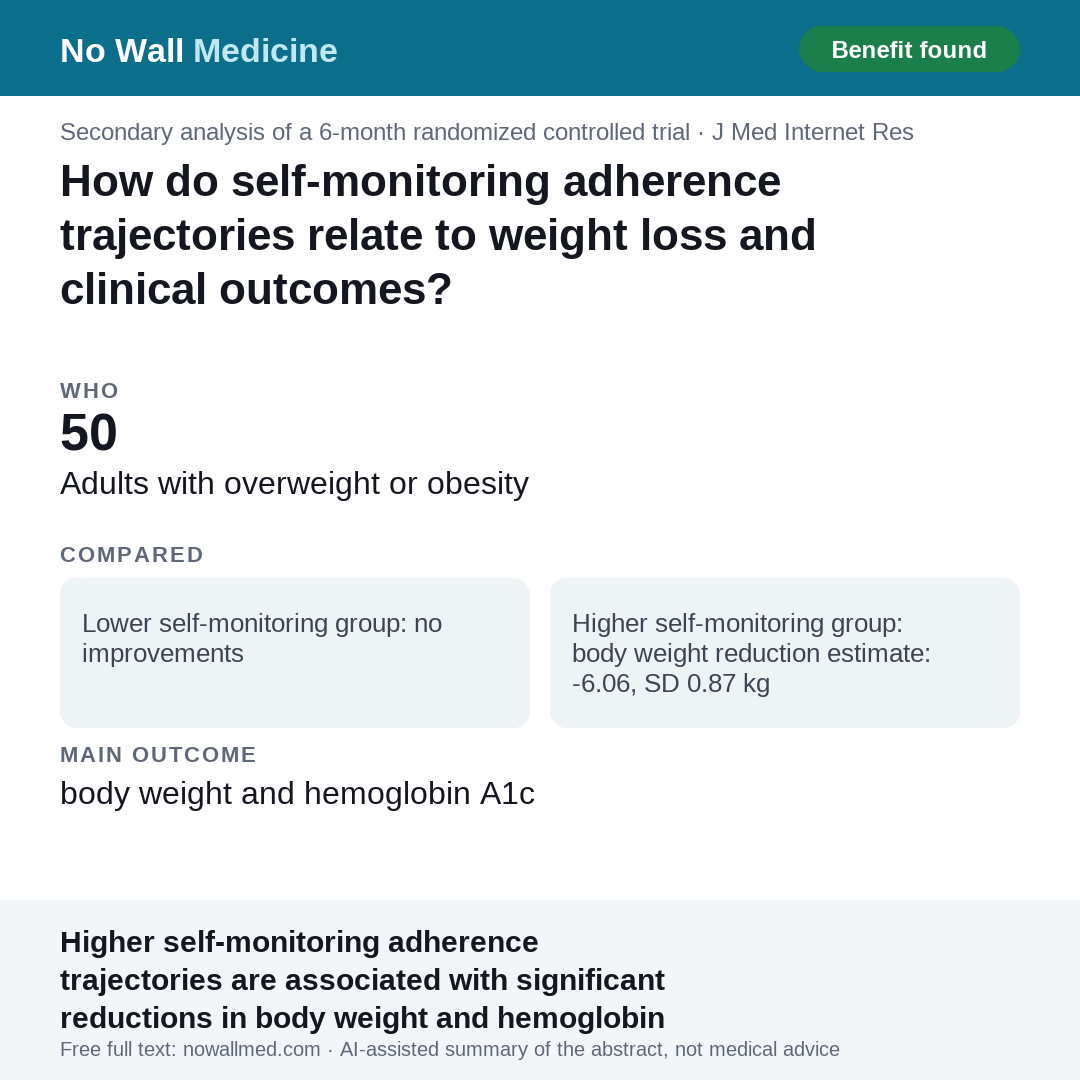
Clinical question: How do self-monitoring adherence trajectories relate to weight loss and clinical outcomes?
Why it matters: It is difficult to achieve significant weight loss through lifestyle interventions and early identification of nonresponders is needed to provide tailored support.
Key points
- Researchers analyzed 50 adults with overweight or obesity participating in a 6-month digital lifestyle intervention.
- The Higher self-monitoring group showed a body weight reduction of -6.06, SD 0.87 kg and a hemoglobin A1c reduction of -0.38, SD 0.11%.
- The Lower self-monitoring group, representing 42% of participants, showed no improvements in clinical outcomes.
Headline and key points written with AI from the paper’s abstract, with every number checked against it. Read the paper before relying on them.
Topics
Cite this article
Li S, Du Y, Miao H, Sharma K, Li C, Yin Z. Understanding Heterogeneity in Individual Responses to Digital Lifestyle Intervention Through Self-Monitoring Adherence Trajectories in Adults With Overweight or Obesity: Secondary Analysis of a 6-Month Randomized Controlled Trial. J Med Internet Res. 2024. doi:10.2196/53294
Spotted a mistake? Suggest a correction
Top studies every Monday
The week’s key trials and guidelines in your specialties, plus any topics you follow. By email, free.
Get the weekly digest